
When a Florida marriage ends, the house is where the money is — and where the costliest mistakes hide. Whether you sell it, one of you buys the other out, or one spouse stays until the kids finish school, each path changes three separate things: your homestead exemption, your Save Our Homes tax cap, and your federal capital gains bill. Get the order and timing right and you protect tens of thousands of dollars. Get it wrong and you hand it to the IRS or the tax collector.
Transfer between spouses: Tax-free (federal Section 1041) — but the receiver takes the original cost basis and its built-in gain
Keep the house & stay: Your homestead exemption and Save Our Homes cap survive — no reassessment
Both move out / sell: You can split the Save Our Homes benefit and each port up to your share (Form DR-501T)
Capital gains: $500,000 exclusion if you sell together while married; usually $250,000 each if you sell solo later
Florida tax: None — no state income, capital gains, estate, or inheritance tax. Federal only.
Florida Basics: What You Will — and Won't — Be Taxed On
Start with the good news. Florida has no state income tax, no state capital gains tax, and no estate or inheritance tax. That removes an entire layer of tax that couples in many other states have to worry about. In a Florida divorce, the tax questions around the house are almost entirely federal, plus routine transaction costs like the documentary stamp tax on a deed.
Florida is also an equitable distribution state, not a community-property state. That means marital assets — including the marital home and, importantly, the tax benefits attached to it — are divided fairly, though not always 50/50. The home you bought or lived in together during the marriage is typically a marital asset subject to division.
The Three Decisions That Move the Money
Almost every dollar of tax consequence in a divorce home decision flows from three separate questions. People tend to blur them together; keeping them separate is how you avoid expensive surprises.
The three separate questions
- Who keeps the homestead exemption and the Save Our Homes cap? (a property-tax question)
- Can the accumulated Save Our Homes benefit be split and moved? (a portability question)
- Who owes federal capital gains, and when? (an income-tax question)
Homestead & Save Our Homes: Who Keeps the Cap
Florida's homestead exemption lowers your taxable value, and the Save Our Homes cap limits how much your assessed value can rise each year to 3% or the change in the Consumer Price Index, whichever is less. After years in the same home, the gap between your capped assessed value and the home's true market value — the "assessment differential" — can be worth thousands of dollars a year in tax savings.
Here's what a lot of divorcing couples fear but don't need to: a change of title due to divorce does not automatically blow up your Save Our Homes cap. Florida keeps the homestead exemption and the Save Our Homes cap in place through a divorce-related transfer as long as the remaining owner keeps living there as their permanent residence. The home is not reassessed to full market value.
Keep it as your permanent residence and your homestead exemption and Save Our Homes cap continue uninterrupted — no reassessment, no tax spike. Just make sure the exemption stays in your name and confirm your status with your county property appraiser after the deed changes.
Once you establish a new permanent residence, you give up the homestead and Save Our Homes benefit on the old home — and years of built-up savings can be lost. But that benefit may not have to vanish: with the right paperwork, you may be able to port your share of it to your next home (see below). This is one of the most overlooked pieces of a divorce settlement.
Splitting Save Our Homes: The Move Most People Miss
The accumulated Save Our Homes assessment differential is a real, valuable asset — and Florida law treats it as one that can be divided in a divorce. If both spouses give up the homestead (for example, by selling the marital home), they can split the assessment differential and each "port" their share to a new Florida homestead.
To capture it, each spouse:
- Establishes a new Florida homestead within three years (specifically, receives homestead on the new home within three tax years of January 1 of the year the old homestead was abandoned)
- Files a portability application, Form DR-501T, along with the new homestead application (Form DR-501)
- Shares in a benefit capped at a total of $500,000 of transferred differential
If one spouse instead keeps the home with the homestead intact, that differential stays with the home — the leaving spouse generally can't port it unless the homestead is abandoned (which triggers a reassessment). This is exactly the kind of trade-off worth negotiating deliberately in the settlement, sometimes offset against other assets. The Florida Bar has even written about treating the Save Our Homes differential as marital property to be divided.
Use the Save Our Homes Portability Calculator to see how much accumulated benefit is actually on the table. For long-time owners, the differential can be worth more than people realize — and how you split it can swing the fairness of the whole settlement.
Selling or moving? Your biggest tax benefit is on the line.
Most Florida homeowners have tens of thousands of dollars in Save Our Homes protection — and lose it by accident when they move. Check what yours is worth and what happens to it if you sell.
The $250,000 / $500,000 Capital Gains Trap
This is where divorcing couples most often leave money on the table. Under federal tax rules (IRC Section 121), you can exclude capital gain on the sale of your main home:
- $500,000 of gain if you're married filing jointly
- $250,000 of gain if you're a single filer
To qualify, you generally must have owned and used the home as your main residence for at least 2 of the last 5 years. Here's the divorce trap: the full $500,000 exclusion is a married, filing-jointly benefit. If you sell the home together while you're still married and file jointly, you can shelter up to $500,000 of gain. If instead one spouse keeps the home and sells alone years later, that spouse is usually limited to the $250,000 single exclusion — and any gain between $250,000 and $500,000 that would have been tax-free becomes taxable.
Federal law includes special divorce provisions. A spouse who moves out can still be treated as "using" the home for the 2-of-5-year test if a divorce or separation instrument lets the other spouse live there, and a spouse who receives the home in the settlement can add the other spouse's ownership time toward the test. These rules can preserve the exclusion — but they're technical and fact-specific. Confirm your situation with a CPA before assuming you qualify.
Remember: because the home is in Florida, any gain above your exclusion is taxed at federal long-term capital gains rates (0%, 15%, or 20% depending on income, plus a possible 3.8% net investment income tax) — there is no additional Florida state capital gains tax.
Estimate the Capital Gains Difference
See roughly how much the timing decision is worth. Enter what you originally paid (plus major improvements) and today's market value. This compares selling together now, while married, against one spouse selling the home alone later.
Divorce Home-Sale Capital Gains Estimator
An educational estimate of the federal exclusion difference — not tax advice
Sell together now (married, jointly)
One spouse sells alone later (single)
Educational estimate only. Assumes the 2-of-5-year ownership and use test is met and ignores selling costs and special divorce provisions. Confirm with a CPA.
The Buyout Basis Trap
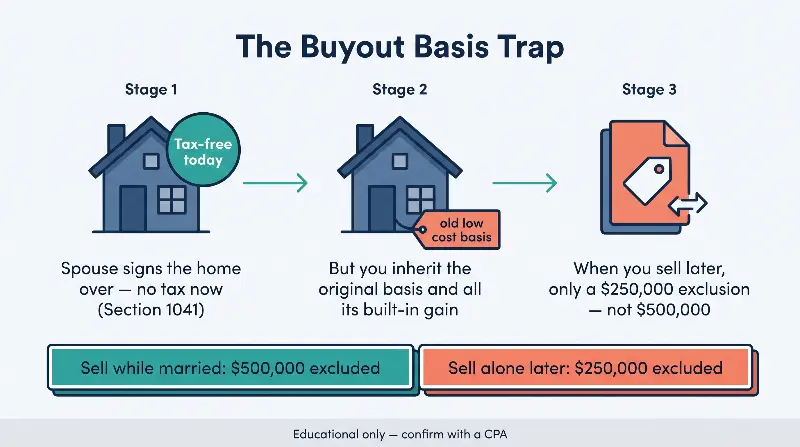
Say you keep the house and buy out your spouse's share. That transfer is tax-free at the time it happens under Section 1041 — no capital gains due when your ex signs the home over. But there's a catch that surprises people years later: you take the home at its original cost basis (carryover basis), not its current value.
That means the entire built-in gain — all the appreciation from the day it was bought — is now sitting on your shoulders. When you eventually sell, you'll calculate gain against that old, low basis, and you'll only have a $250,000 single exclusion to shield it. A "50/50" split that gives one spouse the house and the other an equal amount of cash is not really equal if the house comes loaded with a future tax bill the cash doesn't have.
Sell vs. Keep: A Decision Framework
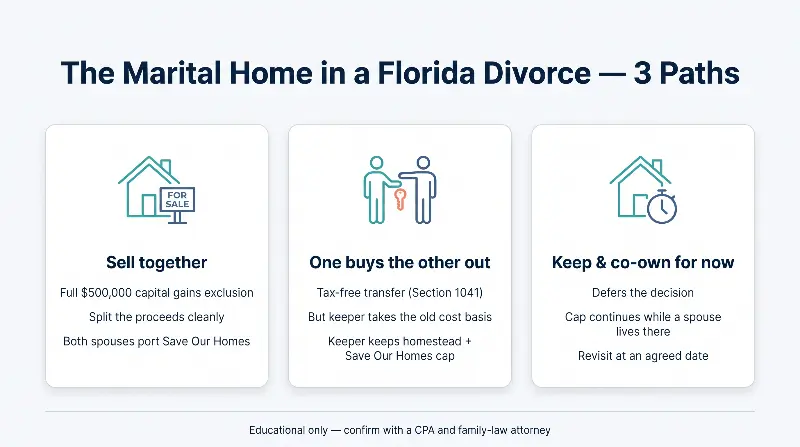
Reasons selling together often wins
- Captures the full $500,000 capital gains exclusion
- Splits proceeds cleanly — a true clean break
- Lets both spouses port a share of Save Our Homes
- Neither person is stuck with the mortgage, insurance, and upkeep alone
Reasons a buyout can still make sense
- Stability for children in the family home and school zone
- The staying spouse keeps the homestead and Save Our Homes cap
- Avoids selling into a soft market or a rushed timeline
- Emotional value of keeping the home
There's no universally right answer — but there is a right process: price out both scenarios with real numbers, including the future tax bill on a buyout and the value of the Save Our Homes benefit, before you sign anything. Rising Florida insurance and property costs also mean the true cost of keeping the home alone is often higher than it looks.
What to Do Now
Your action checklist
- Pull your numbers. Find your original purchase price, the cost of major improvements, and a current market valuation. That's your gain picture.
- Value the Save Our Homes benefit. Check your assessment differential with the portability calculator so it's counted in the settlement.
- Decide the homestead question early. If one spouse will stay, confirm the exemption stays in their name with the county property appraiser after the deed changes.
- Get the deed right. A transfer is usually done by deed pursuant to the divorce judgment — see removing a spouse from a Florida deed.
- Bring in a CPA and a family-law attorney together. The capital gains, basis, and portability pieces interact — coordinate them before signing the settlement, not after.
If the divorce is pushing you toward selling, it's worth understanding your full picture first — from your capital gains on a home sale to your seller closing costs and what happens to your Save Our Homes benefit when you move.
Frequently Asked Questions
Common questions about the marital home, taxes, and homestead in a Florida divorce.
No. Under Section 1041 of the federal tax code, transfers of property between spouses, or between former spouses when the transfer is incident to the divorce, are not taxable events. No capital gains tax is due at the moment of transfer. Florida also has no state income tax, estate tax, or inheritance tax, so there is no state tax on the transfer either. The catch is that the receiving spouse takes the home at its original cost basis, so any built-in capital gain moves to them and can be taxed when they eventually sell.
Not if you keep living there. In Florida, the Save Our Homes assessment cap and homestead exemption remain in place when title changes due to divorce, as long as the remaining owner continues to use the property as their permanent residence. The property is not reassessed to full market value. The spouse who moves out, however, generally gives up the tax benefit on that home unless the settlement splits the Save Our Homes differential through portability.
A married couple filing jointly can exclude up to $500,000 of gain on the sale of a primary residence; a single filer can exclude up to $250,000. Both must generally have owned and used the home as a main residence for at least 2 of the last 5 years. If you sell the home together while still married and filing jointly, you can use the full $500,000. If one spouse keeps the home and later sells alone, they are usually limited to $250,000 — which can create a taxable gain that the $500,000 exclusion would have covered. Special divorce rules under Section 121 can preserve eligibility in some cases, so confirm with a CPA.
Florida has no state income tax and no state capital gains tax, so any tax on the gain from selling a home is federal only. Florida also has no estate or inheritance tax. The main taxes to plan for are federal capital gains on any gain above your exclusion, and ordinary closing costs such as documentary stamp taxes on the deed.
Yes. If both spouses give up the homestead — for example by selling the marital home — Florida law lets them divide the accumulated Save Our Homes assessment differential and each "port" their share to a new homestead. Each files a portability application (Form DR-501T) with their new homestead application, must establish the new homestead within the state within three years, and the total ported benefit is capped at $500,000. This can preserve a valuable tax break that would otherwise be lost.
It depends on the numbers and your goals. Selling together while married can capture the full $500,000 capital gains exclusion, splits proceeds cleanly, and lets both spouses port a share of the Save Our Homes benefit. A buyout lets one spouse and the children stay, but the person keeping the home takes on the original cost basis (and its built-in gain), keeps paying the mortgage and rising insurance alone, and may only get a $250,000 exclusion when they sell later. Run both scenarios with a family-law attorney and a CPA before deciding.
Selling or moving? Your biggest tax benefit is on the line.
Most Florida homeowners have tens of thousands of dollars in Save Our Homes protection — and lose it by accident when they move. Check what yours is worth and what happens to it if you sell.
