
Thousands of Florida homeowners who have never given flooding a second thought are about to get a surprise. Citizens Property Insurance — the state-backed insurer that now covers a huge share of Florida homes — is phasing in a requirement that its policyholders carry a separate flood insurance policy. And unlike the flood rules most people know, this one applies regardless of your flood zone. Live in low-risk Zone X, miles from the coast, never had a drop of water in the house? You can still be required to buy flood coverage — or lose your homeowners policy.
Who: Citizens personal residential policyholders with wind coverage
2026 trigger: Homes with $400,000+ in dwelling coverage (Coverage A) — any zone, including Zone X
2027: Expands to all Citizens policies, regardless of value
How much: At least your dwelling value, up to the NFIP cap of $250,000 (private flood for more)
If you don't: Citizens can non-renew your homeowners policy
What's Actually Happening
Florida does not have a blanket law forcing every homeowner to buy flood insurance. What's changed is a rule from Citizens Property Insurance itself. As a condition of keeping your Citizens homeowners policy, you now have to carry a separate flood policy once your home hits a certain value — and that value threshold drops every year until it reaches everyone.
This grew out of Florida's 2022 insurance reforms — Senate Bill 2-A, codified in the Citizens Property Insurance statute at Florida Statute 627.351(6) — together with Citizens' own eligibility rules. The logic: Citizens has grown enormous, a single major flood event could overwhelm it, and standard homeowners policies never cover flood damage. Requiring flood coverage protects both the homeowner and the pool.
The part that catches people off guard is that it is not limited to high-risk flood zones. The requirement is driven by your home's dwelling value, not a FEMA flood map. So a perfectly ordinary inland home in Zone X can be swept in purely because of what it's insured for.
The Phase-In Schedule
Citizens is rolling the requirement out in waves, lowering the dwelling-value trigger each January until it applies to every policy. If your home is in a Special Flood Hazard Area (high-risk zones like A, AE, V, or VE), flood coverage is already required regardless of value.
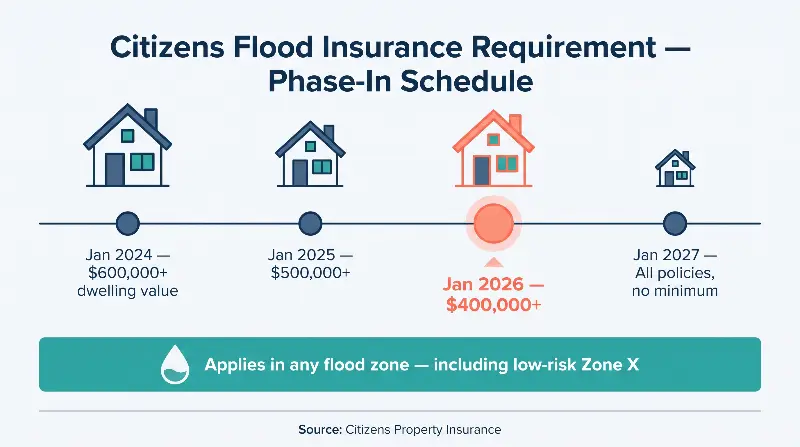
Dwelling-value trigger by year (homes in any zone)
- January 1, 2024 — Coverage A of $600,000 or more
- January 1, 2025 — Coverage A of $500,000 or more
- January 1, 2026 — Coverage A of $400,000 or more
- January 1, 2027 — all Citizens personal residential policies, no minimum
Homes in high-risk Special Flood Hazard Area zones are required to carry flood coverage regardless of dwelling value.
The earlier waves ($600K, then $500K) mostly hit higher-value homes. Dropping the trigger to $400,000 pulls in a large share of ordinary, mid-value Florida homes for the first time — which is why so many owners are running into this now. And in 2027 the minimum disappears entirely.
Who's Affected — and Who's Exempt
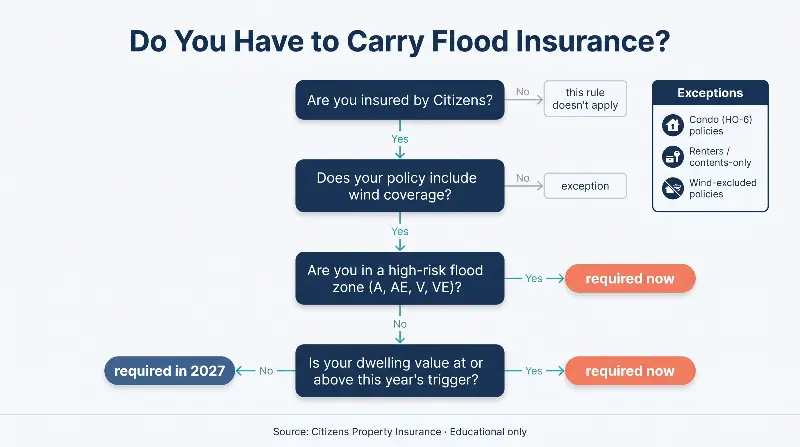
You're likely affected if all of these are true:
- Your homeowners insurer is Citizens (not a private carrier), and
- Your policy is a personal residential policy that includes wind coverage, and
- Your dwelling value (Coverage A) is at or above the current year's trigger — or you're in a high-risk flood zone.
Currently treated as exceptions (generally not required to add flood in the earlier phases):
- Condominium unit-owner (HO-6) policies
- Tenant and contents-only policies
- Policies that exclude wind or hail coverage
"I have a private insurer, so this applies to me too." Not necessarily — this specific rule is a Citizens requirement. Private carriers set their own rules (and your mortgage lender separately requires flood in high-risk zones).
"I'm exempt forever because I own a condo." The 2027 phase is the broad catch-all. Confirm your status directly with Citizens rather than assuming.
Am I Affected? Quick Checker
Answer four quick questions for a plain-English read on whether the Citizens flood requirement applies to you and when. This is an educational estimate — always confirm with Citizens or your agent.
Citizens Flood Requirement Checker
An educational estimate based on Citizens' published phase-in schedule
Estimate only, not insurance advice. Verify your exact requirement and deadline with Citizens or a licensed agent.
Selling or moving? Your biggest tax benefit is on the line.
Most Florida homeowners have tens of thousands of dollars in Save Our Homes protection — and lose it by accident when they move. Check what yours is worth and what happens to it if you sell.
How Much Flood Coverage You Need
Citizens requires your flood coverage to be at least equal to your dwelling limit (Coverage A). Here's the catch that trips people up: the National Flood Insurance Program (NFIP) caps residential building coverage at $250,000 (and $100,000 for contents). If your home is insured for more than $250,000 — which, at a $400,000 trigger, most affected homes are — a maxed-out NFIP policy alone won't fully match your dwelling value.
That's where private flood insurance comes in: private policies can be written well above the NFIP cap to match higher dwelling values, and both NFIP and approved private flood policies satisfy the Citizens requirement.
- Dwelling value up to $250,000: A standard NFIP policy can cover it.
- Dwelling value above $250,000: NFIP caps out at $250,000 — consider a private flood policy (or an excess flood policy) to match your full Coverage A.
NFIP vs. Private Flood Insurance
Both count toward the requirement, but they're different tools:
NFIP (federal)
- Building coverage capped at $250,000; contents at $100,000
- Backed by FEMA; widely available
- Rates set federally under Risk Rating 2.0
Private flood
- Can exceed the $250,000 cap to match higher dwelling values
- May offer broader coverage and faster binding
- Availability and price vary by carrier and property
Shop both. An independent agent can quote NFIP and private options side by side, which matters because flood pricing swings widely by elevation, zone, and construction.
What Happens If You Don't Comply
If you're subject to the requirement and you don't obtain flood coverage, Citizens can non-renew your homeowners policy. In Florida's current market, that's a serious problem: losing your policy can put you in breach of your mortgage, which typically lets the lender buy force-placed insurance on your behalf — coverage that is usually far more expensive and protects the lender, not you.
In other words, skipping the flood policy doesn't save money; it risks a much bigger bill and a coverage scramble at renewal.
Current Status: The NFIP Shutdown Wrinkle
There's an important, fast-moving caveat. Because of a federal lapse in the NFIP, Citizens announced that — effective October 1, 2025 — it would defer the required proof of flood coverage (and the flood affirmation form) until the NFIP resumes normal operations. Once it does, agents get 10 business days to submit documentation.
The deferral pauses the documentation deadline — it does not eliminate the requirement to obtain flood insurance. Because this situation is changing, confirm the current status directly with Citizens or your agent before assuming you're off the hook.
What to Do Now
Your action checklist
- Confirm your insurer and policy type. Check your declarations page: is it Citizens? Does it include wind coverage? What's your Coverage A?
- Find your flood zone. Look it up free on the FEMA Flood Map Service Center.
- Match your trigger to the schedule above to see whether you're required now or in 2027.
- Get quotes for both NFIP and private flood through a licensed agent — and make sure the coverage at least equals your dwelling value.
- Weigh the total cost of staying. If flood coverage on top of your premium changes the math on your home, it may be worth checking your Save Our Homes portability before you decide to sell or move.
Hardening your home can also help on the insurance side: impact-resistant windows and doors can earn wind-mitigation credits, and Florida even offers a sales tax refund on impact windows and doors. Flood and wind are priced separately, but every credit helps against rising costs.
Frequently Asked Questions
Common questions about Florida's Citizens flood insurance requirement, answered in plain English.
There is no statewide law forcing every homeowner to buy flood insurance. But Citizens Property Insurance — the state-backed insurer of last resort — now requires flood coverage for its personal residential wind policies on a phased schedule based on dwelling value. As of January 1, 2026, homes with Coverage A of $400,000 or more must carry flood insurance, even outside high-risk flood zones. The requirement expands to all Citizens policies on January 1, 2027. Separately, mortgage lenders require flood insurance for homes in high-risk (Special Flood Hazard Area) zones.
If you are insured by Citizens on a personal residential policy that includes wind coverage, yes — the requirement applies regardless of flood zone, including low-risk Zone X. As of January 1, 2026, it covers homes with $400,000 or more in dwelling coverage, and by January 1, 2027 it applies to all Citizens policies. Being in Zone X and never having flooded does not exempt you from the Citizens requirement, though it may affect your premium.
Your flood coverage must be at least equal to your Citizens dwelling limit (Coverage A). The National Flood Insurance Program (NFIP) caps residential building coverage at $250,000 and contents at $100,000, so if your dwelling value is higher you may need a private flood policy to fully match it. Both NFIP and approved private flood policies satisfy the Citizens requirement.
If you are required to carry flood insurance and you don't, Citizens can non-renew your homeowners policy. Losing your homeowners coverage can also violate your mortgage terms and lead to expensive force-placed insurance. If you're subject to the requirement, obtaining flood coverage is the only way to keep your Citizens policy in force.
Citizens' flood requirement targets personal residential policies that include wind coverage. Condominium unit-owner (HO-6) policies, tenant and contents-only policies, and policies that exclude wind or hail are treated as exceptions and are generally not required to add flood coverage in the earlier phases. The final phase on January 1, 2027 is the broad catch-all, so condo and tenant policyholders should confirm their status directly with Citizens or their agent.
Only the paperwork is paused, not the requirement. Because of the federal NFIP lapse, effective October 1, 2025 Citizens began deferring the proof of flood coverage and the flood affirmation form until the NFIP resumes normal operations, after which agents have 10 business days to submit documentation. The underlying requirement to obtain flood insurance is unchanged. Always verify the current status with Citizens, since this is a moving situation.
Florida's insurance rules are moving fast. We help homeowners understand the costs of staying — and the options if they're thinking of selling.
Selling or moving? Your biggest tax benefit is on the line.
Most Florida homeowners have tens of thousands of dollars in Save Our Homes protection — and lose it by accident when they move. Check what yours is worth and what happens to it if you sell.
