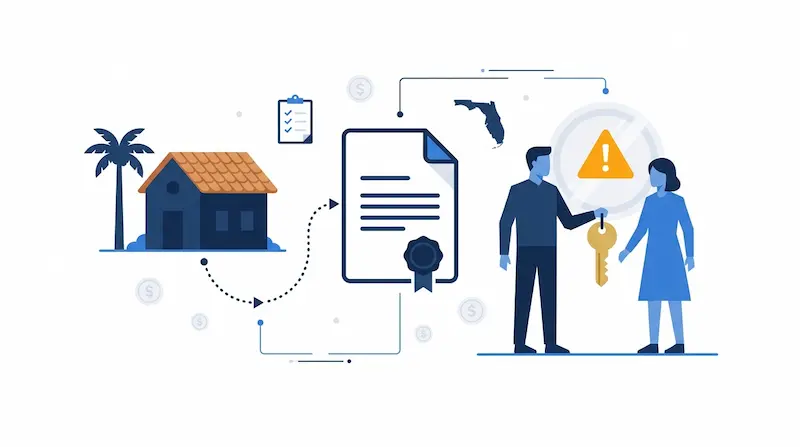
Every year, thousands of Florida parents add a child to their property deed thinking they're simplifying their estate plan. The intent is understandable -- avoid probate, keep the home in the family, save money. But in most cases, this well-meaning decision creates far more problems than it solves: a potential capital gains tax bill of $50,000 or more, exposure to your child's creditors and divorcing spouses, Medicaid ineligibility if you need nursing home care, and possible loss of your homestead exemption and Save Our Homes cap.
This guide covers everything Florida homeowners need to know before making this decision: the five critical problems, the step-by-step process if you proceed anyway, and -- most importantly -- the alternatives that accomplish the same goals without the risks.
Why parents add children to deeds
Most parents who consider this move are acting out of love and practical concern. The most common reasons include:
Avoid probate
Transfer property automatically at death without going through Florida probate court, which can take 6-12 months and cost 3-5% of the estate's value.
Save money on estate administration
Skip probate attorney fees ($3,000-$15,000+) and personal representative compensation that eat into your child's inheritance.
Help with property management
Give your child legal authority to manage, maintain, or sell the property if you become incapacitated or need long-term care.
Simple estate planning
Ensure the family home passes directly to children without complications or disputes among heirs.
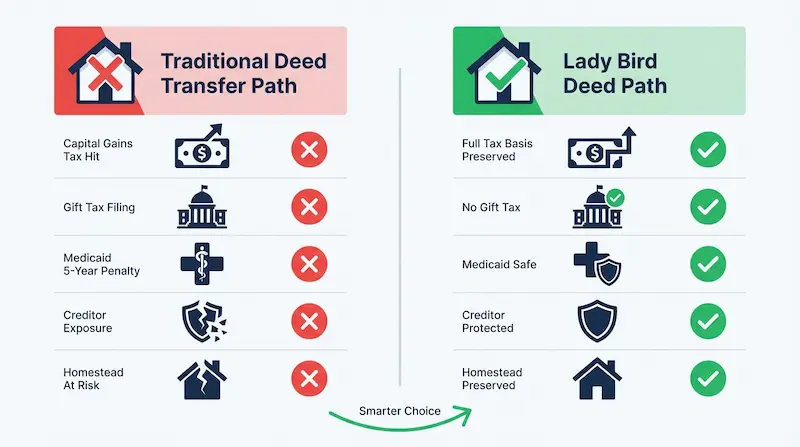
These goals are perfectly valid. The problem is that adding a child directly to your deed is the worst way to accomplish them. Every one of these goals can be achieved more safely with a Lady Bird deed, revocable trust, or transfer-on-death deed -- without the tax traps and legal risks described below.
5 critical problems you need to know
1. Loss of step-up in basis (the biggest tax mistake)
This is the single most expensive consequence, and most families don't realize it until it's too late. When you add your child to the deed during your lifetime, the IRS treats it as a gift -- and your child inherits your original cost basis (what you paid for the home). When they eventually sell, they owe capital gains tax on the entire appreciation.
If instead you leave the property to your child through a will, trust, or Lady Bird deed, they receive a stepped-up basis equal to the home's fair market value at your death -- potentially eliminating capital gains tax entirely.
You bought your home in 1995 for $150,000. Current market value: $500,000.
- If you add your daughter to the deed now: Her cost basis is $150,000 (your purchase price). When she sells for $500,000, she owes capital gains tax on $350,000. At the 15% federal rate, that's $52,500. At the 20% rate for higher earners, it's $70,000.
- If she inherits through your will or Lady Bird deed: Her cost basis steps up to $500,000. She sells for $500,000 and owes $0 in capital gains tax.
This single decision can cost your family tens of thousands of dollars. The step-up in basis is one of the most valuable provisions in the tax code -- don't give it away.
2. Gift tax filing requirement
The IRS treats adding your child to the deed as a gift of their ownership share (typically 50% of the property's fair market value). For 2026, the annual gift tax exclusion is $19,000 per recipient. Since most homes are worth far more, you'll need to file IRS Form 709 (Gift Tax Return).
The One Big Beautiful Bill Act (signed July 2025) permanently raised the federal estate and gift tax lifetime exemption to $15 million per person for 2026 ($30 million for married couples), indexed for inflation going forward. So you probably won't owe actual gift tax -- but the gift still counts against your lifetime exemption, and you're still required to file Form 709. Failure to file carries IRS penalties.
3. Five-year Medicaid lookback period
If you need nursing home care and apply for Florida Medicaid within 5 years (60 months) of transferring your property, Medicaid will impose a penalty period making you ineligible for benefits.
Example: You transfer a $400,000 home to your son in January 2026. You need nursing home care in March 2028 (26 months later).
- Transfer value: $400,000
- Florida penalty divisor (2026): $10,645/month
- Penalty period: 37.6 months of Medicaid ineligibility
- You must privately pay for care until the penalty expires -- potentially $400,000+ at Florida nursing home rates
- Transfer to a disabled or blind child (any age)
- Transfer to a child under 21
- Transfer to a caregiver child who lived with you for 2+ years before you entered a nursing facility and provided care that delayed your need for institutional care
4. Homestead exemption and Save Our Homes cap at risk
Your homestead exemption and Save Our Homes 3% annual cap can be jeopardized if the deed isn't worded correctly or if your child claims a homestead exemption on the same property.
If you lose your Save Our Homes cap, your property will be reassessed to full market value. For long-time homeowners, this can mean a dramatic tax increase. If your assessed value has been capped at $200,000 but market value is $500,000, your annual property tax bill could jump from $2,500 to $8,000+ overnight.
5. Your child's creditors can target the property
Once your child's name is on the deed, their share of the property becomes a legal asset that creditors, lawsuit plaintiffs, divorcing spouses, and bankruptcy trustees can pursue:
- Lawsuit judgment: A creditor can place a lien on your child's ownership interest
- Divorce: Your child's spouse may claim half of their interest in the property
- Bankruptcy: A trustee could force a sale to satisfy debts
- Business debts, medical debt, credit cards: All can potentially reach the property
Even if your child has no financial problems today, you cannot predict the future. A Lady Bird deed avoids this entirely because the child has no present ownership interest -- only a future right that activates at your death.
When you should NOT add your child to the deed
Adding your child directly is not recommended in any of these situations:
- The property has appreciated significantly since you purchased it
- You are over 60 and might need nursing home care within 5 years
- Your child has financial problems, pending lawsuits, or creditor issues
- Your child is going through (or may go through) a divorce
- You have multiple children and only want to add one (creates family conflict and unequal inheritance)
- You want to retain the ability to sell or refinance without needing your child's permission
- Your primary goal is avoiding probate (a Lady Bird deed does this without any downsides)
- You have a Save Our Homes cap protecting your property taxes
Bottom line: For the vast majority of Florida families, adding a child directly to the deed creates more problems than it solves. The alternatives accomplish the same goals without the risks.
Better alternatives to adding your child to the deed
Florida offers several estate planning tools that achieve your goals -- avoiding probate, ensuring your child inherits the home -- without the serious downsides.
Lady Bird deed (Enhanced Life Estate Deed) -- best option for most families
A Lady Bird deed allows you to retain complete control of your property during your lifetime while automatically transferring it to your child at death -- without probate and without any of the problems described above. Florida is one of a handful of states that recognize this powerful estate planning tool.
| Feature | Add child to deed | Lady Bird deed |
|---|---|---|
| Avoids probate | Yes | Yes |
| Preserves step-up in basis | No -- child gets your cost basis | Yes -- child gets FMV at death |
| Medicaid lookback penalty | Yes -- 5-year penalty period | No -- not a disqualifying transfer |
| Gift tax filing required | Yes -- must file Form 709 | No -- no completed gift |
| Homestead exemption protected | At risk if deed is poorly worded | Yes -- fully protected |
| Protected from child's creditors | No -- child's share is exposed | Yes -- no present interest |
| You retain full control | No -- need child's consent to sell/refinance | Yes -- can sell, mortgage, or revoke |
| Typical cost | $500-$1,500 (attorney + recording) | $800-$1,500 (attorney + recording) |
For most Florida homeowners, a Lady Bird deed accomplishes everything you want -- probate avoidance, automatic transfer to your child, protection of the family home -- while preserving the step-up in basis, avoiding Medicaid penalties, eliminating gift tax concerns, and keeping the property safe from your child's creditors. The small additional cost over a direct deed transfer pays for itself many times over.
Revocable living trust -- best for complex estates
A revocable living trust transfers your property into a trust that you control during your lifetime, with instructions for distribution at death. This works best alongside a comprehensive estate plan including a pour-over will.
Trust advantages
- Avoids probate for all assets (not just real estate)
- Preserves step-up in basis
- Complete privacy (trusts aren't public record)
- Manages multiple properties and accounts
- Provides incapacity planning
Trust considerations
- More expensive: $2,000-$5,000+ for creation
- Requires retitling assets into the trust
- Ongoing administration needed
- Overkill if your only goal is avoiding probate on one property
Selling or moving? Your biggest tax benefit is on the line.
Most Florida homeowners have tens of thousands of dollars in Save Our Homes protection — and lose it by accident when they move. Check what yours is worth and what happens to it if you sell.
Step-by-step: how to add your child to the deed (if you proceed)
If you've read the risks above and still want to add your child directly to the deed, consult with a Florida estate planning attorney first. They can explain whether a Lady Bird deed or trust would better serve your goals.
Step 1: Consult a Florida real estate attorney
This is the most important step. An attorney can explain the full tax consequences, draft proper deed language to protect your homestead exemption and Save Our Homes cap, and recommend better alternatives. Cost: $500-$1,500 for deed preparation.
Step 2: Obtain your current deed
Get a certified copy from your county's Clerk of Court official records. Most Florida counties now offer online access to recorded documents. You need this to confirm the current legal description and how title is currently held.
Step 3: Prepare the new deed
Your attorney will draft a new deed transferring ownership from you alone to you AND your child as joint owners. The two most common forms of co-ownership are:
- Joint tenants with right of survivorship (JTWROS): When one owner dies, the other automatically gets full ownership. No probate needed.
- Tenants in common: Each owner holds a separate share. At death, that share passes through probate to the deceased owner's heirs -- which may not avoid probate at all.
The deed must include specific language to preserve your homestead exemption and Save Our Homes cap. Generic online deed forms rarely include these protections. A missing clause can cost you thousands in increased property taxes. The $500-$1,500 you spend on an attorney is cheap insurance against mistakes that are expensive or impossible to undo.
Step 4: Sign with proper witnesses and notary
Florida requires the grantor (you) to sign in the presence of two witnesses and a notary public. The witnesses cannot be your spouse or the child being added to the deed.
As of January 1, 2024, Florida Statute 695.26 requires each witness to have their post office address clearly printed below their signature. Deeds without witness addresses will be rejected by the clerk's office.
Step 5: Record the deed with the county clerk
File the signed, witnessed, and notarized deed with the Clerk of the Circuit Court in the county where the property is located. The transfer is not legally effective until the deed is recorded.
Step 6: File IRS Form 709 (Gift Tax Return)
Since half the property's value almost certainly exceeds the $19,000 annual exclusion, you must file IRS Form 709 with your federal tax return by April 15 of the following year. Consider hiring a CPA to prepare this correctly ($300-$500).
Costs and fees breakdown
| Expense | Estimated cost | Notes |
|---|---|---|
| Attorney fee (deed preparation) | $500-$1,500 | Strongly recommended; includes proper homestead language |
| Recording fee | $10-$20 | ~$10 first page + ~$8.50/additional page (varies by county) |
| Documentary stamp tax | $0.70 minimum | $0.70 per $100 of consideration; gift deeds with nominal consideration pay minimal tax |
| CPA fee (Form 709 preparation) | $300-$500 | Required if gift exceeds $19,000 annual exclusion |
| Total estimated cost | $810-$2,520 | Plus potential capital gains tax of $50,000+ to your child later |
Compare this to a Lady Bird deed at $800-$1,500 total (attorney + recording) with no Form 709, no gift tax implications, no future capital gains hit, and no Medicaid risk. The math speaks for itself.
Frequently asked questions
Share this guide
