When you own Florida property in your name alone and get married, your spouse does not automatically gain ownership rights. That creates a gap with serious consequences: if something happens to you, your spouse may face probate proceedings costing $3,000-$8,000 and lasting months, limited ability to make property decisions, and weaker creditor protection. Adding your spouse to the deed closes that gap -- and when done correctly, it preserves your homestead exemption, costs $300-$800, and takes about two to three weeks.
This guide covers the full process: which ownership type to choose, the step-by-step procedure, costs, tax implications, mortgage considerations, and the situations where you should not add your spouse.
Why add your spouse to your deed
If your spouse's name is not on the deed, they have no ownership interest in the property -- regardless of how long you have been married. As the Florida Bar explains, property titled in a joint ownership form with survivorship rights is not a probate asset. It passes directly to the surviving spouse with no court involvement.
Without joint ownership, your spouse faces a series of preventable problems.
With spouse on deed
- Automatic full ownership on death -- no probate
- Both spouses can make property decisions
- Strong creditor protection via tenancy by the entirety
- Both can speak to mortgage company and insurers
- Easier refinancing with two qualifying borrowers
Without spouse on deed
- Probate required to transfer title ($3,000-$8,000, 3-6 months)
- Spouse cannot make property decisions without court approval
- Property vulnerable to owner's individual creditors
- Spouse cannot deal with mortgage company or insurers
- Complex inheritance issues if children from prior marriage exist
Adding your spouse now costs $300-$800 and takes two to three weeks. Probate after death costs $3,000-$8,000 and takes 3-18 months -- and leaves your spouse navigating the process as a widowed homeowner. For most married couples, this is one of the highest-return estate planning steps available.
The key is doing it correctly. The ownership type you choose affects your taxes, creditor protection, and future flexibility. Florida offers several options, each with distinct advantages and limitations.
Choosing the right ownership type
Not all joint ownership is created equal. Florida law offers three main options, and your choice affects everything from creditor protection to what happens if you divorce. This is the most important decision in the entire process.
Tenancy by the entirety (best for most married couples)
This is the gold standard for married couples in Florida. Tenancy by the entirety (TBE) treats you and your spouse as a single legal entity that owns the property together. It is only available to legally married couples and provides the strongest protection available under Florida law.
Neither spouse can sell, mortgage, or transfer their interest without the other's consent. When one spouse dies, the survivor automatically becomes the sole owner with no probate required. Most importantly, the property is generally protected from individual creditors of either spouse. For a deeper legal analysis, see The Florida Bar's comprehensive guide to TBE.
Avoids probate, provides creditor protection from individual debts, and ensures automatic inheritance. If you are legally married and want the strongest possible joint ownership, this is almost always the answer.
Joint tenancy with rights of survivorship (JTWROS)
Unlike other states, Florida law specifically requires explicit language in the deed to create JTWROS -- it is not the default. Each owner must acquire their interest simultaneously through the same deed with equal shares.
When one owner dies, their share automatically transfers to the survivor without probate. However, during their lifetime, either owner can sell or mortgage their interest without the other's consent, which immediately destroys the joint tenancy. JTWROS offers no creditor protection -- creditors can force sale of an owner's interest or place liens against it.
For married couples, JTWROS is almost always inferior to TBE. It is primarily useful for unmarried co-owners who want automatic inheritance.
Tenants in common (usually NOT recommended for spouses)
With tenants in common, each spouse owns a separate, distinct share of the property. When one spouse dies, their share goes through probate and passes according to their will -- not automatically to the surviving spouse. This defeats the main purpose of adding your spouse to the deed.
The only scenario where tenants in common makes sense for married couples is when one spouse specifically wants their property share to go to children from a previous marriage rather than the surviving spouse. This is rare and requires careful estate planning consultation.
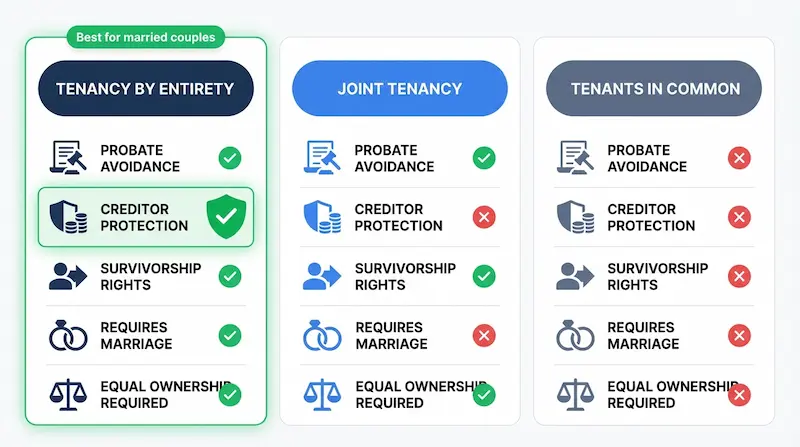
| Feature | Tenancy by Entirety | Joint Tenancy (JTWROS) | Tenants in Common |
|---|---|---|---|
| Avoids probate | Yes | Yes | No |
| Creditor protection | Yes (individual debts) | No | No |
| Marriage required | Yes | No | No |
| Unilateral sale/transfer | No (both must agree) | Yes (destroys joint tenancy) | Yes (own share only) |
| Homestead preserved | Yes | Yes | Varies |
| Best for | Married couples | Unmarried co-owners | Blended families (rare) |
What about your existing mortgage
This is the number-one question homeowners ask: "Will my mortgage company call my loan or force me to refinance?" The answer is no -- federal law protects you.
The Garn-St. Germain Depository Institutions Act of 1982 (12 U.S.C. §1701j-3) explicitly prohibits lenders from enforcing due-on-sale clauses for transfers to a spouse. This applies to all residential properties with fewer than five units, regardless of what your mortgage contract says.
Adding your spouse to the deed (ownership) is different from adding them to the mortgage (loan obligation). Adding to the deed makes them a co-owner and is protected by the Garn-St. Germain Act -- no lender approval needed. Adding to the mortgage makes them responsible for the debt and requires refinancing with full credit and income verification. Most couples only add the spouse to the deed.
Should you notify your lender? While not legally required, notifying your mortgage servicer after recording is recommended best practice. Some lenders prefer to update their records, and failure to notify can cause 1-3 week delays during future refinancing. Your attorney can draft a notification letter as part of their service.
Step-by-step process and timeline
Adding your spouse to your deed involves six clear steps that typically take two to three weeks from start to finish. While the process is straightforward, each step must be completed correctly to ensure your deed is legally valid.
Step 1: Gather required documents (1-2 days)
Start by collecting everything you will need. The most important document is your current deed, which shows exactly how you currently own the property.
- Current deed to your property (get a copy from the county clerk if you cannot find yours)
- Marriage certificate (required for tenancy by the entirety)
- Photo identification for both spouses
- Property tax bill or assessment (shows legal description and assessed value)
- Mortgage documents (to check for any transfer-related provisions)
- Homeowners insurance policy (you will update this after recording)
Step 2: Choose your method -- attorney vs. DIY (decision day)
Attorney preparation ($300-$600)
- 3-5 business days
- Ensures proper legal language
- Checks for title issues
- Provides liability protection
- Best for complex situations or high-value properties
DIY preparation ($50-$150)
- 1-2 days
- Requires careful attention to detail
- No professional review or liability coverage
- Mistakes can be costly to fix later
- Only suitable for simple, straightforward situations
Most couples benefit from attorney preparation. The cost difference is small compared to your home's value and the importance of getting it right. Find qualified attorneys through The Florida Bar's attorney directory or the Real Property, Probate and Trust Law Section.
Step 3: Prepare the new deed (3-5 business days)
Most spouse additions use a quitclaim deed, which transfers your current ownership interest to both spouses jointly. The new deed must include specific legal language establishing the ownership type you have chosen. Review the complete Florida deed requirements before drafting.
The deed must also comply with Florida's documentary stamp tax requirements. Transfers between spouses are generally exempt, but this must be properly documented on the deed itself.
Step 4: Sign and notarize (same day)
The current owner (grantor) must sign the deed in the presence of a notary public and two witnesses. Under Florida Statute §689.01, only the grantor is legally required to sign. However, most attorneys recommend that both spouses sign -- the grantor to transfer interest and the receiving spouse to acknowledge acceptance.
As of January 1, 2024, Florida Statute §695.26 requires each witness's post office address to be printed, stamped, or typewritten below their signature and name. A physical address or P.O. box is acceptable; email addresses are not. Deeds without witness addresses will be rejected by the county clerk.
Step 5: Record with county clerk (1-3 business days)
Take the signed and notarized deed to the county clerk's office where your property is located. They will review the document for completeness, collect recording fees (typically $10-$15 per page), and add it to the public record. Most clerks can record deeds the same day if you arrive early. The clerk will stamp the deed with official recording information and return a recorded copy to you.
Keep multiple copies of the recorded deed in safe places. You will need copies for insurance updates, future refinancing, and estate planning purposes.
Step 6: Update insurance and other records (1 week)
- Homeowners insurance: Add your spouse as a named insured. Most insurers can do this over the phone immediately.
- Property appraiser: Contact within 30 days to ensure homestead exemption continuity. Bring your marriage certificate and a copy of the recorded deed.
- Mortgage servicer: Send a courtesy notification with a copy of the recorded deed.
- Estate planning documents: Update your will if it specifically mentions the property.
Week 1: Gather documents, choose method, prepare deed. Week 2: Sign, notarize, and record with county clerk. Week 3: Update insurance, notify mortgage company, confirm with property appraiser. Start during normal business days and avoid holiday periods when clerk offices may be busier.
Selling or moving? Your biggest tax benefit is on the line.
Most Florida homeowners have tens of thousands of dollars in Save Our Homes protection — and lose it by accident when they move. Check what yours is worth and what happens to it if you sell.
Costs and hidden expenses
Adding your spouse to your deed typically costs $300-$800 total. Some costs are fixed regardless of property value, while others can vary by county. Here is the complete breakdown.
| Expense | Typical cost | Notes |
|---|---|---|
| Attorney fees | $300-$600 | Flat fee for deed preparation, review, notarization, and recording coordination |
| Recording fees | $10-$15/page | Most deeds are 2-3 pages ($20-$45 total). Varies by county. |
| Documentary stamps | Usually $0 | Spousal transfers of homestead property are generally exempt when only consideration is existing mortgage |
| Title search (optional) | $150-$300 | Recommended if property was purchased more than 5 years ago or if title concerns exist |
| DIY (no attorney) | $50-$150 | Online form services plus recording fees. Higher risk of errors. |
On a $400,000 home, documentary stamps would normally cost $2,800 (at $0.70 per $100). The spousal transfer exemption saves you this entire amount -- as long as the transfer is properly documented and the only consideration is the existing mortgage balance.
Tax implications and homestead protection
The number-one concern Florida homeowners have about adding a spouse to the deed is losing their valuable homestead exemption. The good news: when done correctly, adding your spouse preserves all your current tax benefits.
Homestead exemption: usually no impact
According to Florida Statute 196.031 and the Florida Department of Revenue, homestead exemption is maintained when property is held jointly by spouses as long as it continues to serve as the family's primary residence. Your exemption benefits -- up to $51,411 in assessed value reduction (2026, CPI-adjusted under Amendment 5) plus the Save Our Homes 3% assessment cap -- all remain intact.
Save Our Homes protection
The Save Our Homes assessment cap is often worth more than the homestead exemption itself, especially for properties owned for many years. When you add your spouse to the deed, the accumulated Save Our Homes benefit typically transfers with the property. You must ensure the transfer is properly documented as a spousal transfer to maintain this protection.
You bought your home in 2018 for $280,000. Today it is worth $450,000, but your assessed value is only $320,000 due to the 3% annual cap. Annual savings: ($450,000 - $320,000) x 2% effective tax rate = $2,600 per year. Losing this benefit through an improper transfer would cost you thousands annually. Calculate your Save Our Homes savings to see what's at stake.
Gift tax implications (usually none)
Under the unlimited marital deduction (IRC Section 2523), transfers between spouses who are both U.S. citizens are exempt from gift tax regardless of property value. No gift tax return is required. However, if one spouse is not a U.S. citizen, different rules apply and professional tax advice is essential.
Capital gains considerations
There is a common misconception that adding your spouse to the deed is required to claim the full $500,000 capital gains exclusion. Under IRC §121(b)(2)(A), married couples filing jointly can exclude up to $500,000 as long as either spouse meets the ownership test and both meet the use test. You do not need both names on the deed to qualify.
When you add your spouse to the deed during your lifetime, the IRS treats this as an interspousal transfer under IRC §1041. Your spouse receives a carryover basis -- your original purchase price, not the current market value. This matters significantly for capital gains tax when selling. If instead you kept the property in your name alone and passed away, your spouse would receive a full stepped-up basis to fair market value at date of death. With joint ownership like TBE in Florida, only the deceased spouse's 50% share receives a step-up. Consult a tax professional if your property has appreciated significantly.
Protecting your assessment after recording
- Include spousal relationship language in the deed
- File with proper documentary stamp exemption claims
- Contact your county property appraiser within 30 days of recording
- Provide marriage certificate if requested
- Confirm continued homestead exemption status in writing
Preserving additional tax benefits
If you currently receive additional property tax exemptions such as senior exemptions, veteran benefits, or disability exemptions, adding your spouse to the deed should not affect these benefits. However, some exemptions are tied to specific individuals rather than the property itself, so confirm with your county property appraiser.
In some cases, your spouse may qualify for additional exemptions based on their own age, veteran status, or disability -- potentially increasing your total tax savings. Review all current exemptions with the property appraiser when notifying them of the ownership change. If your assessed value seems too high, you may also want to appeal your property taxes. And if you're considering downsizing, make sure you understand how portability transfers your Save Our Homes savings to a new property.
When you should NOT add your spouse
While beneficial for most couples, adding your spouse to your deed can create serious problems in specific situations. Understanding these red flags before you act can save you from costly, difficult-to-reverse mistakes.
- Your spouse has outstanding judgments or liens. Adding them to the deed exposes your property to their creditors. Even TBE cannot protect against federal tax liens. Keep property in your name until debts are resolved, or explore a Lady Bird deed for death-only transfer.
- Medicaid planning is a factor. Adding your spouse creates a countable asset for Medicaid purposes. Property transfers within Medicaid's five-year look-back period create penalty periods that can delay benefits. The same concern applies to adding a child to your deed.
- You have children from a previous marriage. Joint ownership with survivorship means the surviving spouse inherits everything, potentially disinheriting your biological children. Your children would then need to navigate inheriting the home through more complex channels. Consider tenants in common with specific percentages, a revocable trust, or a comprehensive will instead.
- Your spouse has high professional liability. While TBE protects against individual debts, the protection is lost if both spouses are liable or if you later divorce. In some cases, keeping property in the lower-risk spouse's name may be more protective.
- Marriage instability or recent marriage. Once on the deed, your spouse gains ownership rights — removing a spouse from the deed requires their consent or a court order. In divorce, jointly-owned property becomes part of the marital estate subject to equitable distribution, even if you owned it before marriage.
Consider waiting if
- Issues are resolvable within 1-2 years
- Marriage is under 2 years old
- Major business or career changes are pending
- Estate planning strategy is still developing
Proceed with caution if
- Issues are permanent but manageable
- Benefits clearly outweigh risks
- You have comprehensive professional advice
- No suitable alternatives exist
Frequently asked questions
Share this guide
