
What Is Downsizing & Is It Right for You?
Downsizing—often called "rightsizing"—means moving from your current property to a smaller, more manageable home that better fits your lifestyle and financial goals. It's not just about square footage; it's about optimizing your life for what matters most to you now.
Modern downsizing takes many forms: moving from a family home to a condo with minimal maintenance, relocating to a smaller house in a different area with lower costs, or transitioning to a 55+ community with built-in amenities and social connections. According to AARP's 2024 housing research, about two-thirds of adults would consider downsizing, though 75% of those 50+ still prefer single-family homes.
Key Benefits of Downsizing
Lower Monthly Costs: Most downsizers save $500-2,000 monthly from reduced utilities, taxes, maintenance, and insurance—adding up to $6,000-24,000 annually.
Equity Release: Downsizing typically unlocks $50,000-200,000+ in home equity that can be invested for retirement, used for travel, or provide financial security. Fannie Mae research shows the average homeowner has $212,000 in tappable equity.
Less Maintenance: Dramatically reduced cleaning, repairs, and upkeep means more time for hobbies, travel, and family.
Better Location: Smaller homes often allow you to afford prime locations or proximity to family and amenities that were previously out of reach.
Reduced Stress: Less financial pressure and fewer responsibilities contribute to peace of mind—and your home size finally matches your current needs.
When Downsizing Might Not Be Right
Downsizing isn't ideal for everyone. If you're in financial distress and need to sell quickly, you may not get optimal value for your home. In a buyer's market, waiting for better conditions could save you significant equity. If adult children expect to inherit the family home or visit regularly with grandchildren, have that conversation first.
Similarly, if you've recently renovated or made significant improvements, you may not recoup those costs immediately. The best downsizing decisions are made from a position of choice, not necessity.
Case Study: Maria & Carlos Rodriguez, Ages 64 & 67
Sarasota to Naples, 2024
Maria and Carlos downsized from their 3,200 sq ft Sarasota home to a 1,800 sq ft villa in East Naples. Beyond saving over $1,000 monthly on utilities, maintenance, and insurance, they took advantage of Florida's Save Our Homes portability to transfer their homestead assessment cap to the new property.
The move eliminated their $1,800 annual flood insurance premium entirely. Their new community includes hurricane-rated construction and backup generators, reducing both insurance costs and storm-related stress.
"The biggest surprise was eliminating flood insurance completely. Our new community has storm-rated construction and backup power, so we actually feel safer than before. Plus our Save Our Homes exemption transferred, keeping property taxes reasonable."
— Maria Rodriguez
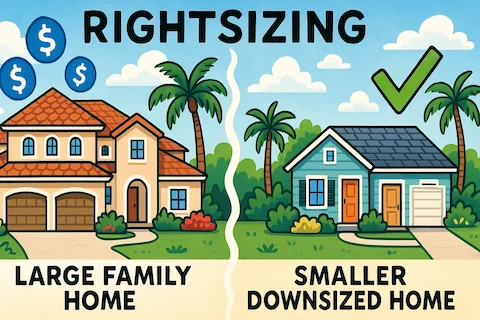
Rightsizing can unlock financial freedom and a simpler lifestyle
Complete Financial Calculator
Before making any downsizing decision, you need to understand the complete financial picture. Our calculator shows you exactly how much you could save monthly, release in equity, and boost your retirement fund by downsizing.
Florida Downsizing Calculator
Estimate your potential savings from downsizing in Florida
Your Current Home
Use a recent appraisal or comparable sales
Check your latest mortgage statement
Used to estimate utility and maintenance costs
Your Target Home
What you expect to pay for your new home
Smaller homes have lower ongoing costs
Your Downsizing Results
Enter your home values to see results
Your potential savings will appear here
Learn more about preserving your Florida property tax benefits: Save Our Homes Portability Guide
The Full Cost Reality: What They Don't Tell You
Too many downsizing guides focus only on the potential savings while glossing over the real costs. Here's the complete financial picture - both the expenses you'll face and the savings you'll gain.
Complete Transaction Costs Breakdown
Downsizing Example
All calculations below use these home values
The biggest shock for most downsizers is the total cost of making the move. You'll face expenses on both ends - selling your current home and buying your new one. Here's what to expect:
Selling Your Current Home (6-8% of home value)
Real Estate Agent Fees: The largest expense is typically realtor commissions at 5-6% of your sale price. On an $800,000 home, that's $40,000-48,000 split between your listing agent and the buyer's agent.
Tip: Working with a Realtor specializing in downsizing can reduce these fees by 25-40% (a $10,000-19,200 savings on an $800k home).
Additional Selling Costs: Beyond agent fees, budget for closing costs ($2,000-4,000), home staging ($1,000-3,000), and pre-sale repairs ($5,000-15,000). For example, in Florida, in most counties the seller pays the buyer's title policy. Use our Florida seller closing costs calculator for a detailed breakdown.
Total Selling Costs: $48,000-70,000 on an $800k home (6.0-8.8%)
Buying Your New Home - Cash Purchase (1-2% of home value)
Assuming a cash purchase (common with downsizing equity release), you'll avoid loan-related fees but still need essential services.
Required Costs: Home inspection ($500-1,000), independent appraisal for your peace of mind ($600-900), and attorney or closing fees ($1,000-2,000). See our Florida buyer closing costs calculator for exact estimates.
Additional Expenses: You'll pay prorated property taxes, homeowners insurance, and moving expenses ($2,500-6,000 for professional movers handling a larger home's contents).
Total Buying Costs: $4,600-9,900 on a $400k cash purchase
Hidden Ongoing Costs People Forget
Beyond the one-time moving costs, there are ongoing expenses that can surprise new downsizers. Many of these costs didn't exist in your larger suburban home:
HOA Fees
$400/month for your new condo (didn't exist in your $800k home)
New Furniture
$8,000-25,000 to fit new space layout
Storage Units
$300/month if you can't part with everything
Immediate Repairs
$3,000-12,000 for unexpected issues in new home
Your Ongoing Savings Breakdown
While the upfront costs are significant, the monthly savings from downsizing can be substantial and long-lasting:
Property Taxes: Moving from an $800,000 to $400,000 home typically cuts property taxes roughly in half. Depending on your location, this could mean $200-800 monthly savings.
Utilities: Heating, cooling, electricity, and water costs decrease significantly with less square footage. Most downsizers from larger homes save $150-400 monthly on utilities.
Maintenance: Fewer repairs, less landscaping, reduced cleaning costs, and smaller insurance premiums typically save $300-800 monthly when moving from a large family home.
Total Monthly Savings: $650-2,000 (Most save $800-1,200)
Adding up to $9,600-24,000 annually
Complete 10-Year Financial Projection
Here's the complete financial picture for our $800k → $400k example, including investment returns and opportunity costs:
Year 1
$235,000
Net cash available for investment after all costs
Year 5
$390,000
Cumulative savings + investment growth at 7.5% annually
Year 10
$625,000
Total benefit including all savings and investment returns
Opportunity Cost
$135,000
Missed appreciation on $400k difference at 3% annually over 10 years
Net 10-Year Benefit: $490,000
After accounting for all costs, savings, investment returns, and missed home appreciation
*Assumes $12,000 annual savings, 7.5% investment return, 3% home appreciation. Results will vary based on individual circumstances.
Tax Implications & Exemption Transfers
Capital Gains Considerations: With an $800,000 home sale, you may face capital gains taxes if your profit exceeds the $250,000 ($500,000 for couples) primary residence exemption. Plan accordingly and consider consulting a tax professional. Learn more about home sale tax rules from the IRS or see our capital gains tax guide. For tax-smart downsizing strategies, Kiplinger's retirement tax guide offers additional insights.
Property Tax Exemption Transfers: Basic homestead exemptions usually transfer to your new primary residence, but age-based exemptions, veteran exemptions, and disability exemptions may have different rules. Research exemptions available in your target area and factor these into your savings calculations.
Florida Residents: If moving within Florida, protect your Save Our Homes benefit, which limits annual assessment increases and can provide significant tax savings. Learn more from the Florida Department of Revenue or use our Save Our Homes portability calculator.
Costly Mistakes & How to Avoid Them
These expensive mistakes cost downsizers thousands of dollars and months of stress. Learn from their experiences to avoid making the same costly errors.
The Most Expensive Downsizing Mistakes
💸 1. Severely Underestimating Total Moving Costs
The Rodriguez family learned this lesson the hard way. They budgeted $8,000 for their entire downsizing move but ended up spending $26,500.
"We only calculated realtor fees and moving trucks. The overlap costs, storage, new utility deposits, and last-minute hotel stays nearly tripled our budget." - Maria Rodriguez
⚠️ What people commonly forget: Realtor fees on both homes if buying before selling, overlap period costs during double housing payments, storage fees for excess furniture, utility connection fees, emergency hotel stays during delays, and higher-than-expected professional moving costs.
📏 2. Downsizing Too Dramatically, Too Fast
The Chen family went from a 2,800 sq ft house to an 1,100 sq ft condo, then had to move again 18 months later to an 1,800 sq ft townhome.
"The condo felt like a prison after 6 months. We had no space for grandkids to visit, nowhere for my workshop, and felt cramped constantly. Moving twice cost us $35,000 in transaction fees." - David Chen
⚠️ Warning signs you're going too small: Reducing square footage by more than 40%, eliminating guest space entirely, no storage for hobbies or collections, choosing location over basic space needs, or not considering future accessibility requirements.
Smart approach: Start with a 25-30% reduction in size. You can always downsize further later, but "upsizing" again is expensive and stressful.
🏢 3. Failing to Research HOA Finances Thoroughly
The Williams family thought they'd found the perfect condo with a $450/month HOA fee. Two years later, they received a $12,000 special assessment bill.
"The roof, elevator, and HVAC all needed replacement, and the HOA had no reserves. We got hit with a massive bill just as we thought we'd reduced our expenses." - Janet Williams
Essential HOA research: Always review the HOA's financial statements, reserve fund levels (should be at least 25% of annual budget), history of special assessments, pending litigation, and maintenance schedules for major building systems.
🚩 Red flags: Deferred maintenance, low reserves, high percentage of rentals vs. owners, or reluctance to share financial documents. A well-managed HOA should be transparent about finances.
💭 4. Making Emotional Rather Than Financial Decisions
The Martin family fell in love with the idea of downtown living and chose an expensive downtown condo over a practical suburban option.
"We loved the 'idea' of it, but we're not night owl people. The constant noise, parking costs, and higher prices made us miserable. The practical choice would have saved us $50,000 and been much better for our lifestyle." - Robert Martin
Common emotional traps: Falling in love with the first property you see, buying based on vacation feelings rather than daily life needs, ignoring practical requirements for aesthetic preferences, or making decisions based on what friends did rather than your own situation.
Stay objective: Create a must-have vs. nice-to-have list before you start looking. Visit properties at different times of day and seasons. Bring a trusted friend to viewings who can ask practical questions.
📉 5. Being Forced to Move During Unfavorable Market Conditions
Sometimes life forces your hand - job loss, health crisis, divorce, or family emergencies can require immediate action. However, the most successful downsizers start planning 2-3 years before they actually need to move.
📊 Prevention strategy: Begin monitoring local market conditions and preparing your home for sale long before you're forced to act. Build an emergency fund specifically for moving costs. Start decluttering gradually rather than in a rush.
Being forced to sell in a buyer's market or during economic uncertainty can cost $30,000-100,000+ in lost equity compared to selling when you have flexibility to wait for better conditions.
Complete Mistake Prevention Checklist
✅ Before You Start
- • Create comprehensive budget including ALL transaction costs (8-10% of home value)
- • Build 6-month emergency fund for unexpected expenses
- • Get professional home valuation, not online estimates
- • Research at least 3 different property types and neighborhoods
✅ During Property Search
- • Review HOA financials, reserves, and assessment history
- • Visit properties at different times of day and week
- • Calculate ALL ongoing costs, not just purchase price
- • Test commute times to important locations
Following this checklist can save you $20,000-50,000+ in avoidable mistakes and regrets.
Property Types & Location: What Actually Works
Choosing the right type of property and location can make or break your downsizing success. Here's what different homeowners discovered works best for various lifestyles and goals.
Property Types: Real Homeowner Experiences
🏢 Condominiums - Most Popular Choice for First-Time Downsizers
Condos offer maintenance-free living with building amenities, professional management, and often walkable locations. However, expect shared walls, HOA fees, and limited storage space.
✅ What People Love:
- • Zero exterior maintenance
- • Building amenities (pool, gym)
- • Security and gated access
- • Walkable to shopping/dining
❌ Common Complaints:
- • Noise from neighbors
- • Rising HOA fees
- • Renovation restrictions
- • Limited storage space
Best for: Those who hate yard work, frequent travelers, urban lifestyle seekers. "Research HOA finances thoroughly - this makes or breaks the experience." - Multiple condo owners
🏠 Smaller Single-Family Homes - For Those Wanting Outdoor Space
Perfect for downsizers who want private outdoor space and freedom to customize. You'll have no shared walls and complete privacy, but remain responsible for all maintenance.
✅ What People Love:
- • Private yard for pets/gardening
- • No shared walls or noise
- • Freedom to renovate
- • Usually no HOA fees
❌ Common Complaints:
- • Still handle all maintenance
- • Ongoing yard work required
- • Less walkable locations
- • Higher cost per square foot
Best for: Garden enthusiasts, pet owners, those wanting complete privacy. "Look for ranch-style homes to future-proof for mobility issues." - Occupational therapist
🌅 55+ Active Adult Communities - Growing in Popularity
Active adult communities provide built-in social networks, extensive amenities, and maintenance-free living. According to the National Association of Realtors, buyers aged 75+ are most likely to downsize, with proximity to family and healthcare being top priorities. However, age restrictions limit family visits and HOA fees are typically higher.
✅ What People Love:
- • Built-in social community
- • Extensive amenities (golf, pools)
- • Age-appropriate activities
- • Maintenance-free lifestyle
❌ Common Complaints:
- • Age restrictions limit family visits
- • Higher HOA fees for amenities
- • Can feel isolated from community
- • Limited resale market (55+ only)
Best for: Active retirees seeking community, golf enthusiasts, social people comfortable with age restrictions. "Visit multiple times - the culture varies dramatically between communities." - Real estate agent
Location Strategy: Stay Local or Relocate?
One of the biggest downsizing decisions is whether to stay in your current area or relocate entirely. Both approaches have significant trade-offs that affect your finances, lifestyle, and family relationships.
Staying local lets you keep established social networks, familiar healthcare providers, and proximity to family. You already know the area's amenities and services. However, you'll face limited cost savings, fewer property options, and the same cost-of-living pressures.
Relocating can unlock dramatic cost savings and tax benefits, better weather, and more property choices. It's a fresh start. But you'll lose social connections, need to find new healthcare providers, and face distance from family. Unknown area risks and costs can also surprise you.
Future-Proofing Your Decision
Consider these factors to ensure your new home serves you well for the next 10-20 years as your needs evolve:
- Accessibility: Single-floor living, wider doorways, walk-in showers, grab bars, and proximity to healthcare facilities.
- Transportation: Plan for when driving becomes difficult—public transit, walkability, ride services, and delivery options.
- Healthcare: Proximity to quality hospitals, specialists, pharmacies, and medical services becomes increasingly important.
- Family access: Consider proximity to adult children and grandchildren for ongoing support, visits, and relationships.
Your Step-by-Step Action Plan
Ready to move forward? Here's the proven step-by-step process successful downsizers follow to ensure a smooth transition.
9-12 Month Downsizing Timeline
Months 1-4: Planning & Preparation
Get a professional home valuation and calculate your total transaction costs. Research target areas and property types while beginning the decluttering process. Interview real estate agents who specialize in downsizing, visit different communities, and create your wish list vs. must-haves. Check your credit and get finances in order.
Months 5-8: Active Marketing & Searching
Complete any home repairs or improvements needed before listing. List your current home with professional photos and marketing. Intensify your new home search—visit properties immediately when listed and research HOA finances thoroughly. Make competitive offers and work to coordinate closing timelines between both transactions.
Months 9-12: Transition & Settlement
Hire professional movers early and transfer utilities and addresses. Complete final inspections and handle all closing documentation. After the move, apply for your new homestead exemption, find new healthcare providers, and explore your neighborhood amenities.
When to Get Professional Help
- Real Estate Agent: Always recommended. Find one specializing in downsizing and your target area or property type.
- Financial Advisor: For investment strategy on released equity and retirement planning, especially if your estate value exceeds $750k.
- Tax Professional: Essential if you expect large capital gains or need help with exemption transfers between properties.
- Estate Attorney: For complex estates, blended families, or if you need to update wills and trusts after your move.
If You Decide Not to Downsize
Some Florida homeowners decide their current home is perfect for their needs. If you're staying put but want to ensure your home passes smoothly to your children, consider a Lady Bird Deed. This lets you transfer property to family while maintaining complete control during your lifetime—you can still sell, refinance, or change your mind, but if you keep the home, it passes to beneficiaries without probate.
Final Decision Quiz
Before making your downsizing decision, complete this comprehensive readiness assessment. Each section must be thoroughly evaluated to ensure you're making the right choice.
Complete Decision Framework
Complete Each Section Before Making Your Decision
Complete each card in order
Financial Readiness
Market Timing
Property Research
Support & Execution
Frequently Asked Questions About Downsizing
Here are the most common questions Florida homeowners ask about downsizing, with honest, straightforward answers based on real experiences.
Will I lose my Save Our Homes benefit if I downsize in Florida?
+How does Florida's no state income tax affect my downsizing profits?
+What about hurricane insurance when downsizing in Florida?
+How much can I realistically save on property taxes by downsizing?
+What are the best areas in Florida for downsizing?
+Should I downsize within Florida or move to another state?
+Do 55+ communities really save money compared to regular neighborhoods?
+What if my family expects to inherit my current home?
+Still Have Questions About Downsizing in Florida?
Every situation is unique. We're here to help with personalized guidance for your specific circumstances.
Serving all Florida counties including Miami-Dade, Broward, Orange, Hillsborough, Pinellas, Palm Beach, Duval, and beyond
Live Chat
Available Now
Usually respond within seconds
Property Exemption Team
Our team includes licensed real estate professionals and specializes in Florida Homeownership Guidance. We analyze current regulations, interview industry professionals, and provide educational resources to help Florida homeowners make informed decisions.