
If a Florida divorce is on the horizon and the home is part of it, the dollars at stake on tax benefits often dwarf any difference in how you split the equity. Long-time Florida homeowners typically carry a Save Our Homes assessment cap worth tens of thousands of dollars per year for the rest of their time in the state. The federal capital gains exclusion can shield up to $500,000 of gain — or as little as $250,000 each, depending on timing. And the transfer of the home itself between spouses can be tax-free, or not. Every one of these rules turns on getting the procedure right at the moment of the divorce, not on what feels fair.
How Florida Law Handles the Marital Home
Florida is an equitable-distribution state, not a community-property state. Under Fla. Stat. §61.075, the court must begin with the premise that distribution of marital assets and liabilities should be equal — unequal distribution requires justification under the statutory factors listed in §61.075(1)(a) through (j). The statute uses the word "premise" deliberately rather than "presumption"; an unequal split is fully on the table when the factors point that way.
For the marital home specifically, two rules matter most:
The home is presumed marital. Under §61.075(6)(a)(2), all real property held by the spouses as tenants by the entireties — whether acquired before or during the marriage — is presumed to be a marital asset. The burden falls on the spouse who claims any portion is non-marital (for example, a down payment from a pre-marriage account) to prove it with documentation.
The home does not have to be sold. §61.075(1)(h) explicitly tells the court to consider keeping the marital home as a residence for any dependent child of the marriage — when it would be equitable to do so, when it is in the best interest of the child or that party, and when it is financially feasible to maintain the residence until the child is emancipated or until exclusive possession is otherwise terminated. The statute extends the same consideration to "any other party," meaning a court can also weight one spouse's connection to the home in the calculus.
Practically, Florida courts almost always accept a reasonable agreement between the spouses about the home — sell now, one buys out the other, or defer the sale — and incorporate it into the final judgment. The tax and exemption rules below decide which option preserves the most value.
Three Paths for the Marital Home
There are essentially three structures Florida divorces use for the home, and each carries a different set of tax and exemption consequences:
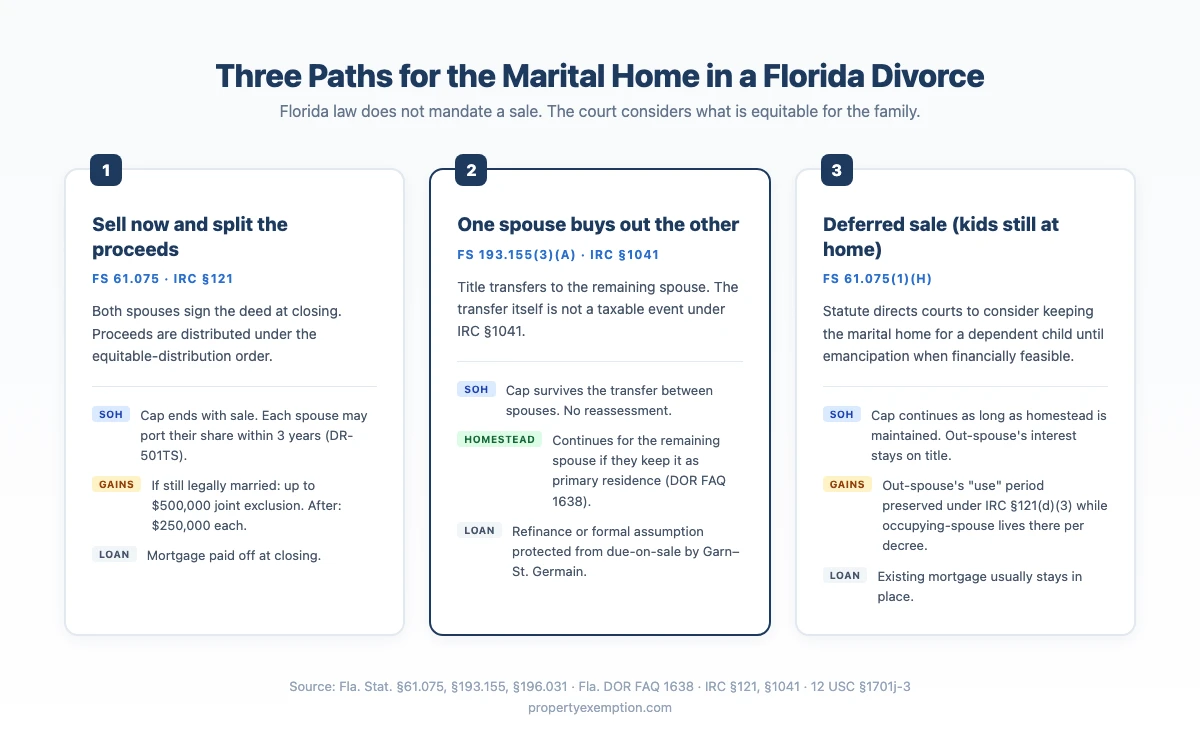
Each path interacts with the same set of underlying rules — Florida's Save Our Homes cap, the homestead exemption, the federal capital gains exclusion, and the spousal-transfer rules — in different ways. The sections that follow take them one at a time, in the order that usually matters most to Floridians.
Save Our Homes Survives the Divorce
The single most valuable tax benefit on a Florida homestead is usually the Save Our Homes assessment cap, established by Article VII, Section 4(d) of the Florida Constitution and implemented by Fla. Stat. §193.155. The cap limits the annual increase in your homestead's assessed value to the lower of 3% or the change in the Consumer Price Index, regardless of how fast the market value rises. Long-time owners often carry assessed values hundreds of thousands of dollars below the home's true market value.
Ordinarily a "change of ownership" wipes out that accumulated benefit and resets the assessed value to current market value. But §193.155(3)(a) carves out an exception for spousal transfers. The statute provides verbatim:
The statute provides that "change of ownership" does not include a transfer in which "legal or equitable title is changed or transferred between husband and wife, including a change or transfer to a surviving spouse or a transfer due to a dissolution of marriage."
In plain English: when a divorce assigns the marital home to one spouse, the property appraiser does not reset the assessed value. The receiving spouse inherits the existing capped assessment and keeps paying property tax on that lower value. The 2024 Florida property tax amendments (Ch. 2024-158) did not disturb this exception — it remains the law for the 2025 tax roll and beyond.
This is why a buyout structure (one spouse takes title to the home) almost always preserves more property-tax value than a sale plus repurchase. Two examples to make the math vivid:
Long-time owner buying out: Spouse A keeps the $600,000-market-value home with a $400,000 capped assessed value. The $200,000 difference is intact. No reassessment. Spouse A pays property tax on the lower number going forward.
Same home, sold instead: The home sells for $600,000 to a buyer. Spouse A then buys a different $600,000 home. Without filing portability paperwork, the new home is reassessed at full market value. The accumulated $200,000 cap benefit evaporates — gone forever unless ported correctly within three years.
Selling or moving? Your biggest tax benefit is on the line.
Most Florida homeowners have tens of thousands of dollars in Save Our Homes protection — and lose it by accident when they move. Check what yours is worth and what happens to it if you sell or split.
The DR-501TS: Splitting the SOH Benefit
What if both spouses give up the marital homestead and each buys a new Florida home? Florida explicitly allows the accumulated Save Our Homes benefit to be split between them.
Florida DOR Form DR-501TS — "Designation of Ownership Shares of Abandoned Homestead" exists for exactly this scenario. Both ex-spouses sign it, designate the percentage of the SOH benefit each will take to their new homestead, and file it with the property appraiser in the county of the abandoned homestead. Two ironclad rules:
- Percentages must total exactly 100%. The benefit is divided, not duplicated. You cannot each claim 100%.
- The designation is irrevocable once filed. Get the split right at the time of the divorce, not after.
After the DR-501TS is on file, each ex-spouse then files Form DR-501T — "Transfer of Homestead Assessment Difference" with the property appraiser in the county where they have established their new homestead, by March 1 of the year the new exemption takes effect. The new-homestead appraiser then coordinates with the previous-homestead county to apply the designated share to reduce the assessed value of the new home.
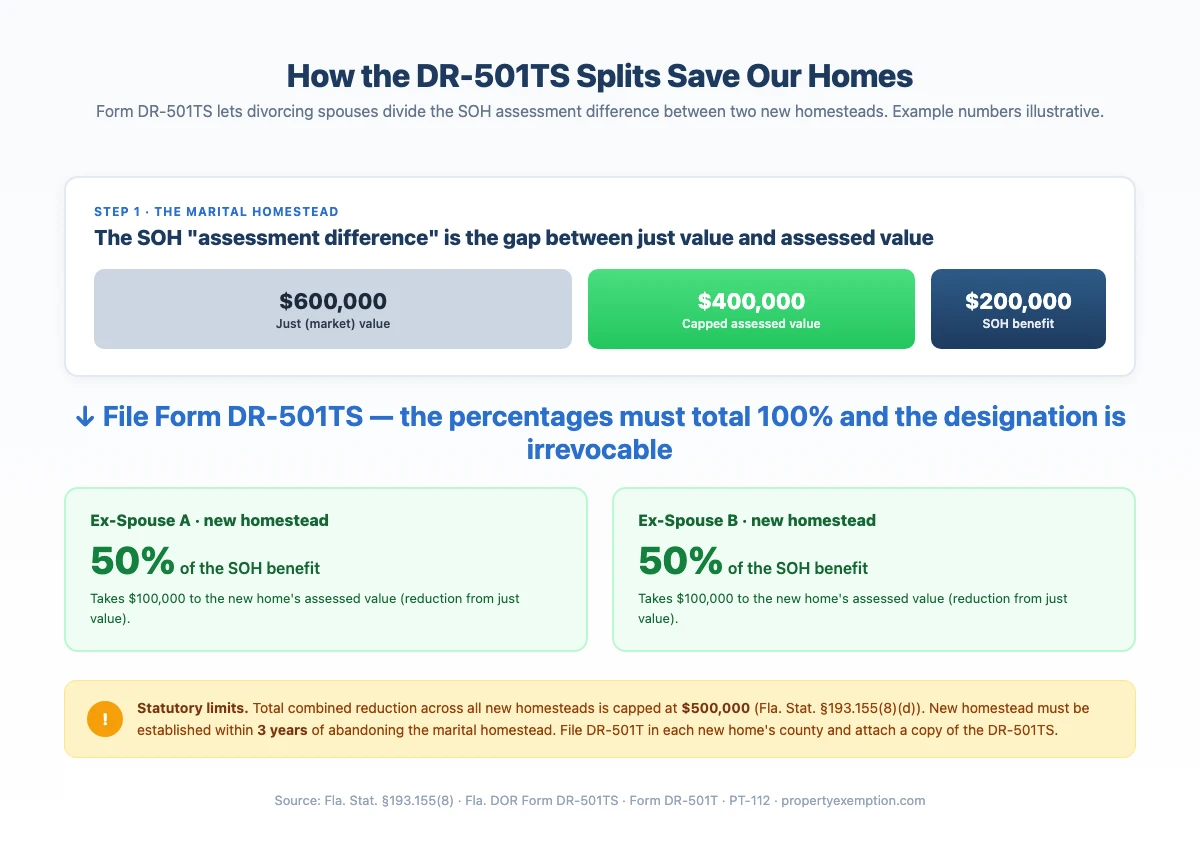
Two statutory limits cabin the benefit:
Three-year window. Under Fla. Stat. §193.155(8), the new homestead must have received its homestead exemption as of January 1 of any of the three immediately preceding years — effectively a three-year window from abandoning the old homestead. (Amendment 5, effective January 1, 2021, extended this window from two years to three.)
$500,000 combined cap. §193.155(8)(d) provides that "the total reduction from just value for all new homesteads established under this paragraph may not exceed $500,000." The cap is shared between the ex-spouses, not duplicated. If the combined SOH benefit being ported is $600,000, only $500,000 of it survives the move.
The Miami-Dade Property Appraiser's portability page covers eligibility, how the benefit is calculated, and how to submit Form DR-501T (online portal, email, appointment, or walk-in). Other Florida county appraisers publish similar overviews on their own portability pages.
The No-Double-Homestead Trap
One mistake recurs in Florida divorces: the spouse who moves out tries to claim a homestead exemption on a newly purchased home while their name is still on the deed of the marital residence. Florida does not allow this.
The Florida DOR addresses the situation directly in FAQ 1638:
"If one spouse maintains the property as his or her permanent residence, the homestead exemption will continue. However, if either spouse purchases a new home in Florida, he or she cannot receive the homestead exemption on the new home as long as he or she owns or co-owns the property that the couple shared while married."
The takeaway is concrete: the path to porting the Save Our Homes benefit to a new home for the out-spouse requires relinquishing ownership of the marital home, not merely moving out. Until the divorce decree assigns title (or the home is sold), the out-spouse cannot stack a new homestead. The remaining spouse, meanwhile, continues to qualify for the exemption under Fla. Stat. §196.031 as long as they hold title interest and use the property as their permanent residence as of January 1.
Federal Capital Gains: $500,000 vs. $250,000
On the federal side, the home-sale gain exclusion is governed by IRC §121. The headline numbers:
Single filer: up to $250,000 of gain excluded. Married filing jointly: up to $500,000. Both have been unchanged since the Taxpayer Relief Act of 1997 and are not indexed for inflation — a significant compounding disadvantage on long-held Florida homes that have doubled or tripled in value.
To qualify, §121(a) requires that the home was owned and used as the taxpayer's principal residence for periods aggregating at least two years during the five-year period ending on the date of sale. The $500,000 joint exclusion adds two more conditions in §121(b)(2)(A): either spouse meets the ownership test, both spouses meet the use test, and neither spouse used the §121 exclusion in the prior two years.
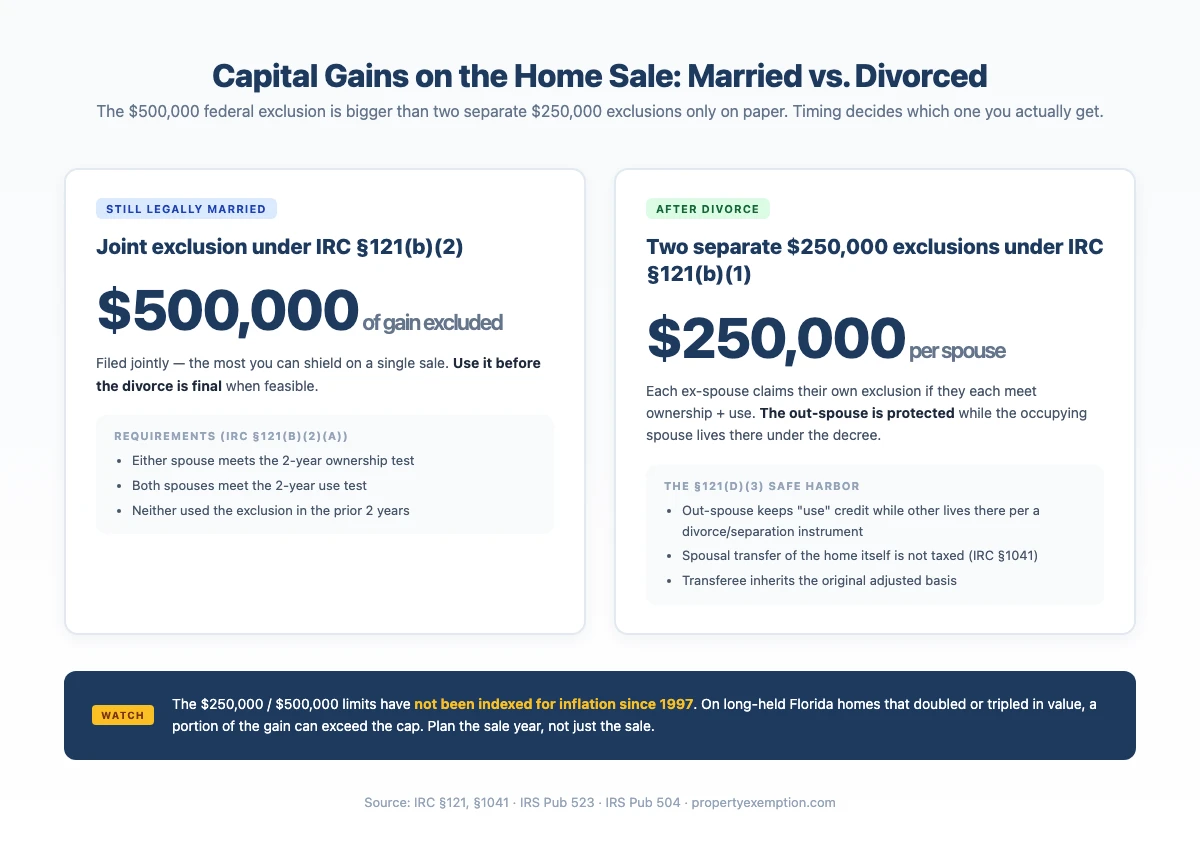
Divorce complicates the test in two places under §121(d)(3), and a third resale rule sits one paragraph over in §121(b)(3):
1. The out-spouse's "use" period — §121(d)(3)(B). If a divorce or separation instrument lets one spouse continue living in the home, the other spouse is treated as also using it as a principal residence during that time. The out-spouse keeps the use clock running even after physically moving out, so the §121 exclusion is not lost just because the divorce takes a year or two to finalize.
2. Property transferred between spouses — §121(d)(3)(A). When the home transfers from one spouse to the other under §1041 (described below), the transferee is treated as having owned the home for the period the transferor owned it — the ownership clock carries over.
3. The two-year resale limit — §121(b)(3). A taxpayer cannot use the §121 exclusion if they used it on another principal-residence sale within the prior two years. A recently divorced taxpayer who already claimed the exclusion on an earlier sale can be locked out for two years. (The $500,000 joint exclusion under §121(b)(2)(A) cross-references this same paragraph (3) in its own eligibility test.)
For homeowners whose total expected gain is well under $500,000, the practical takeaway is that capital gains rarely drives the timing decision. For long-held Florida homes with $700,000 or more of unrealized gain, the difference between $500,000 (joint, pre-divorce) and $250,000 + $250,000 (separate, post-divorce) is a real planning variable. IRS Publication 523 sets out the specific rules for separated or divorced taxpayers — covering principal-residence treatment when a former spouse occupies the home, basis for a home received in divorce, and when divorce can qualify as an unforeseeable event for a partial exclusion.
Why the Spousal Transfer Itself Is Not Taxed
If one spouse buys out the other — or if the divorce decree assigns the home to one spouse outright — the transfer of title between spouses is not a taxable event. IRC §1041(a) provides:
"No gain or loss shall be recognized on a transfer of property from an individual to (or in trust for the benefit of)— (1) a spouse, or (2) a former spouse, but only if the transfer is incident to the divorce."
Three operating rules from IRS Publication 504 and Treas. Reg. §1.1041-1T:
"Incident to divorce" has a defined meaning. A transfer qualifies if it occurs within one year after the marriage ends (Treas. Reg. §1.1041-1T, Q&A-6), or if it is "related to the cessation of the marriage" — defined by Treas. Reg. §1.1041-1T, Q&A-7 as a transfer pursuant to a divorce or separation instrument occurring within six years after the marriage ends. Transfers more than six years out are presumed unrelated (and therefore taxable). The presumptions are rebuttable.
Carryover basis, not stepped-up basis. Under §1041(b)(2), the transferee takes the transferor's adjusted basis. If your spouse takes the home, they inherit your original cost basis plus improvements — not a basis equal to today's value. When they eventually sell, the full pre-divorce appreciation is on their tax return.
Keep the records. The transferor should hand over the cost-basis paper trail at the time of transfer: original purchase HUD/closing statement, every receipt for capital improvements, depreciation taken on any portion of the home. Without those records, the transferee's basis defaults to whatever can be documented — almost always less than what was actually spent.
The Mortgage: Garn–St. Germain Protection
Almost every Florida residential mortgage contains a due-on-sale clause — a contractual right for the lender to call the entire balance due when the property transfers. Federal law carves out specific exceptions, and divorce is one of them.
The Garn–St. Germain Depository Institutions Act, 12 USC §1701j-3, bars a lender from enforcing a due-on-sale clause for certain transfers, including "a transfer where the spouse or children of the borrower become an owner of the property" and "a transfer resulting from a decree of a dissolution of marriage, legal separation agreement, or from an incidental property settlement agreement, by which the spouse of the borrower becomes an owner of the property." This is a federal preemption of contrary loan-contract language.
What that means practically:
The remaining spouse can take title without the loan being accelerated. The lender cannot demand payoff just because the deed transferred under the divorce decree.
Refinancing into one name is usually the cleaner path. Even though Garn–St. Germain blocks acceleration, both names usually remain on the original promissory note. The out-spouse is still legally on the hook if payments are missed. A refinance into the remaining spouse's name alone (subject to income and credit qualification) clears the note. A formal loan assumption is an alternative when the lender allows it.
Deeds and notes are different documents. Transferring the deed does not transfer the loan obligation. Read the final settlement carefully — "hold harmless" and "indemnification" language in the property-settlement agreement is what protects the out-spouse from credit damage if the remaining spouse later defaults.
Timing: Sell Before or After the Divorce Is Final
If both spouses agree that the home will be sold, the question of when — before the divorce is final or after — turns mostly on the size of the expected gain and on which spouse occupies the home in the meantime. A short framework:
Sell while still legally married, filing jointly. Up to $500,000 of gain excluded under §121(b)(2). Simplest. Best for couples with a gain at or under $500,000 who can cooperate through closing.
Sell after the divorce. Each ex-spouse claims their own $250,000 exclusion. Same total ($500,000), but only if both still meet the two-year ownership and use tests at sale. The §121(d)(3) safe harbor protects the out-spouse's "use" period if a divorce or separation instrument lets the other live there.
One spouse buys out, then later sells. The buying spouse's basis is the original cost basis under §1041(b)(2). When they sell, they have a single $250,000 exclusion — the full pre-divorce appreciation is potentially exposed. This is where carryover-basis planning matters most: a buyout in a high-appreciation market can create a tax bill that does not show up until years later.
One more variable to weight: the value-protection effect of preserving Save Our Homes through the buyout. Property tax savings of a few thousand dollars per year, compounding for the rest of the buying spouse's ownership, often exceeds the federal-tax difference between scenarios. The right answer depends on the home, the gain, the timeline, and the spouses' long-term plans — ask both a divorce attorney and a CPA before locking the structure into the settlement.
A Heads-Up on the 2026 Ballot Amendment
Florida lawmakers considered proposals during the 2026 regular session that would raise or remove the $500,000 Save Our Homes portability cap in Fla. Stat. §193.155(8). The regular session ended March 13, 2026 without those measures clearing both chambers. For any such amendment to reach a future statewide ballot it would need to pass both chambers by a three-fifths vote (likely in a special session) and then be approved by at least 60% of voters, per Fla. Const. art. XI, §5. The framework described in this article reflects current law; if the cap is later raised or removed, portability would expand, not contract. Check the Florida Division of Elections for the current ballot.
For the broader property-tax context, see our companion guides on Florida's $250,000 homestead exemption proposal and the DeSantis property tax elimination plan.
Frequently Asked Questions
The questions Florida divorcing homeowners ask most, answered with the underlying statute or IRC section cited.
Selling or moving? Your biggest tax benefit is on the line.
Most Florida homeowners have tens of thousands of dollars in Save Our Homes protection — and lose it by accident when they move. Check what yours is worth and what happens to it if you sell or split.
Share this guide
