
JUNE 2, 2026 — HJR 1F PASSES BOTH CHAMBERS; HEADS TO NOVEMBER BALLOT
The Florida House passed CS/HJR 1F at 12:29 PM on a 75–26 vote, and the Florida Senate followed at 12:57 PM with a 30–9 vote. Three Senate Democrats crossed party lines to support it (Mack Bernard, Daryl Rouson, Barbara Sharief), and two Senate Republicans voted against (Nathan Boyles, Patt Maney). The Senate's identical version (CS/SJR 2-F) was laid on the table in favor of the House measure. The amendment now goes on the November 3, 2026 statewide ballot, where it needs 60% voter approval under Fla. Const. art. XI, §5. If ratified, the amendment takes effect January 1, 2027. The Hillsborough County Property Appraiser projects $725 million in combined losses across 13 local taxing authorities within two years; the Senate analysis put the statewide annual revenue impact at roughly $8.4 billion.
Earlier in the process
JUNE 1, 2026 — SPECIAL SESSION OPENS; SCHOOLS CARVED OUT
Lawmakers convened in Tallahassee for the property tax special session. In a significant revision to the Governor's original plan, the House amended HJR 1F so the new exemptions do not apply to school district levies — meaning homeowners would keep paying the school portion of their tax bill (roughly 40% of a typical bill). Lawmakers also rejected an amendment that would have let cities impose new user fees to recover lost revenue.
MAY 27, 2026 — DESANTIS CALLS THE SPECIAL SESSION, UNVEILS "SAVE OUR HOMES FROM EXCESSIVE PROPERTY TAXES"
Governor DeSantis called a special session for the week of June 1 and unveiled his concrete proposal: raise the homestead exemption from $50,000 to $150,000 in 2027, then $250,000 in 2028 (inflation-adjusted), and direct the Legislature to develop — through general law — a schedule for full elimination of homestead property taxes. Senate President Ben Albritton immediately backed the plan: "I can't think of a more meaningful way to celebrate America's 250 than the passage of $250,000 in tax relief for every Florida homeowner." This was the breakthrough — the Senate killed the House's earlier attempt (HJR 203) in March.
MARCH 13, 2026 — REGULAR SESSION ENDS, HJR 203 DIES
The regular legislative session ended without the Senate taking any action on HJR 203, which had passed the House 80-30 on February 19. The bill died in the Senate Appropriations Committee — no hearing was ever scheduled. View what happened to all seven House proposals →
What's Actually Being Proposed
After a year of competing proposals, dead bills, and House-versus-Senate standoffs, Florida settled on one concrete plan: HJR 1F, the "Save Our Homes from Excessive Property Taxes" amendment, paired with its implementation bill HB 3F. Both chambers passed it on June 2, 2026 (House 75–26, Senate 30–9), and it now goes to you — the voters — on November 3, 2026 (60% required to ratify).
Here is exactly what HJR 1F does:
- Homestead exemption jumps from $50,000 to $150,000 in 2027, then to $250,000 in 2028 and beyond, adjusted annually for inflation. The exemption applies to the non-school portion of your tax bill.
- School taxes are NOT included. Lawmakers carved school district levies out during the special session — you keep paying the school portion (roughly 40% of a typical bill) no matter how large the exemption gets.
- About 60% of homesteaded Floridians would owe zero non-school property tax once the $250,000 exemption is in place, according to the Governor's office.
- A directive to go further: the amendment requires the Legislature, through general law, to develop a schedule for full elimination of homestead property taxes. No specific future dollar figure or end-date is named in the bill itself — that schedule is left to the Legislature to produce.
- New Florida residents wait five years. Anyone establishing Florida residency after January 1, 2027 gets only the current $50,000 exemption for their first five years — the full exemption is reserved for established residents, by design, so the tax cut doesn't fuel a new migration wave.
- Non-homestead property gets one benefit: the annual assessment increase cap on rentals, second homes, and commercial property drops from 10% to 5% per year.
- A state trust fund would provide grants to local governments — primarily rural counties with small tax bases — to maintain core services. Per Section 9 of the amendment, remaining county and city ad valorem revenue may be used only for seven categories: (a) public safety (law enforcement, fire, EMS); (b) education and public schools; (c) infrastructure (including roads, bridges, stormwater); (d) natural resource projects (including flood control); (e) local bonds and debt-service payments on existing obligations; (f) retirement benefits for local-government employees; and (g) operations and administration of county and municipal government.
- HB 3F requires transparency: the state must launch a public website where you can estimate your savings, and property appraisers must mail every owner a notice explaining the amendment before the vote.
The plan requires a constitutional amendment because property taxes are levied by local governments under state constitutional authority. Florida Statute 196.031 governs the current homestead exemption, but restructuring an entire category of taxation requires changing the state's foundational document — which is why HJR 1F needed 60% approval from each chamber (achieved June 2 with 75–26 in the House and 30–9 in the Senate) and will need 60% approval from voters on November 3.

Tampa Family Home

Miami Beach Condo

Naples Home
Florida homes like these would see their non-school property taxes shrink or disappear under the proposed $250,000 homestead exemption. Actual savings depend on your assessed value and local millage rates — the Broward and Miami-Dade property appraisers estimate average savings of roughly $1,500–$1,800 per year.
Selling or moving? Your biggest tax benefit is on the line.
Most Florida homeowners have tens of thousands of dollars in Save Our Homes protection — and lose it by accident when they move. Check what yours is worth and what happens to it if you sell.
The $55 Billion Question
Property taxes (Ad-Valorem) currently generate approximately $55-60 billion annually across Florida, see figure below, funding everything from public schools to police departments. According to the Florida Policy Institute, property taxes fund roughly half of public school operating budgets and a major share of county and city budgets statewide. That is why lawmakers carved school levies out of HJR 1F during the special session — and why the remaining fiscal impact is still enormous. Property tax revenue collected by local governments has nearly doubled in seven years and is projected to reach $83 billion by 2032 if nothing changes, the statistic the Governor's office cites as the core justification for the amendment.

"Property taxes effectively require homeowners to pay rent to the government. Florida residents need relief."
— Governor Ron DeSantis, March 2025 press release
The remaining bar is voter ratification. Florida's constitution requires 60% voter approval for amendments — a higher bar than any recent presidential candidate has achieved in the state. The legislative obstacle that killed every previous attempt is now cleared: the special session ended on June 2 with both chambers passing the amendment. The House had passed its own earlier elimination plan (HJR 203) back in February, only to watch it die in the Senate; this time, with the House, the Senate, and the Governor aligned behind a single proposal, the chambers delivered.
What Would and Wouldn't Be Exempted
HJR 1F targets homesteaded properties - homes where owners live as their primary residence and have filed for homestead exemption. After the special-session revisions, the lines are now clear:
Exempt Under HJR 1F
First $150,000 (2027), then $250,000 (2028+) of your homestead's assessed value
County, city, and special-district (non-school) levies
Condominiums and townhomes (if homesteaded)
Exemption amount rises with inflation each year
Still Taxed
School district taxes — carved out, you keep paying these
Assessed value above the exemption amount
Vacation homes, rentals, and commercial real estate (but their assessment cap improves from 10% to 5%/yr)
New residents (after Jan 1, 2027) above $50,000 — they wait 5 years for the full exemption
How We Got Here: A Year of Competing Proposals
HJR 1F did not appear out of nowhere. Throughout 2025, the Florida House Select Committee on Property Taxes studied options ranging from full elimination to local-option referendums. House Speaker Daniel Perez released seven separate constitutional amendment proposals in October 2025, arguing voters should "choose some, all, or none of the proposals on the 2026 ballot." Only one — HJR 203, a phased 10-year elimination — passed the House, and the Senate let it die without a hearing. We cover what happened to all seven proposals below.
The political momentum never went away, because the underlying pressure never went away. Florida's property value surge means homeowners have watched their tax bills climb even with existing protections like the Save Our Homes assessment cap, creating demand for relief that crosses party lines. The Governor's May 27 proposal finally gave the House and Senate a single plan both chambers could support.
How This Affects Your Property Taxes
If HJR 1F reaches the ballot and passes, your non-school property taxes shrink dramatically — or disappear entirely. The math is simple: the exemption removes the first $150,000 (2027) and then $250,000 (2028+) of your home's assessed value from county, city, and special-district taxation. If your assessed value is below the exemption, your non-school tax bill is zero. You keep paying school taxes either way.
Two quick examples. A homeowner with a $300,000 assessed value in Tampa currently pays tax on $250,000 of it (after the existing $50,000 exemption). Under HJR 1F in 2028, they would pay non-school tax on just $50,000 — and school tax on $275,000 (the school exemption stays at $25,000). A homeowner with a $200,000 assessed value would owe no non-school property tax at all. Note that assessed value is usually far below market value for long-time owners, thanks to the Save Our Homes cap — which is why most long-time homeowners fall under the threshold.
For historical context, the sections below preserve our analysis of the proposals that led here — the options floated in 2025 and the seven House resolutions from the regular session. These are now superseded by HJR 1F, but they show how the final plan took shape.
Option 1: Complete Elimination (The Original Rhetoric) - $20 billion Impact?Now Outdated
Governor DeSantis's original rhetoric was straightforward: eliminate all property taxes on homesteaded properties. Under that approach, if you live in your home and have filed for homestead exemption, your annual property tax bill becomes zero. HJR 1F does not do this immediately — but it constitutionally mandates the Legislature to chart a path toward it, so this remains the long-term destination.
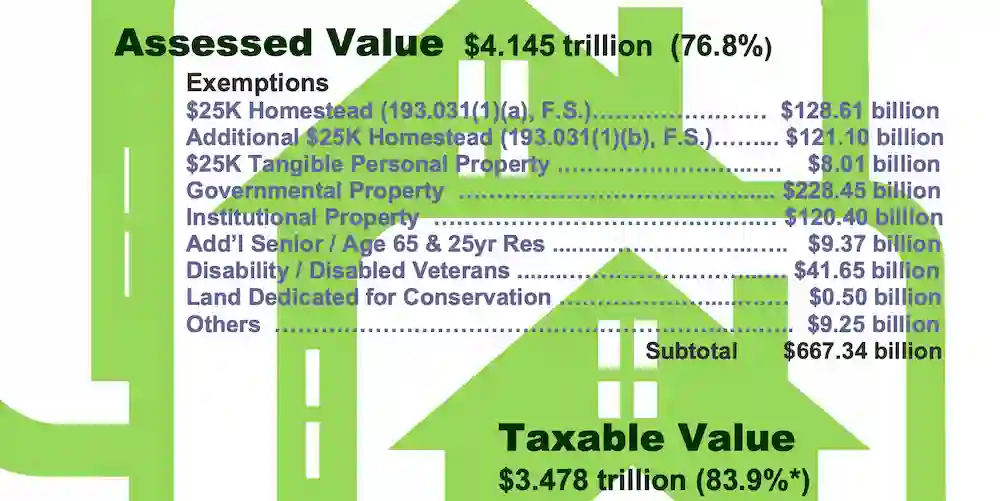
We estimate this taking the percentage of property taxes paid by homesteaded properties (approximately 30-35% of total collections) and applying it to the $55 billion total, resulting in an estimated $20 billion annual revenue loss for local governments. The figure below shows the percentages paid for the 2024-2025 fiscal year.
How it works: A constitutional amendment would prohibit local governments from levying property taxes on any homesteaded property, regardless of value. Whether your home is worth $200,000 or $2 million, you'd pay nothing in property taxes.
The Appeal
Maximum benefit for homeowners, easy to understand, and politically popular.
The Challenge
Requires replacing the largest share of lost revenue - potentially $20 billion annually from homestead properties alone.

Option 2: Massive Homestead Exemption Increase — The Approach That Won
This is the approach HJR 1F takes. Instead of complete elimination in one step, the exemption increases dramatically — to $150,000 in 2027 and $250,000 in 2028 — eliminating non-school property taxes for most middle-class homeowners while keeping higher-value properties partially on the tax rolls. The amendment then directs the Legislature, through general law, to develop a schedule for full elimination. Our earlier analysis below modeled larger hypothetical exemptions ($500K–$1M) to estimate what the eventual phase-out could cost the state.
If we assume the homestead exemption is increased to $1 million we can compare this to the figures below for the amount of assessed value that is currently shielded by the homestead exemption. In 2025 this was $128.6b + $121.1b = $249.7 billion of exempted value. Dividing by the roughly $50,000 exemption per home, this implies around 4.9 million Florida homes benefit from homestead.
Using statistical analysis applying the $1 million homestead exemption gives us a rough estimate of a $16-18 billion annual tax revenue loss - very similar to Option 1.
$500,000 Exemption Example
- $400,000 home: $0 property tax
- $600,000 home: Pay taxes on $100,000 only
- $800,000 home: Pay taxes on $300,000 only
$1 Million Exemption Example
- $800,000 home: $0 property tax
- $1.2M home: Pay taxes on $200,000 only
- $1.5M home: Pay taxes on $500,000 only
The Appeal
Protects middle-class homeowners while maintaining some revenue from high-value properties.
The Challenge
More complex to calculate and still requires significant revenue replacement.
Did You Know?
10.5% annual growth vs. ~4.5% average inflation over the same period
While some of the increase is due to new properties being taxable, the major shift has been rising property values creating massive unrealized capital gains that have fed into assessed values and property taxes.
Source: Florida Department of Revenue
Additional: Efficiency and Loophole closures
In our investigations, Property Exemption has identified multiple instances where homeowners are needlessly overpaying property taxes, whether due to forgetfulness, complex guidelines, clerical errors, or outdated portability mechanisms.
For example, our analysis examined payment records of the top 20 counties and statistically found over $500 million could have been saved if homeowners simply took full advantage of the 4% early payment discount.
Some potential fixes:
- Provide an additional alert to a homeowner if the tax collector sees a property tax bill has not been paid by the last week of November
- Create better digital systems to identify more exemptions and benefits a homeowner can qualify for - i.e. put more responsibility on the County to better inform homeowners
- Close inefficiencies, such as denying the Save Our Homes Benefit transfer until the next full year of ownership. Example: If you purchase and move into a new home in March 2025, you will not be able to benefit from SOH portability until 2026. So in the year of purchase you are potentially paying an inflated property tax payment.
Will you vote YES on HJR 1F in November?
The Florida Legislature passed HJR 1F on June 2, 2026 (House 75–26, Senate 30–9). The amendment now goes to Florida voters on November 3 — 60% approval required to ratify. Where do you stand?
Anonymous · one vote per browser.
The Seven House Proposals: How the Regular Session Failed (History)
Before HJR 1F, there were seven. On October 16, 2025, House Speaker Daniel Perez released a memorandum outlining seven constitutional amendment proposals, each targeting non-school property taxes, arguing voters should be able to "choose some, all, or none of the proposals on the 2026 ballot." Only HJR 203 passed the House — and the Senate let it die. That failure is what forced the Governor's hand: rather than waiting for the chambers to reconcile, DeSantis wrote his own plan and called a special session to vote on it. The breakdown below is preserved for the record.
| Proposal | What it did | Est. impact | Outcome |
|---|---|---|---|
| HJR 203 | Phase out non-school homestead taxes over 10 years | $14.1B/yr (after 10-yr phase-in) | Passed House 80-30, died in Senate |
| HJR 201 | Immediate full elimination of non-school homestead taxes | $14.1B/yr | Stalled in committee |
| HJR 209 | $200K bonus exemption for insured homes | ~$8B/yr | Died on calendar |
| HJR 205 | Eliminate non-school taxes for seniors 65+ | ~$5B/yr | Stalled in committee |
| HJR 207 | Exempt 25% of every homestead's value | ~$3.5B/yr | Did not advance |
| HJR 211 | Unlimited Save Our Homes portability | Not scored | Stalled in committee |
| HJR 213 | Slow assessment growth with multi-year caps | Not scored | Died on calendar |
Impact estimates based on Florida Policy Institute analysis and state economist projections. Only HJR 203 received a House floor vote.
"Placing more than one property tax measure on the ballot represents an attempt to kill anything on property taxes. It's a political game, not a serious attempt to get it done for the people."
— Governor Ron DeSantis, October 2025 Twitter Post
Governor DeSantis's concerns about multiple ballot measures proved well-founded — but the outcome was different from what anyone expected. Rather than voters facing a confusing menu of options, the House ultimately brought only HJR 203 to the floor, where it passed 80-30, only for the Senate to let it die. The resolution came in late May 2026: DeSantis stopped waiting for the chambers to produce their own plan and wrote one himself — HJR 1F, the single unified proposal now being voted on in the special session.
Important Note: All seven proposals preserve school property taxes and only eliminate or reduce non-school taxes levied by counties, cities, special districts, and water management districts. School taxes make up approximately 40% of the average Florida property tax bill. All proposals include language prohibiting reductions in local law enforcement funding.
Read the full breakdown of all seven proposals Sponsors, mechanics, fiscal impact, and our analysis of each — preserved for the record
HJR 201: Complete Elimination of Non-School Homestead Taxes
STALLED — Passed State Affairs Committee (December 2025) | Did not advance from Ways & Means CommitteeSponsor: Rep. Kevin Steele (R-Dade City)
Potential Impact: This is the most aggressive proposal, eliminating all non-school property taxes for homesteaded properties effective January 1, 2027. Homeowners would still pay school taxes (approximately 39% of current bills) but nothing for county, city, or special district services. The fiscal impact would be substantial - state economists estimate $14.1 billion annually in lost non-school local government revenue that would need replacement through state funding mechanisms or alternative revenue sources. Property owners with non-homestead properties (vacation homes, rentals, commercial) could face increased rates to offset this loss.
This proposal most closely matches rhetoric from Governor Desantis albeit now more focused in terms of target homes: Homesteaded; and what taxes to remove: All Non-School board; Although now we have a clearer picture of the estimated fiscal impact, it remains a massive challenge to replace this lost revenue for local governments on such short notice.
In addition, it is important to consider how non homestead owners (those of whom are entitled to vote) and renters will vote on property tax reform. If a proposal is too extreme and it is very obvious the bill is negative for their status quo then the likelihood of this voter base voting positively diminishes greatly.
HJR 203: Phased Elimination Over 10 Years
PASSED HOUSE 80-30 (Feb 19, 2026) | Died in Senate (Mar 13) | Superseded by HJR 1FSponsor: Rep. Monique Miller (R-Palm Bay)
Potential Impact: This proposal takes a gradual approach, increasing the homestead exemption by $100,000 annually for ten years, reaching complete elimination of non-school taxes by January 1, 2037. For a homeowner with a $400,000 assessed value, they'd see incremental savings growing each year - potentially $1,000-1,500 in year one, increasing annually until reaching full elimination of non-school taxes in year ten. The phased approach spreads the revenue impact over a decade, giving local governments and the state time to develop alternative revenue sources and adjust spending.
This is essentially the same as previous proposal HJR 201 but using a longer time frame to make this more palatable for local government. On paper it seems like an easier sell but will still face the similar voter challenges as HJR 201.
HJR 205: Senior Citizen Exemption (Age 65+)
STALLED — Passed State Affairs Committee (December 2025) | Did not advance from Ways & Means CommitteeSponsor: Rep. Juan Carlos Porras (R-Miami)
Potential Impact: This targeted proposal eliminates non-school homestead taxes only for Florida residents age 65 and older, effective January 1, 2027. With approximately 4.7 million Floridians over 65 (about 22% of the population) and an estimated 1.5-2 million homesteaded properties owned by seniors, the fiscal impact would be significantly smaller - estimated in the high single digit billions. This directly addresses concerns about seniors on fixed incomes being priced out by rising property taxes while maintaining revenue from working-age homeowners.
In an ideal altruistic society this would seem to be a very good option. From our experience seniors have the highest struggles with property taxes as well as the greatest desire to "age in place". Almost all are in retirement on fixed incomes and rising property taxes are derailing what should be some of their best years. The hurdle this proposal will face is potential self interest - why should a younger voter pay to subsidize the well being of a senior citizen?
Our view is this issue can and should have already been dealt with via more senior focused exemptions and benefits coupled with enthusiasm from local governments to implement. The fact this idea is going to a potential constitutional vote shows how little progress has been made in this area to date.
HJR 207: 25% Assessed Value Exemption
STATUS: Did not advance from State Affairs CommitteeSponsor: Rep. Shane Abbott (R-DeFuniak Springs)
Potential Impact: This proposal replaces the current $51,411 homestead exemption with a percentage-based system - 25% of assessed value for non-school taxes, effective January 1, 2027. A $400,000 home would receive a $100,000 exemption (saving roughly $1,000-1,500 annually on non-school taxes), while a $1 million home would get a $250,000 exemption (saving $2,000-3,500). This scales benefits with home values, providing proportionally larger dollar savings to higher-value properties.
This proposal is very simple to understand for voters. Essentially 75% of your property will be taxable while 25% will have a persistent tax shield on it. The benefit of this proposal is the tax reduction is directly correlated 1:1 with your property's assessed value; or to think of it another way it is a homestead exemption that rises in lock step with your property value.
HJR 209: Insurance-Linked Exemption ($200,000 Bonus)
DIED ON SECOND READING CALENDAR (Mar 13, 2026) — Cleared all committees but never received a House floor vote before the regular session endedSponsor: Rep. Demi Busatta (R-Coral Gables)
Potential Impact: This proposal provides an additional $200,000 exemption against non-school taxes for any homestead covered by comprehensive multiperil property insurance, effective January 1, 2027. The idea of this approach is it addresses Florida's property insurance crisis by incentivizing homeowners to maintain coverage - a major concern given recent carrier exits and skyrocketing premiums. Specific insurance requirements would be determined by general law, allowing flexibility in defining "comprehensive multiperil" coverage.
The idea of adding an additional $200,000 to the homestead exemption is clear. The insurance requirement most likely is a way to use tax incentives to nudge homeowners toward maintaining coverage, thereby protecting both themselves and Florida's fiscal health. Could this proposal be too much of a stick and not enough of a carrot for poorer households? With home insurance policies running into the thousands if not more, does a c.$2,000 - $3,200 saving in property taxes really incentivize poorer homeowners to get insured?
HJR 211: Unlimited Save Our Homes Portability
STALLED — Passed State Affairs Committee (December 2025) | Did not advance from Ways & Means CommitteeSponsor: Rep. Toby Overdorf (R-Palm City)
Potential Impact: This proposal removes the current $500,000 cap on Save Our Homes portability for non-school taxes (school tax portability would remain capped at $500,000), effective January 1, 2027. Currently, homeowners who've accumulated substantial SOH benefits on long-owned properties can only transfer $500,000 of that benefit when moving. This particularly affects South Florida homeowners with properties that have grown dramatically in value. Removing the cap would allow full portability - if you've accumulated $800,000 in SOH benefits on your current home, you could transfer the entire amount to your next Florida home. The fiscal impact is harder to quantify but it encourages more transactions and prevents tax resets when seniors downsize.
The $500,000 SOH cap that has existed since 2008 may now seem insufficient considering the run up in property prices in the past five years. A total elimination on the $500,000 may not even be necessary with a $1,000,000 cap potentially sufficient to cover the vast majority of households that would benefit most.
Although this proposal does not immediately eliminate any taxes on your tax bill it is still a highly important one for future life planning that we see as warranting good attention on.
HJR 213: Modified Assessment Increase Caps
DIED ON SECOND READING CALENDAR (Mar 13, 2026) — Cleared all committees but never received a House floor vote before the regular session endedSponsor: Rep. Griff Griffitts (R-Panama City Beach)
Potential Impact: This complex proposal restructures Save Our Homes caps differently for school versus non-school taxes, effective January 1, 2027. For homestead properties: school taxes continue with annual 3% or CPI caps, but non-school tax assessments would be done every three years with a maximum 3% or CPI increase over that three-year period. For non-homestead properties: school taxes remain fully taxable at market value, but non-school assessments would occur every three years with a 15% maximum increase over three years (versus current 10% annually). This essentially slows assessment growth for non-school taxes while maintaining current protections for school funding.
Once again this proposal is focused on future life planning for homeowners. It has its merits in further limiting future property tax increases and warrants more attention however lacks any near term relief that many homeowners are desperate for.
How the Seven Proposals Ended
HJR 203 passed the Florida House 80-30 on February 19, 2026 — the only property tax proposal to receive a floor vote. HJR 209 and HJR 213 cleared all committees but died on the Second Reading Calendar without floor votes. HJR 201, 205, and 211 stalled before the Ways and Means Committee. Only HJR 207 did not advance from State Affairs.
HJR 203 then died in the Senate Appropriations Committee when the regular session ended March 13, 2026 without a hearing. Appropriations Chair Ed Hooper's rural-county concern — "There's 67 totally different counties in this state, and a property tax issue that is great for one county could crush 31 poor counties" — became the defining objection.
HJR 1F answers it directly: the Governor's plan includes a state trust fund specifically designed to backfill rural counties with small tax bases, which is a major reason Senate President Albritton endorsed it. The seven House proposals are now history; HJR 1F is the plan Florida voters will decide on November 3.
Timeline: What Happens When
Understanding the timeline for Florida's property tax overhaul is crucial for homeowners. This isn't happening overnight - but for the first time, every milestone between now and a smaller tax bill has a date attached to it.
The first change would hit your 2027 tax bill: a $150,000 exemption, rising to $250,000 in 2028. Here's what needs to happen and when.
Key Milestones for Property Tax Elimination
House Select Committee Report
37-member bipartisan committee studied revenue impacts, gathered stakeholder input, and published final recommendations. Governor DeSantis pushed for full elimination; House Speaker Perez preferred giving voters multiple options.
House Committee Passage
State Affairs Committee approved 5 of 7 proposals (HJR 201, 203, 205, 209, 211). HJR 207 did not advance. HJR 209 also cleared Ways & Means in December.
HJR 203 Passes the House 80-30
Party-line vote. The only property tax proposal to receive a floor vote. HJR 209 and 213 were on the Second Reading Calendar but never brought to the floor. HJR 201, 205, and 211 stalled before Ways & Means.
HJR 1F Passes Both Chambers
Governor DeSantis called the special session on May 27 and unveiled the "Save Our Homes from Excessive Property Taxes" amendment (HJR 1F) with implementation bill HB 3F. On June 1, the House amended it to protect school district levies. On June 2, both chambers passed it: House 75–26 at 12:29 PM, Senate 30–9 at 12:57 PM. Three Senate Democrats crossed over (Bernard, Rouson, Sharief) and two Republicans voted against (Boyles, Maney). The amendment now goes on the November 3, 2026 statewide ballot.
The Campaign
HB 3F requires property appraisers to mail every property owner a notice explaining the amendment and the state to launch a savings-estimate website. Expect an expensive, contentious campaign: homeowner and taxpayer groups pushing for passage; local government associations, education organizations, and public safety unions warning about service cuts.
Voter Approval (60% required)
Florida voters would need to approve the amendment with a 60% supermajority. For context, no presidential candidate has achieved 60% in Florida in modern history. Amendment 4 (abortion rights) in 2024 received 57% but failed to meet this threshold. Polling on property tax relief, however, consistently shows broad bipartisan support.
Implementation Begins
The homestead exemption rises to $150,000 for the 2027 tax year, then $250,000 in 2028 and beyond, indexed to inflation. The amendment directs the Legislature to develop, through general law, a schedule for full elimination of homestead property taxes — no specific future dollar amount or end-date is set in the amendment itself. The state trust fund for local governments activates, and local budgets begin restructuring.
2025: The Study Phase (Complete)
The Florida House Select Committee on Property Taxes met throughout 2025, with key sessions in September and October. The 37-member bipartisan committee gathered input from homeowners, local governments, businesses, and other stakeholders and presented its final recommendations, which led to seven formal proposals.
The committee's work shaped the proposals that were voted on during the 2026 session. Ultimately, HJR 203 — a phased 10-year elimination of non-school homestead taxes — was the only proposal to pass the House floor.
2026: The Political Gauntlet
The 2026 regular session revealed a clear divide between the House and the Senate/Governor on property tax reform. House Speaker Daniel Perez pushed HJR 203 through the House 80-30 on February 19, but the Senate let it die without a hearing. Governor DeSantis, who once championed immediate full elimination, urged patience — posting on February 19 that "it's better to do it right than do it quick." That standoff broke on May 27, when DeSantis unveiled his own plan (HJR 1F) and Senate President Albritton immediately endorsed it. For the first time, all three power centers in Tallahassee are behind the same proposal.
"We don't want to wait on promises or generalities. We want to see real numbers and understand the impact on budgets."
— House Speaker Daniel Perez, on the need for detailed analysis before proceeding
"I fully expect us to have something on the ballot for our constituents to eventually vote on. I do expect it to be one proposal for them to vote on."
Perez added that it is "somewhat still up in the air" what final proposal will emerge from the multiple bills under consideration. Update: Perez subsequently pushed HJR 203 through the House 80-30 on February 19, 2026.
— House Speaker Daniel Perez, January 2026
Now that HJR 1F has passed both chambers, the real campaign begins. Expect intense lobbying from both sides — homeowner groups and taxpayer advocates pushing for passage, while local government associations, education organizations, and public safety unions oppose it. The Florida Association of Counties has already warned the plan is "a tax shift" that "makes Florida more unaffordable," and the Florida Policy Institute estimates the $250,000 exemption alone would cost counties roughly $4.8 billion per year. The Florida League of Cities warns there is no dedicated revenue source backing the proposed trust fund: "trust funds, when there are recessions, get raided first."
The ballot language itself will be crucial. Constitutional amendments must be clearly worded, and the phrasing can significantly influence voter behavior. Notably, HB 3F creates an exception to Florida's usual 75-word limit for ballot summaries — a sign lawmakers expect this measure to need careful explanation.
The Fallback: A 2028 Citizen-Led Amendment
If HJR 1F fails at the ballot box in November, the debate doesn't end. Rep. Ryan Chamberlin, R-Belleview, is organizing a citizen-led constitutional amendment for the 2028 ballot that targets all property taxes, not just the homestead portion. Citizen-led amendments face a higher bar — tightened signature-verification rules resulted in zero citizen amendments qualifying for the 2026 ballot — but a 2028 effort would land on a presidential-election turnout cycle, which can meaningfully affect outcomes.
November 2026: Decision Day
Florida voters face a historic choice on November 3, 2026. The 60% approval threshold is deliberately high — it's designed to ensure only amendments with overwhelming public support become part of the state constitution. Property tax relief polls well across party lines, but the opposition campaign will focus voters on what the money pays for: police, fire, roads, and parks.
If It Passes (60%+ approval)
Constitutional amendment becomes law
Implementation begins for 2027 tax year
State must activate revenue replacement plans
Local governments begin budget adjustments
If It Fails (under 60%)
Property taxes continue as normal
Legislature may consider smaller reforms
Possible revised proposal in future sessions
Focus shifts to incremental changes
The campaign leading up to the vote will likely be expensive and contentious. Both sides will present compelling arguments about the future of Florida's tax structure and public services.
2027 and Beyond: Implementation Challenges
If voters ratify HJR 1F on November 3, the real work begins. (Note: HJR 1F does not eliminate property taxes immediately — it raises the homestead exemption to $250,000 by 2028 and directs the Legislature to develop a schedule for full elimination through general law.) The state will need to implement whatever revenue replacement mechanism was included in the amendment or approved separately by the Legislature.
According to Tax Foundation analysis, major tax restructuring typically requires 2-3 years to fully implement. HJR 1F's own phase-in is built into the amendment text: $150,000 exemption in 2027, $250,000 in 2028, then a Legislature-developed schedule for full elimination through general law.
Local governments would need to dramatically restructure their budgets, potentially leading to service changes, employee layoffs, or new funding mechanisms. The transition period will be crucial for maintaining essential services while adapting to the new fiscal reality.
How Would Florida Pay for Services?Now Outdated
This is the question that makes or breaks Florida's property tax elimination plan. Florida's property taxes don't just disappear into thin air - they fund schools, police, fire departments, roads, and countless other services that keep communities running. So where would that money come from instead?
HJR 1F gives a partial answer: a state trust fund to backfill rural counties, plus restrictions that force remaining property tax revenue toward core services. But critics note the trust fund's size and funding source are unspecified, and the long-term mandate to eliminate homestead taxes entirely revives the full $20+ billion question. Below we examine the replacement options that have been discussed and their real-world implications for Florida families.
Where Your Property Taxes Go Today
2024 Florida ad valorem revenue: $55.2 billion across four categories
School Districts
Largest sharePublic schools receive the largest single share through the state-mandated "Required Local Effort" plus discretionary millage set by school boards.
Annual funding
Share of ad valorem
School districts
Alternative Revenue Sources
Florida leaders have floated several creative alternatives to sales tax increases, though none would likely generate enough revenue on their own to replace property taxes entirely.
"Entry Fees" for New Residents
Charging newcomers a one-time fee when establishing Florida residency.
Expanded Tourist Taxes
Higher hotel, rental car, and attraction taxes could generate several billion annually.
Business Tax Increases
Higher taxes on commercial properties, corporate income, or business transactions.
State Budget Surplus
DeSantis's stated plan: use budget surpluses and a state trust fund to backfill local governments, with rural counties prioritized.
"When you eliminate property taxes, it's obviously gonna benefit a lot of people that really didn't need that benefit, while the burden is going to fall on those with more limited means."
— Real estate broker Budge Huskey, Fox Business interview
State Funding for Local Governments
Rather than finding new revenue sources, Florida could redirect existing state taxes to local governments. This approach would essentially make cities, counties, and school districts dependent on state funding rather than local property taxes.
Potential Benefits
Could equalize funding across rich/poor areas
Centralized budget planning
No immediate tax increases needed
Major Risks
Local governments lose autonomy
State budget constraints affect everyone
Political decisions override local needs
This approach has worked in some states for school funding, but applying it to all local services would be unprecedented. Critics worry about turning vibrant local communities into administrative districts dependent on Tallahassee's political priorities.
The Bottom Line: Math Matters
Every economic analysis reaches the same conclusion: there's no magic solution that eliminates property taxes without significant trade-offs. Whether through higher sales taxes, new revenue sources, or increased state control, Floridians will pay for government services one way or another.
The question isn't whether Florida can afford to eliminate property taxes — it's whether the replacement system will be better, worse, or just different than what exists today. That's what Florida voters will decide on November 3, 2026.
The Case For and Against
Florida's property tax elimination debate has created passionate advocates on both sides. Supporters see historic tax relief and economic opportunity, while critics warn of unintended consequences that could undermine the very services that make Florida attractive.
Why Supporters Love the Plan
For many Florida homeowners, the appeal is straightforward: thousands of dollars back in their pockets every year. Property tax elimination would make Florida the only state with neither income tax nor property tax on primary residences, creating an unprecedented competitive advantage.
"[The Governor's approach] will provide meaningful relief for Florida families, while protecting businesses from extreme tax increases and safeguarding local funding for public safety, education and our clean water infrastructure."
— Senate President Ben Albritton, memo to senators, May 2026
Beyond personal savings, supporters argue the plan would supercharge Florida's economy. Real estate professionals expect a "huge boom" in home sales and construction as people rush to take advantage of tax-free homeownership. The appeal is obvious: "Why wouldn't you want to move here at that point?"
Governor DeSantis frames this as "Florida First" tax relief - money that stays with residents rather than benefiting tourists through sales tax cuts. Supporters also argue that forcing local governments to operate with less revenue would eliminate waste and improve efficiency, similar to how businesses must adapt when facing budget constraints.
What Critics Are Warning About
Opponents don't question whether homeowners would benefit - they question whether the trade-offs are worth it. Their primary concern is that eliminating property taxes shifts the burden to regressive sales taxes that hit working families harder than wealthy homeowners.
"We know this is a tax shift. They're framing this as a tax cut, but there are small businesses, all businesses, they're going to feel the pain. Renters — they're not going to get an exemption. This proposal makes Florida more unaffordable."
— Jeff Scala, Deputy Director, Florida Association of Counties, June 1, 2026
Critics point to the math: wealthy homeowners with expensive properties would save the most in absolute dollars, while everyone would pay higher sales taxes. A Naples homeowner saving $15,000 annually in property taxes benefits more than a rural homeowner saving $3,000, but both face the same higher sales tax rates.
Local government officials worry about losing control over their own budgets and becoming dependent on state funding that could fluctuate with political winds. According to Florida Policy Institute analysis, this could weaken local democracy and make communities vulnerable to Tallahassee's budget priorities rather than local needs.
Supporters' Strongest Arguments
Direct savings: Thousands of dollars annually back to homeowners
Unique advantage: Only state with no income + no property tax
Economic boom: Massive migration and investment influx
Government efficiency: Forces elimination of wasteful spending
Resident-focused: Benefits Floridians over tourists
Critics' Major Concerns
Regressive burden: Sales tax hits lower-income families hardest
Service cuts: Schools, police, and infrastructure could suffer
Wealthy benefit most: Higher-value homes save more in absolute dollars
Local control lost: Communities become dependent on state funding
Implementation risk: No detailed plan for revenue replacement
The Political Reality
Despite the concerns, property tax elimination polls well with voters who see immediate, tangible benefits. The complexity of revenue replacement and potential service impacts are harder to grasp than the simple appeal of eliminating a major annual expense.
This political dynamic creates a challenge for opponents: explaining why homeowners shouldn't want to eliminate a tax they hate paying. Meanwhile, supporters can point to concrete savings while dismissing implementation concerns as solvable details.
The debate ultimately comes down to competing visions of Florida's future. Supporters envision a tax-free haven that attracts unprecedented growth and prosperity. Critics worry about sacrificing the public investments that made Florida attractive in the first place - quality schools, safe communities, and well-maintained infrastructure.
The Bottom Line
Both sides make valid points. Property tax elimination would provide real financial relief to homeowners and could boost Florida's economy. But the revenue must come from somewhere, and the replacement system could create new problems while solving old ones. The question for voters in 2026 will be whether the benefits outweigh the risks — and whether they trust state leaders to implement the change responsibly.
Your Action Steps as a Homeowner
While Florida debates this historic change, you don't have to sit on the sidelines. Here's how to stay informed, make your voice heard, and protect your interests regardless of what happens with property tax elimination.
Stay Informed on the Process
HJR 1F passed both chambers on June 2, 2026 and now goes to Florida voters on November 3. Under HB 3F, property appraisers will mail every owner an explanation of the amendment along with the August TRIM notice, and the state will publish an estimator website. Follow the process through the official sources below.
Official Sources
Key Dates
Committee recommendations released
HJR 203 passes House 80-30
Regular session ended (HJR 203 died)
Special session — redistricting only (property tax not included)
DeSantis unveils HJR 1F, calls special session
HJR 1F passed both chambers (House 75–26, Senate 30–9)
Voter decision day — 60% required to ratify
Make Your Voice HeardNow Outdated
Your representatives need to hear from constituents about this issue. Whether you support or oppose property tax elimination, letting them know your position helps shape their decision-making.
Contact Your Representatives
Find Your Legislators:
- • Find Your House Rep
- • Find Your Senator
- • Attend town halls and public meetings
What to Include:
- • Your position on property tax elimination
- • How it would affect your family personally
- • Concerns about implementation details
Prepare for 2026 Decision
The constitutional amendment is on the November 3, 2026 ballot. You'll need to make an informed decision. Start preparing now by understanding how different scenarios would affect your specific situation.
Research the Details
Read the actual ballot language carefully
Understand implementation timeline
Calculate your personal financial impact
Consider effects on your community services
Ask the Hard Questions
How exactly will lost revenue be replaced?
What happens to school funding quality?
Will local services be maintained?
Can the plan be reversed if it doesn't work?
Protect Yourself in the Meantime
Regardless of what happens with elimination, make sure you're not overpaying property taxes right now. Many homeowners miss exemptions or fail to challenge incorrect assessments.
Immediate Actions You Can Take
Review Your Current Exemptions and Benefits: Check Here
Ensure you're receiving homestead, senior, veteran, or other applicable exemptions
Check Your Property Assessment
If your home's assessed value seems too high, you may be able to appeal. Learn more in our complete guide to property tax appeals
Plan Your Finances
Don't count on elimination happening - budget assuming current tax levels continue. Our capital gains calculator can help with financial planning decisions
Stay Educated
Follow reliable news sources and avoid social media misinformation about the proposal
Monitor your property automatically: Check Here
Signup for free to have a second pair of eyes look out for your property finances
Selling or moving? Your biggest tax benefit is on the line.
Most Florida homeowners have tens of thousands of dollars in Save Our Homes protection — and lose it by accident when they move. Check what yours is worth and what happens to it if you sell.
Frequently Asked Questions
Here are the most common questions Florida homeowners ask about property tax elimination, with clear, factual answers based on what we know about the proposals under consideration.
The Florida Legislature passed HJR 1F on June 2, 2026 (House 75-26, Senate 30-9). If voters approve the amendment by 60% on November 3, 2026, the homestead exemption rises to $150,000 of assessed value starting with the 2027 tax year, then $250,000 in 2028 and beyond, adjusted for inflation. The exemption applies to non-school property taxes only. You will still pay property taxes on your 2026 tax bill regardless of the outcome.
Yes. During the June 2026 special session, lawmakers amended HJR 1F so the new homestead exemptions do not apply to school district levies. School taxes typically make up roughly 40% of a Florida property tax bill, so even homeowners whose assessed value falls entirely under the $250,000 exemption would continue to pay the school portion of their bill.
For most homeowners, the new $250,000 exemption would dwarf existing exemptions like the veteran disability, senior, and widow exemptions on the non-school portion of the bill. Those exemptions would still matter for the school portion of your taxes, which the new exemption does not touch, and they would still apply if your assessed value exceeds the new exemption amount.
Yes. HJR 1F only expands the exemption for homesteaded properties - your primary residence where you live and file homestead exemption. Vacation homes, second homes, rental properties, commercial real estate, and vacant land remain fully taxable. The proposal does include one benefit for them: the annual assessment increase cap on non-homestead property would drop from 10% to 5%. One more catch: anyone who establishes Florida residency after January 1, 2027 gets only the current $50,000 exemption for their first five years as a resident before qualifying for the full amount.
Reversing a constitutional amendment is extremely difficult and would require another constitutional amendment approved by 60% of voters. Once property tax elimination is embedded in Florida's constitution, bringing back property taxes would be a major political and legal undertaking. This is why many critics emphasize the importance of getting the policy right the first time.
The new exemption is statewide and follows the homestead, so you would receive it on any new primary residence once you establish homestead exemption there. Your Save Our Homes assessment cap and its portability rules also remain in place, so transferring your accumulated Save Our Homes benefit when you move still matters - especially for the school portion of your taxes, which the new exemption does not cover.
Property tax elimination would likely increase home values, as the annual cost of ownership decreases. However, this could be partially offset by higher sales taxes and potential service cuts. The overall effect depends on how buyers weigh ongoing tax savings against other costs and quality-of-life factors in their purchasing decisions.
Probably not. If you already have homestead exemption, you would receive the larger exemption automatically. The implementation bill, HB 3F, requires property appraisers to send every property owner a notice explaining the amendment (with the August TRIM notice) and requires the state to publish a public website where you can estimate your savings. Property appraisers will provide specific guidance closer to the effective date.
HJR 1F establishes a state trust fund to provide grants to local governments - primarily rural counties with small tax bases - to help maintain core services. Per Section 9 of the amendment, remaining county and city ad valorem revenue may be used only for seven categories: public safety, education and public schools, infrastructure (including roads, bridges, and stormwater), natural resource projects (including flood control), local bonds and debt-service payments on existing obligations, retirement benefits for local-government employees, and operations and administration of county and municipal government. Items like libraries, parks, and senior centers are notably not on the list. Critics note the trust fund's size and funding source have not been specified, and the Hillsborough County Property Appraiser projects local taxing authorities there would lose a combined $725 million within two years.
Every situation is unique. We're here to help with personalized guidance.
(929) 433-6766 • customer@propertyexemption.com
Serving all Florida counties including Miami-Dade, Broward, Orange, Hillsborough, Pinellas, Palm Beach, Duval, and beyond
Share this guide
