
The short version: a take-out letter (officially called a Policyholder Notice) is Florida's mechanism for moving you from the state-run Citizens Property Insurance Corporation to a private insurer that has volunteered to take your policy. The decision is governed by Fla. Stat. §627.351(6) and Citizens' own Depopulation Plan, and the math that decides whether you can stay on Citizens or must accept a private offer is the "20% rule." In 2025, only about 3.5% of take-out offers exceeded the 20% threshold — meaning the rule pushed roughly 96.5% of policyholders off Citizens whether they wanted to leave or not. The rest of this guide explains why, what the letter says, and what to actually do.
What a Take-Out Letter Is — and Why You Got One
Citizens Property Insurance Corporation is Florida's statutory insurer of last resort. Its enabling statute, Fla. Stat. §627.351(6)(a)(2), says explicitly that Citizens "shall provide insurance for residential and commercial property, for applicants who are entitled, but, in good faith, are unable to procure insurance through the voluntary market." In other words: Citizens is for people who can't get coverage anywhere else. When a private insurer is willing to take a policy from Citizens, the state's policy framework is to push the policy out into the private market.
Two statutes do that work. Fla. Stat. §627.3511 governs the Depopulation Program directly, including a per-risk bonus of up to $100 that Citizens pays the assuming insurer for each policy removed. Fla. Stat. §627.3518 establishes the Property Insurance Clearinghouse "as an organizational unit within the corporation" whose purpose is to "facilitate the diversion of ineligible applicants and existing policyholders from the corporation into the voluntary insurance market." Together they give Citizens both a process for matching its policies with private insurers and a mechanism for funneling new applicants away from Citizens before they ever get a Citizens policy.
The take-out letter is the operative document. Per Citizens' own depopulation page, an assumption "is a process by which Citizens transfers its rights, title and interest in your policy to a participating insurance company, on a specific date." That date is the Assumption Date. The letter itself is the Policyholder Notice, and it must arrive at your house at least 30 days before that Assumption Date.
You did not request the take-out. Citizens did not select your policy because of anything you did. The Florida Office of Insurance Regulation (OIR) approves which insurers can assume which policies under a consent order, and Citizens matches eligible policies to participating insurers based on the insurer's filing. The letter is, in effect, the state telling you the private market is willing to insure your home.
The 20% Rule: The Single Most Important Thing to Understand
The decision the letter forces is governed by Fla. Stat. §627.351(6)(c)5. The statute reads (the rule applies both to new applications and, since April 1, 2023, to renewals):
"With respect to personal lines residential risks that are primary residences, if the risk is offered coverage from an authorized insurer at the insurer's approved rate… the risk is not eligible for any policy issued by the corporation unless the premium for coverage from the authorized insurer is more than 20 percent greater than the premium for comparable coverage from the corporation."
"For policies that renew on or after [April 1, 2023], the risk is not eligible for coverage with the corporation unless the premium for coverage from the authorized insurer is more than 20 percent greater than the corporation's renewal premium for comparable coverage."
The threshold was raised from 15% to 20% by SB 2-A in the December 2022 Special Session and has been in effect at renewal since April 1, 2023. Citizens' own depopulation page summarizes the rule in plain English: policies receiving offers "not more than 20% greater than Citizens' estimated renewal premium are no longer eligible to remain with Citizens." Only offers more than 20% greater preserve the homeowner's right to stay.
The rule produces a counter-intuitive result for most homeowners. The cheaper the private offer, the less choice you have:
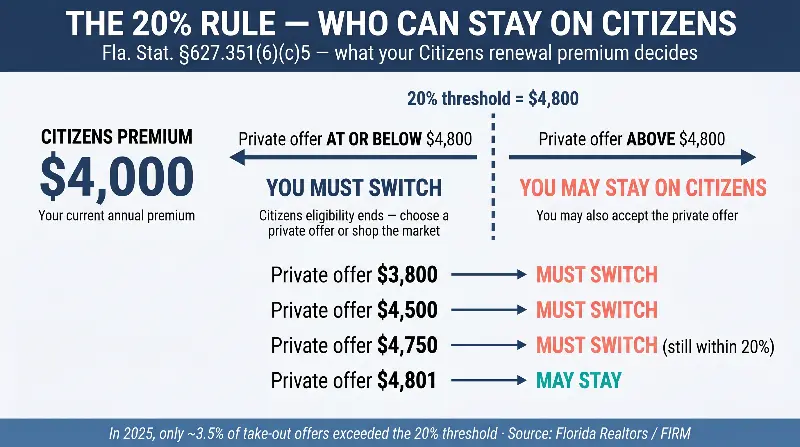
| Citizens renewal premium | Highest private take-out offer | Ratio | Eligible for Citizens? |
|---|---|---|---|
| $4,000 | $3,800 | 0.95× | No — must accept private |
| $4,000 | $4,500 | 1.13× | No — must accept private (within 20%) |
| $4,000 | $4,750 | 1.19× | No — still within 20% |
| $4,000 | $4,801 | 1.2003× | Yes — offer is more than 20% above, may stay on Citizens |
| $4,000 | $5,500 | 1.375× | Yes — can stay on Citizens or accept private |
The threshold is calculated against the "comparable coverage" benchmark, which means the comparison strips out coverage differences (a higher deductible, different sub-limits) before applying the 20% test. In practice, most take-out offers come in at or near Citizens' premium because the depopulation program was designed precisely to move policies that the private market is willing to write competitively. According to data reported by Florida Realtors and the FIRM (Floridians for Insurance Reform) advocacy group covering January through October 2025, only 14,732 of 416,233 take-out offers (about 3.5%) exceeded the 20% threshold. The other 96.5% were "must-switch" offers.
Selling or moving? Your biggest tax benefit is on the line.
Most Florida homeowners have tens of thousands of dollars in Save Our Homes protection — and lose it by accident when they move. Check what yours is worth and what happens to it if you sell.
The 30-Day Policyholder Notice and Your Options
The Policyholder Notice is not optional reading. Per the Citizens Depopulation Plan (as amended July 9, 2024), the notice must reach you no later than 30 days before the Assumption Date and must contain three items required by §627.351(6):
- The estimated premium the assuming insurer would charge.
- A description of the coverage being offered.
- A side-by-side comparison of the assuming insurer's premium and coverage to Citizens' premium and coverage.
Accompanying the notice is an Offer Form that lists each Assumption Offer from each approved insurer (there can be more than one). The form has a deadline, also at least 30 days from when the notice was sent. You have three substantive options, plus one default:
Option 1: Accept an Assumption Offer. Pick one of the private insurers offering to take your policy. You will be transferred to that insurer on the Assumption Date, and your relationship with Citizens ends.
Option 2: Elect to remain with Citizens — only if you are eligible. The form will tell you whether you are eligible to stay. You are only eligible if the lowest private offer is more than 20% above Citizens' premium for comparable coverage. If you are eligible and elect to stay, you continue as a Citizens policyholder. If you are not eligible and try to choose "remain with Citizens," the election will not be honored.
Option 3: Decline all offers and shop the open market. You are free to find your own private insurance on different terms than the take-out offers. You must, however, secure replacement coverage; you cannot simply refuse the take-out and continue with no insurance.
The default: do nothing, lose the choice. Per Citizens' Depopulation Plan, "If the policyholder does not make a selection from among the Assumption Offers set forth in the Policyholder Notice, and does not elect to remain with Citizens if given the option in the manner set forth in the Policyholder Notice, the policyholder's policy may be assumed by one of the Insurers or Approved Surplus Lines Insurers making an Assumption Offer… based on an objective methodology established by Citizens." Citizens' published consumer guidance is simpler: "Regardless of eligibility, if a choice is not registered by the date indicated in your Offer Form, Citizens will assign your policy to the private-market company that offered the lowest premium." Non-response is, in practice, an opt-in to the cheapest offer.
Through December 2023 there was a 30-day period after an assumption during which a policyholder could choose to return to Citizens. That window was eliminated by Depopulation Plan amendments effective December 2023. Citizens now states explicitly, twice on its consumer-facing depopulation page: "There no longer is a 30-day post-assumption period during which you can return to Citizens." The only future path back to Citizens is at the next renewal, and only if the assuming insurer's renewal premium turns out to be more than 20% above Citizens' premium for comparable coverage.
The Three-Year Floor: What the Assuming Insurer Owes You
An assuming insurer is not free to drop you after a year. Citizens' Depopulation Plan imposes three obligations that protect the assumed policyholder for a minimum period:
- The insurer must offer coverage on the assumed policy for a minimum of three years from the Assumption Date.
- The insurer must offer comparable coverage to what Citizens provided.
- The insurer may not cancel or non-renew the assumed policy "for exposure management or for any underwriting reason that the Insurer or Approved Surplus Lines Insurer knew or should have known of at the Assumption Date."
The underlying statute — §627.3511 — takes a longer view for the broader take-out replacement-policy program: "If an insurer assumes the corporation's obligations for a policy, it must issue a replacement policy for a 1-year term upon expiration of the corporation policy and must renew the replacement policy at approved rates on substantially similar terms for four additional 1-year terms, unless canceled or not renewed by the policyholder." That language describes a five-year framework. The operative Citizens Depopulation Plan uses a three-year Assumption Term for in-force policy assumptions; the five-year framing in the statute applies to a related but distinct depopulation track. The practical floor most assumed policyholders can rely on is three years of non-renewal protection on the policy as it was at the Assumption Date.
What the rule does not guarantee is the premium. Year-one premium is what was quoted in the Offer Form. Beyond year one, the insurer files its own rates with OIR and can charge them, subject to the comparable-coverage and no-targeted-non-renewal limits. Many homeowners who accepted take-outs in 2023 and 2024 report meaningful premium increases at renewal; that is permissible under the statute as long as the renewal rate is OIR-approved and the underlying coverage stays comparable.
Is the Private Insurer Solid? How to Check
The strongest reason for caution about take-out offers is that several Florida-domiciled property insurers have failed or been downgraded in recent years. The Florida Office of Insurance Regulation approves every take-out insurer based on financial resources, business plan, and claims-paying ability, and issues a consent order specifying the policies eligible for removal. OIR approval is the threshold; it is not, by itself, a guarantee that the insurer will be solvent five years from now.
Three checks to make before accepting an offer:
1. Demotech Financial Stability Rating (FSR) or AM Best rating. Florida lenders generally require an insurer to carry either an AM Best rating of B+ or higher, or a Demotech FSR of A or higher. Most Florida-domiciled take-out insurers carry Demotech ratings rather than AM Best ratings, because the smaller-capital market depends on Demotech. If the assuming insurer's rating is below the lender threshold, your mortgage servicer may force-place coverage on top — an expensive outcome you can avoid by raising the issue before the Assumption Date.
2. Track record at Florida Office of Insurance Regulation. OIR maintains insurer-specific filings, complaint data, and rate-history filings. The insurer's market conduct and any prior consent orders are public.
3. Reinsurance and capital position. Florida-domiciled insurers buy reinsurance to absorb hurricane losses; the strength of that reinsurance backing is part of what OIR evaluates, but it is also worth asking the insurer (or an independent agent) about their reinsurance program before accepting.
The 2021–2024 Florida insurance market saw multiple insolvencies and rating downgrades affecting tens of thousands of homeowners. The list of failed or downgraded insurers includes Florida Specialty (2019), FedNat (2022), Lighthouse Property Insurance (2022), Weston Insurance (2022), Avatar Property & Casualty (2022), UPC Insurance (2022), Centauri Specialty (downgrade, 2022–2023), and FirstHome (2024). When an insurer becomes insolvent, the Florida Insurance Guaranty Association (FIGA) covers claims up to statutory limits, but processing delays are real and out-of-pocket costs between policies can be substantial. The OIR consent order is a starting point; an independent agent's read on the carrier's current rating and reinsurance is the rest.
Special Protection for Homesteaded Properties
Florida law treats your primary residence differently from a vacation home or rental for take-out purposes. Effective July 1, 2024, under CS/CS/HB 1503 (signed May 2024), approved surplus lines insurers were authorized to participate in Citizens' depopulation program for the first time. But the statute carved out a critical exception: a surplus lines insurer may assume a policy only if the underlying risk is "not a primary residence nor a residence which maintains a homestead exemption under chapter 196, Florida Statutes, at the time of Assumption."
The practical effect: if your home is your homestead, any take-out offer in your Policyholder Notice must come from an admitted, OIR-licensed insurer — not from a non-admitted surplus lines carrier. Admitted insurers are subject to Florida's rate regulation and are backed by FIGA for claims if they fail. Surplus lines insurers are not. The carve-out is a meaningful consumer protection for homesteaded primary residences.
If you receive a take-out letter for a homesteaded primary residence and it lists a surplus lines insurer as the assuming party, that is a red flag worth raising with Citizens or an independent agent immediately. The offer would not comply with the statute.
Practical Checklist When the Letter Arrives
Steps to take in order, starting the day you open the envelope:
- Note the Assumption Date and the Offer Form deadline. These dates anchor everything else. The deadline is typically about 30 days from when Citizens sent the notice; check the Offer Form for the exact date and assume nothing.
- Read the side-by-side coverage comparison carefully. Focus on hurricane deductible, all-other-perils deductible, sub-limits for jewelry / electronics / water damage, sinkhole coverage, ordinance-or-law coverage, and screened enclosure / pool cage coverage. "Comparable coverage" in the statute permits some differences; the comparison panel is where they show up.
- Calculate the 20% threshold for yourself. Take Citizens' renewal premium and multiply by 1.20. Compare each Assumption Offer against that number. Only offers strictly greater than that number make you eligible to stay on Citizens.
- Check each assuming insurer's rating. Look up the Demotech FSR or AM Best rating. Confirm both meet your mortgage servicer's minimum (typically Demotech A or AM Best B+).
- Verify admitted vs surplus lines status. If your home is your homestead, the assuming insurer must be admitted. Confirm at the OIR's take-out companies page.
- Talk to an independent agent. An independent agent (not an insurer-employed agent) can pull comparable quotes from the open market that are not on the Offer Form, and can flag specific carriers' reputations for claim handling. Most independent agents do not charge for this conversation.
- Notify your mortgage servicer of the change. If you accept an Assumption Offer, your mortgage company needs the new insurance information before the policy effective date or they may force-place a (very expensive) policy.
- Make your election in writing before the deadline. Sign and return the Offer Form, or complete the online process at the Citizens portal. Keep a copy with your records. Do not rely on non-response — the default assignment to the lowest-premium insurer is rarely the choice you would have made.
- Calendar the next renewal. The three-year non-renewal floor expires; year-one premium can change at year-two renewal. Build a reminder to re-shop the market 60–90 days before your next renewal.
The Bigger Picture: Why Florida Is Doing This
The depopulation program exists because Citizens was never supposed to be the largest insurer in Florida. By design Citizens carries the risks the private market does not want, with rates capped by statute below what the market would charge. When too many policies sit in Citizens, the state itself bears too much hurricane exposure; if Citizens runs out of money after a major storm, an assessment is levied on every Florida property-insurance policy — including those of homeowners who are not Citizens customers — to make claims whole. Moving policies out of Citizens limits that assessment risk.
The program has been extraordinarily active. According to a Citizens press release dated December 10, 2025, the corporation's policy count peaked at 1.42 million in October 2023 and is projected to fall to 385,000 by the end of 2025 — a 73% reduction in roughly two years. In 2025 alone, more than 546,000 policies were transferred out of Citizens through assumption.

The pressure-release valve is also showing up in rates. On December 10, 2025, the Citizens Board approved a recommended 2.6% statewide average rate decrease for personal lines policies for 2026 — the first rate decrease since 2015. Three of five Citizens policyholders are projected to receive an average premium reduction of 11.5%, or approximately $359. Final rates are subject to OIR review; if approved, the new rates take effect June 1, 2026. The decrease is a market signal that the private capacity returning to Florida has begun to relieve the pressure on Citizens.
None of this changes the calculus on a specific take-out letter that just arrived in your mailbox. The 20% rule, the Policyholder Notice, the three-year floor, and the homestead carve-out are all operative right now, and the deadline on your Offer Form is the deadline. But for a homeowner trying to decide whether to fight against an assumption or accept it, it is worth knowing that the program is working as the Legislature intended and that the broader market is in better shape than it has been in years.
Frequently Asked Questions
The questions Florida homeowners ask most after receiving a Citizens take-out letter, answered with the underlying statute, regulation, or Citizens Depopulation Plan section cited.
A take-out letter — formally called a Policyholder Notice — is the document Citizens sends when a private insurer, approved by the Florida Office of Insurance Regulation, has offered to assume your policy under the state's depopulation program (Fla. Stat. §§627.3511 and 627.3518). The notice arrives at least 30 days before the Assumption Date and must include the estimated private premium, a description of the coverage, and a side-by-side comparison to your current Citizens policy.
The 20% rule, codified at Fla. Stat. §627.351(6)(c)5, makes a Citizens policyholder ineligible to remain with Citizens whenever a private take-out offer is not more than 20% greater than Citizens' comparable premium. In plain English: only if the private offer is more than 20% above Citizens may you choose to stay. In every other case — by far the more common one — the law forces you onto the private insurer; your choice is which private insurer, not whether to switch.
Under Citizens' Depopulation Plan, if you do not register a choice by the deadline shown on the Offer Form, your policy is automatically assigned to the private-market insurer that submitted the lowest-premium assumption offer. There is no longer a 30-day post-assumption window to return to Citizens; that escape valve was eliminated in December 2023. Non-response is effectively the same as accepting the cheapest offer on the table.
Only if the private offer is more than 20% higher than Citizens' premium for comparable coverage. If the private offer is within 20%, declining the take-out means losing Citizens coverage entirely; you must accept one of the assumption offers (or shop the open market). If multiple insurers have made offers and the highest one is more than 20% above Citizens, you may select the highest offer and remain eligible for Citizens, but you cannot stay on Citizens simply because you prefer it.
Under Citizens' Depopulation Plan and Fla. Stat. §627.3511, the assuming insurer must offer coverage on the assumed policy for at least three years from the Assumption Date, must offer coverage comparable to what Citizens provided, and cannot cancel or non-renew the policy for exposure management or for any underwriting reason it knew or should have known at the Assumption Date. The depopulation statute frames a longer five-year (1 initial plus 4 renewal terms) rate-controlled framework for replacement policies; the practical floor most assumed policyholders rely on is three years of non-renewal protection.
Yes. Effective July 1, 2024 under CS/CS/HB 1503, approved surplus lines insurers were authorized to participate in Citizens' depopulation program, but they cannot assume a policy that covers a primary residence or that maintains a homestead exemption under Chapter 196, Florida Statutes. If your home is your homestead, any take-out offer you receive must come from an admitted, OIR-licensed insurer — not a non-admitted surplus lines carrier.
Florida lenders generally require the homeowner's insurer to hold either an AM Best rating of B+ or higher, or a Demotech Financial Stability Rating (FSR) of A or higher. Check both ratings on the insurer's website or directly with AM Best and Demotech. The Florida Office of Insurance Regulation also publishes a list of approved take-out companies at floir.gov/property-casualty/take-out-companies, along with consent orders that show the number of approved removals and any stipulations. Multiple Florida insurers were liquidated or downgraded between 2021 and 2024, so the rating check is not academic; if your assigned insurer's rating is below those thresholds, raise it with your mortgage servicer before the Assumption Date.
Yes, at least at the state level. Citizens' policy count fell from a peak of 1.42 million in October 2023 to a projected 385,000 by the end of 2025 — a 73% reduction — through the depopulation program. The Citizens Board approved a 2.6% statewide average rate decrease for personal lines policies for 2026, the first decrease since 2015, with three of five policyholders projected to receive an average premium reduction of 11.5% (approximately $359). Final rates are subject to Office of Insurance Regulation review; if approved, the new rates take effect June 1, 2026.
Selling or moving? Your biggest tax benefit is on the line.
Most Florida homeowners have tens of thousands of dollars in Save Our Homes protection — and lose it by accident when they move. Check what yours is worth and what happens to it if you sell.
Share this guide
