
Florida just rewrote the rules on who pays for old condo buildings, and the bill is landing on individual unit owners across the state. Three pressures are stacking on top of each other: mandatory structural inspections under Fla. Stat. §553.899 are surfacing repairs that have been deferred for decades; mandatory Structural Integrity Reserve Studies under Fla. Stat. §718.112(2)(g) are forcing reserves to be fully funded; and HB 913 (effective July 1, 2025) lets the board levy special assessments and take out loans without a unit-owner vote. Some owners are facing assessments of $134,000, $175,000, even higher per unit. Many cannot refinance because their building is now on Fannie Mae's ineligible list. For tens of thousands of owners, the question is no longer whether to sell but when — and whether they can preserve the Save Our Homes benefit they built up over decades.
What Just Changed: SIRS, Milestone Inspections, and HB 913
Florida's post-Surfside condo safety regime is built on two statutes and a string of amendments. The two statutes are Fla. Stat. §553.899 (mandatory milestone structural inspections) and Fla. Stat. §718.112(2)(g) (the Structural Integrity Reserve Study). They were enacted by SB 4-D (2022), refined by SB 154 (2023), HB 1021 (2024), and most recently amended by CS/CS/HB 913 — signed June 23, 2025 and effective July 1, 2025.
Four mechanics decide whether your building is in scope and what your board can do about it:
1. Coverage. Both statutes apply to a "building that is three or more habitable stories" as determined by the Florida Building Code. HB 913 inserted the word "habitable" to exclude parking, storage, and mechanical floors from the story count. Single-family, two-family, three-family, and four-family dwellings with three or fewer habitable stories above ground are excluded.
2. Milestone trigger. §553.899 requires the initial Phase 1 milestone inspection by December 31 of the year the building reaches 30 years of age (measured from the certificate of occupancy), and every 10 years after that. Local enforcement agencies may accelerate to 25 years for buildings where local conditions — including proximity to salt water — warrant. Phase 2, which may involve destructive testing, is triggered when Phase 1 identifies substantial structural deterioration.
3. SIRS scope. The Structural Integrity Reserve Study must cover eight elements: roof; load-bearing structure; fireproofing and fire protection systems; plumbing; electrical; waterproofing and exterior painting; windows and exterior doors; and any other item with a deferred-maintenance or replacement cost exceeding $25,000 that affects structural integrity. The SIRS must be updated at least every 10 years.
4. No more reserve waivers. For budgets adopted on or after January 1, 2025, members cannot vote to waive SIRS reserves or divert them to any other purpose. The narrow exceptions are termination under §718.117, Division-approved multicondo alternate funding, and a board-approved temporary pause if a milestone inspection identifies urgent repairs that must be funded first.
The critical change for owners is HB 913's grant of unilateral board authority. The bill authorizes the board of every non-developer-controlled Florida condo association in existence on or after July 1, 2025 to levy special assessments and obtain loans for maintenance, repair, or replacement required by the milestone inspection report or the SIRS report — without prior membership approval and notwithstanding any contrary provision in the governing documents. This is the legal mechanism behind the current wave of board-imposed assessments.
The Florida Division of Condominiums states it directly on its official guidance page: "If a condominium's SIRS finds that the association does not have enough reserve funding to cover the anticipated cost to maintain or replace major structural items, it may be necessary for associations to levy fee assessments or secure a loan or line of credit, to meet the funding schedule in the SIRS."
Two transition deadlines drove the current wave. Buildings that reached 30 years of age before July 1, 2022 were required to complete their initial milestone inspection by December 31, 2024 — that deadline has passed. Buildings reaching 30 years between July 1, 2022 and December 31, 2024 must complete it by December 31, 2025, with the SIRS due the same day. The mass of inspections being completed in 2025 is what is now translating into the assessments hitting individual owners.
What the Bill Looks Like: Three Real Buildings
The statute is abstract. What individual owners see on their statements is not. Three South Florida buildings have publicly reported, named-attribution assessment figures that show the range:
| Building | City | Assessment | Per unit | Source |
|---|---|---|---|---|
| Cricket Club | North Miami | ~$30 million | ~$134,000 | Axios Miami, May 15, 2024 |
| Palm Bay Yacht Club | Miami | ~$48M proposed ($33M recertification + $11M windows) | ~$175,000 upfront, or up to $5,000/mo for 20 years | NBC Miami, Dec 18, 2025 |
| Mariners Bay | North Miami | Deferred-maintenance projection tied to 40-year recertification | Over $100,000 per unit | CBS Miami, Aug 2024 |
Cricket Club, a nearly-50-year-old North Miami bayfront tower, was hit with what Axios Miami reported as "a $30 million special assessment — which works out to about $134,000 per owner — on the building, which is nearly 50 years old." Palm Bay Yacht Club owners were presented with a proposed $48 million package, which NBC Miami reported would have required "about $175,000 upfront or face monthly increases of up to $5,000 for as long as 20 years." Mariners Bay residents told CBS Miami they were looking at "over $100,000 each in dues and assessments to stay."

These three buildings are not outliers in their submarket. They are the publicly reported tip of a much larger pattern: any older, oceanfront or bayfront, mid-to-high-rise condominium with deferred maintenance is now mathematically vulnerable to the same shock. The size of an individual assessment is a function of building age, deferred capital, number of units to spread the cost across, and how aggressively the prior board funded reserves — not a function of any individual owner's financial situation.
Why You Cannot Refinance Out: Fannie Mae's Ineligible List
The reason owners cannot simply borrow against their equity to pay the assessment is that the same building condition that triggered the assessment also disqualifies the building from conventional mortgage financing. Fannie Mae Selling Guide B4-2.1-03 — the rulebook every lender uses to decide whether a Fannie-eligible mortgage can be written on a condo unit — lists project-level conditions that make a building ineligible.
The disqualifiers most relevant to SIRS buildings:
- Critical repairs — material deficiencies likely to cause a critical element or system to fail within one year, mold, water intrusions, or damaging leaks.
- Significant deferred maintenance.
- Failed state, county, or jurisdictional mandatory structural-safety inspections — Florida's milestone inspection regime is a state-jurisdictional mandatory structural-safety inspection within the meaning of the guide.
- Unfunded repairs over $10,000 per unit due within the next 12 months.
- Special assessments tied to an unremediated critical repair.
The last item is the trap most owners do not see coming: levying the special assessment does not restore warrantability. The building stays on the ineligible list until the underlying repair is complete. Until then, prospective buyers cannot get a Fannie- or Freddie-backed mortgage, lenders will not refinance existing owners, and the practical buyer pool collapses to cash purchasers and a thin slice of portfolio lenders.
According to data from law firm Allcock Marcus cited by TD Economics in May 2025, more than 1,400 Florida condo associations sat on Fannie Mae's ineligible list, with roughly half in the Miami metro. The list itself is not public; lenders look up your building when they underwrite a mortgage. The first time many owners learn their building is ineligible is when their refinance is denied or a buyer's loan falls through during due diligence.
This is the mechanical reason the cliched fix — "just borrow against the equity to pay the assessment" — does not work in many SIRS-affected buildings. The building's condition disqualifies the mortgage that would have funded the payoff.
Sell Before or Sell After the Assessment?
The single most consequential timing question is whether to list before or after the special assessment is voted and recorded. There is no universal answer — the right choice depends on the building's specific repair status, the size of the projected assessment, your cash position, and whether you need to preserve Save Our Homes portability to a new homestead. The structural tradeoffs:
Selling before the assessment is voted. Higher likely list price; you do not have a recorded assessment number to disclose. But the milestone inspection report and any in-progress SIRS still have to be delivered to the buyer under §718.503(2)(a), and the inspection report is what triggers the buyer's broader concern. Sophisticated buyers and their agents will price the unknown assessment into the offer anyway, especially in any building flagged by Fannie Mae.
Selling after the assessment is voted. The dollar liability shifts to the seller's side of the closing statement (special assessments levied before closing typically belong to the seller, though contract language controls the split). Buyer financing becomes more achievable once the underlying repair is funded or complete. List price drops by an amount that often approximates the assessment, sometimes more in buildings already on Fannie's ineligible list. Days on market typically lengthens.
The cash-buyer reality. If the building is on Fannie Mae's ineligible list, the buyer pool collapses to cash purchasers regardless of when you list. List-price expectations should drop accordingly. Cricket Club, Palm Bay Yacht Club, and similar buildings effectively have a two-tier market: cash buyers at deep discount, financed buyers at near-zero volume.
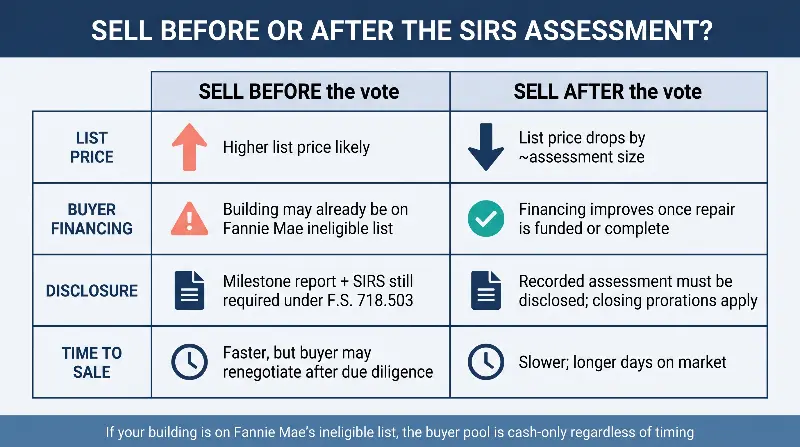
The simpler version of the question, for many owners, is whether to stay and pay or sell and move on. Long-time homesteaded owners who can absorb the assessment and who would lose meaningful Save Our Homes protection by selling are often better off staying. Owners who cannot pay the assessment in cash, who cannot refinance, and who do not need to preserve homestead status (or are moving out of state anyway) are the ones whose math points clearly toward selling.
Selling or moving? Your biggest tax benefit is on the line.
Most Florida homeowners have tens of thousands of dollars in Save Our Homes protection — and lose it by accident when they move. Check what yours is worth and what happens to it if you sell.
What You Must Disclose to a Buyer
Florida's condo resale disclosure rules sit in Fla. Stat. §718.503. For non-developer sales (which is almost every individual owner sale), §718.503(2)(a) lists the documents the seller must deliver at the seller's expense before the contract becomes binding. The list, paraphrased from the statute:
- The declaration of condominium
- The articles of incorporation
- The bylaws and rules
- The most recent year-end financial statement
- The current annual budget
- The "Frequently Asked Questions and Answers" sheet required by §718.504
- The most recent milestone inspection report under §553.899 (Phase 1 and Phase 2 if applicable)
- The most recent Structural Integrity Reserve Study — or a statement that the association has not completed a SIRS
The buyer receives a statutory cancellation right tied to receipt of those documents. HB 913 extended the cancellation window from 3 business days to 7 business days for contracts executed on or after July 1, 2025. The cancellation window runs from the later of contract execution or receipt of the disclosure documents. If documents arrive after execution, the clock starts when they land.
Two important nuances:
The statute does not separately enumerate a pending, proposed, or voted-but-not-yet-collected special assessment as a required disclosure item. Section 718.504's FAQ sheet asks for the "assessment amount" but the statute expressly states this is exclusive of any special assessments. That means the 718.503 statutory document package can technically be delivered without mentioning a pending special assessment by name — the pending assessment would still surface through the milestone report and the budget, but it is not separately called out.
Florida common-law disclosure duties for material facts known to the seller may apply independently of §718.503. Whether a known pending special assessment must be disclosed as a "material fact" is a question for a Florida real estate attorney on your specific facts. A safe practice in any building with a known SIRS-driven assessment is to disclose it in writing, attach the relevant board minutes, and document the buyer's acknowledgment — both because withholding it invites a claim later and because most sophisticated buyers will find it on their own due-diligence call to the association's manager.
Will the Assessment Reduce Your Capital Gains Tax?
If you sell the condo for a gain that exceeds the IRC §121 exclusion ($250,000 single, $500,000 married filing jointly), the question of whether the special assessment you paid adds to your cost basis — and therefore reduces taxable gain — is real money.
The IRS addresses condo association assessments specifically. IRS Publication 523 ("Selling Your Home"), Worksheet 2 Line 4f, instructs taxpayers to add to basis:
"Any special assessments for local improvements (such as special tax or condominium association assessments that aren't merely for repairs or maintenance)."
The publication frames the underlying improvement test on page 9: improvements add to the value of the home, prolong its useful life, or adapt it to new uses. Page 10 expressly excludes from basis "any costs of repairs or maintenance that are necessary to keep your home in good condition but don't add to its value or prolong its life."
The practical implication for a SIRS-driven assessment is fact-dependent:
Assessments that fund structural restoration likely to prolong useful life — major concrete restoration, roof replacement, building-wide window replacement, life-safety electrical upgrade — have a reasonable argument as basis-additive improvements under Pub 523's framing. The Pub 523 example on page 10 treats replacing a single windowpane as a repair but replacing all the windows in the home as part of a larger window-replacement project as an improvement.
Assessments that fund routine maintenance and ordinary repairs — painting, minor patching, ordinary plumbing or electrical service work, deferred-maintenance cleanup that does not prolong the building's useful life — do not add to basis under page 10's exclusion.
The IRS has not published SIRS-specific guidance, and no Revenue Ruling or Private Letter Ruling addresses Florida SIRS assessments directly. Whether a particular assessment qualifies is a facts-and-circumstances question that should be reviewed with a CPA who can characterize the assessment against the engineering scope of work, the SIRS report itself, and the board's resolution levying it. Keep the SIRS report, the milestone inspection report, the board resolution levying the assessment, and all paid receipts — those are the documents your CPA will work from.
Protect Your Save Our Homes Benefit Before You List
If your Florida condo is homesteaded and you sell to buy another Florida home, the single most valuable thing on your tax bill is the Save Our Homes assessment difference you have accumulated. Under Fla. Stat. §193.155(1), the homestead's assessed value is capped to the lower of 3% or the change in the Consumer Price Index per year, regardless of how fast market value rises. Long-time owners often carry tens of thousands of dollars per year of compounded protection.
That accumulated benefit is portable. §193.155(8) allows up to $500,000 of accumulated Save Our Homes assessment difference to transfer to a new Florida homestead. The mechanics:
Three-year window. The new homestead must receive its homestead exemption within three years — specifically, as of January 1 of any of the three immediately preceding years counted from the abandonment of the old homestead.
$500,000 cap. §193.155(8)(d) limits the total reduction from just value to $500,000.
The form. File Florida DOR Form DR-501T ("Transfer of Homestead Assessment Difference") with the property appraiser in the county where you have established the new homestead, by March 1 of the year the new exemption takes effect.
The trap unique to a SIRS-driven condo sale: if you sell and move out of Florida — even temporarily — the SOH benefit is lost entirely. Owners selling under financial pressure and relocating to family in another state often realize months later that they could have established a Florida homestead first and ported, instead of giving up the benefit. The portability decision belongs in the sell-or-stay analysis, not as an afterthought after closing.
For the dollar value of what you would lose by accident on the move, the Save Our Homes Portability Calculator shows your actual accumulated benefit on your specific condo address and what you would carry to a new Florida home.
South Florida Right Now
The market-level effects of the SIRS regime are most visible in the South Florida tri-county area, where the building stock is oldest and the coastal concentration is highest. Per TD Economics's May 2025 Florida condo market report, approximately 85% of the condo stock in Fort Lauderdale and West Palm Beach is 30 or more years old. Across the state, about 900,000 of Florida's 1.5 million condo units are 30+ years old, and TD estimates close to two-thirds could be in scope once coastal proximity is layered on.
The 2024 market snapshot from luxury brokerage ISG World — corroborated by CBS Miami, WLRN, and Bisnow — counted 18,704 resale condo listings across Miami-Dade, Broward, and Palm Beach counties. Of those, 15,759 (84%) were for units 30 years and older — roughly 6,700 in Miami-Dade, 4,900 in Broward, and 4,200 in Palm Beach.
"I've never seen this before; close to 18,000 of them on the market.... No buyer wants to take the risk of walking into a black hole in space. That's what a special assessment seems like at the moment, and the mortgage lenders feel exactly the same way."
The on-record voices from inside affected buildings line up with the data. Laura Galeano, President of the Mariners Bay Condos Association, told CBS Miami in August 2024 that the association was facing deferred-maintenance costs that "would have been upwards of $100,000 each" for the 40-year recertification, and that "Insurance went up 800%, and that's insurmountable." Borja de la Plaza, a Palm Bay Yacht Club owner, told NBC Miami in December 2025 after the proposed $48M assessment was put forward: "When this happened, I found myself in debt, and I saw other neighbors…vulnerable neighbors, elderly people who were going to lose their homes."
The aggregated picture: Florida condo median prices were down approximately 8% from peak (-4.5% year-over-year) per TD Economics's May 2025 reading; condo sales were off more than 25% from 2018-19 levels; statewide condo/townhome inventory hit roughly 80,000 listings (up about 35% YoY) and crossed 10 months of supply against 5.6 months for single-family homes. By December 2025, Florida Realtors data showed condo months-of-supply easing to about 8.8 — sharply softer than single-family but no longer hitting new highs. The market is segmented: newer condos and well-funded associations are seeing more normal trading; older coastal buildings with active SIRS exposure are the inventory bulge.
What this means for an individual seller: comparable sales data within your specific building is more useful than the broader market trend. A 30-year-old oceanfront tower with a recently completed milestone report and a fully funded SIRS will price very differently than the building next door with an open Phase 2 inspection and a board still negotiating the assessment.
Frequently Asked Questions
The questions Florida condo owners ask most about the SIRS wave, answered with the underlying statute, IRS publication, or Fannie Mae rule cited.
Selling or moving? Your biggest tax benefit is on the line.
Most Florida homeowners have tens of thousands of dollars in Save Our Homes protection — and lose it by accident when they move. Check what yours is worth and what happens to it if you sell.
Share this guide
