
In Lakeland, a 73-year-old cancer survivor who had lived in her home since 1987 says a roofing salesman knocked on her door offering a free inspection. As reported by LkldNow, the homeowner, Sarah Taylor, says she was assured insurance would cover everything but her $1,000 deductible. Her insurer ultimately paid about $15,149 of the roughly $33,000 job. According to the report, the roofing company then sued her for about $21,700, filed a lien on her home, and petitioned a court to have it sold; the case was set for trial in 2026. "I never would have said yes. No way," Taylor told LkldNow. Whatever a court ultimately decides, stories like hers are why every Florida homeowner needs to understand how these arrangements work before the next storm.
The Red Flags Every Florida Homeowner Should Recognize
Most roofing scams share the same handful of warning signs. If you see any of these, slow down -- a legitimate, local roofer will still be there tomorrow.
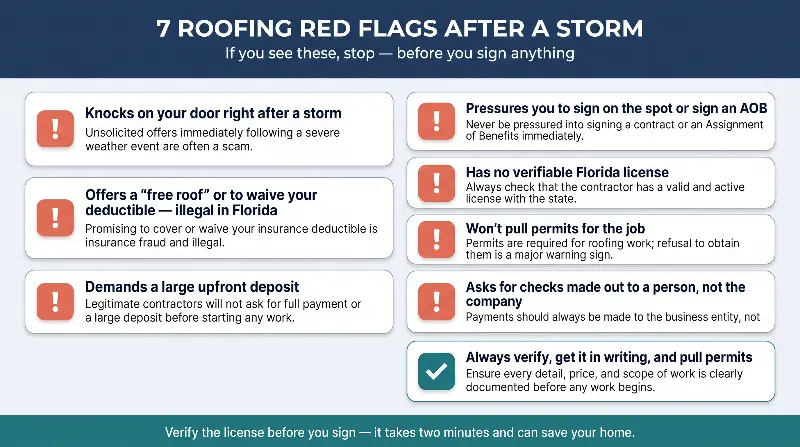
The most important one to understand is the "free roof" or "we'll waive your deductible" pitch. It sounds generous, but in Florida it's illegal -- and it's the clearest sign you're dealing with a scammer, not a deal. We'll cover exactly why below.
The Trap That Can Take Your Home -- Even If You Paid in Full
Here's the danger most homeowners never see coming. Under Florida's Construction Lien Law (Chapter 713), anyone who provides labor or materials for your roof -- not just your contractor, but their subcontractors and suppliers -- can place a lien on your home if they aren't paid. And critically, that can happen even if you already paid your contractor in full.
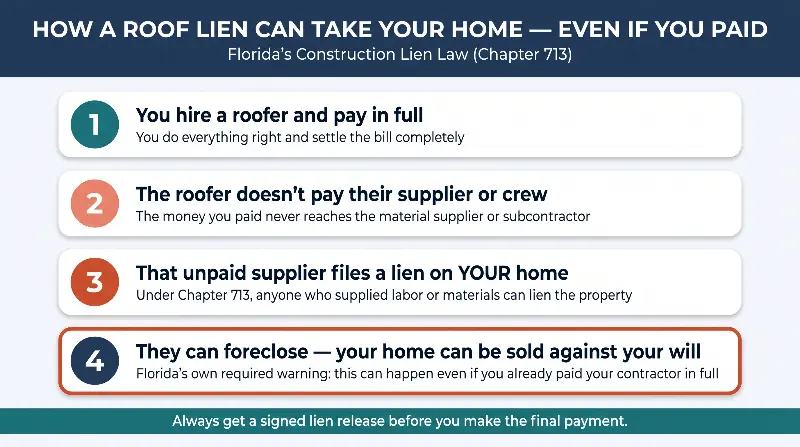
This isn't theoretical. A FOX 13 investigation identified 19 liens placed on Tampa Bay-area homes in 2025 after, the station reported, a roofing contractor the homeowners had hired failed to pay its materials supplier -- even though those homeowners had paid in full. "How could they do this after we paid everything in full?" Spring Hill homeowner Marie Murty told FOX 13. Another, Jennifer Collazo-Soto, said: "I lost my husband in 2021... this is all I have left -- my home."
Florida even requires contractors to warn you about this in writing on contracts over $2,500. The mandatory notice reads, in part: your property "could be sold against your will to pay for labor, materials, or other services" if a lien is filed. The protection is simple but essential: never make your final payment until you have signed lien releases from the contractor and every supplier and subcontractor.
The Law Is on Your Side
Florida has some of the strongest anti-scam protections in the country. Knowing them turns a confusing pitch into an obvious red flag.
A "free roof" or waived deductible is illegal
Under Florida Statute 489.147, a contractor may not offer you "a rebate, gift, gift card, cash, coupon, waiver of any insurance deductible, or any other thing of value" in exchange for letting them inspect your roof or file an insurance claim. Violations carry fines of up to $10,000 each. And when a contractor knowingly and willfully waives your deductible with intent to defraud, it is insurance fraud punishable as a third-degree felony. In short: nobody can legally give you a "free" roof by eating your deductible.
You may be able to cancel within 10 days
If you signed a roof contract within 180 days of a Governor-declared state of emergency and your home is in the declared area, the same law lets you cancel without penalty within 10 days of signing (or by the official start date, whichever comes first). You can also void the contract within 10 days if the contractor left out the required legal notice. Send any cancellation by certified mail, return receipt requested.
How to Protect Yourself Before You Sign
A few minutes of caution prevents nearly every roofing scam:
- Verify the license for free at MyFloridaLicense.com or by calling DBPR at (850) 487-1395.
- Never accept a "free roof" or a waived deductible -- it's illegal and a guaranteed red flag.
- Don't sign an Assignment of Benefits (AOB) that hands a contractor control of your insurance claim.
- Avoid large upfront deposits -- and never make checks out to an individual instead of the company.
- Insist on permits so the work gets inspected.
- Get signed lien releases from the contractor and all suppliers before your final payment.
- Get everything in writing and don't let anyone pressure you to sign on the spot.
A Legitimate Way to Strengthen Your Roof: My Safe Florida Home
If the "free roof" pitch is the scam, the state's My Safe Florida Home program is the real thing. It offers a free wind-mitigation inspection from a state-approved inspector and a matching grant of up to $10,000 toward hurricane-hardening upgrades -- a stronger roof-to-wall connection, secondary water resistance, impact-rated windows, and reinforced openings. That work doesn't just protect your home in a storm; it can also lower your insurance premium.
The program reopened in August 2025 and, under House Bill 811, currently prioritizes low- and moderate-income homeowners; Florida's 2026-2027 budget added hundreds of millions of dollars more, much of it aimed at the roughly 45,000 homeowners already on the inspection waitlist. To qualify, the home generally must be your primary, site-built residence with a dwelling-coverage value of $500,000 or less. Check current eligibility and apply at mysafeflhome.com, and see our full My Safe Florida Home guide for the income tiers, the grant match, and how to apply.
No legitimate contractor can give you a free roof by waiving your deductible -- that's illegal. But a real state grant can help pay to make the roof you have stronger. Start with the free inspection, not a door-knock.
What to Do If You've Been Targeted
If you suspect a scam -- or you've already been hit -- report it and keep every document. Florida's Chief Financial Officer runs an active fraud unit that makes arrests. In an April 2026 press release, for example, the CFO's office announced the arrest of a man it alleges posed as a contractor, collected $174,000 from a homeowner with a fire-damaged Hollywood home, and then abandoned the job. The charges are allegations that have not been proven in court.
- Unlicensed or bad contractor: DBPR — (850) 487-1395, or the unlicensed-activity hotline 1-866-532-1440
- Insurance claim problems: Florida DFS Consumer Helpline — 1-877-693-5236
- Suspected insurance fraud: DFS fraud hotline — 1-800-378-0445 (rewards up to $25,000)
- A lien on your home: talk to a Florida real estate or construction attorney quickly — deadlines are tight
Selling or moving? Your biggest tax benefit is on the line.
Most Florida homeowners have tens of thousands of dollars in Save Our Homes protection — and lose it by accident when they move. Check what yours is worth and what happens to it if you sell.
Frequently Asked Questions
Share this guide
