
If your neighbor sold their home in three days back in 2022 -- five offers, all over asking -- and your home has now sat for two months with barely a showing, here's the first thing to know: you're not doing anything wrong. The market moved. After years of bidding wars and waived inspections, Florida has reversed course. In every major metro across the state, sellers now outnumber buyers -- in many areas by two to one or more. Homes are sitting longer, price cuts have become routine, and the days of naming your price and waiting for the offers to roll in are, for now, over. But "buyer's market" does not mean "don't sell." It means sell differently.
The Market Has Quietly Flipped
For the better part of a decade, selling a Florida home was easy. Inventory was scarce, buyers were plentiful, and a well-priced home -- sometimes any home -- drew competing offers within days. That era is over. According to spring 2026 data, all of Florida's major metro areas are now considered buyer's markets, with sellers outnumbering buyers by a wide margin.
The homeowners who adjust to the new rules are still closing -- often quickly and at strong prices. The ones who price their home like it's still 2022 are the ones sitting unsold, watching the days pile up. The difference isn't luck or location. It's strategy.
Why the market turned
This isn't a crash -- it's a normalization. Three forces converged to hand leverage back to buyers. First, inventory recovered. The pandemic-era shortage that drove bidding wars has unwound, and active listings across Florida have climbed back above pre-pandemic levels. Second, affordability hit a ceiling. Mortgage rates that more than doubled from their 2021 lows, combined with record prices and some of the highest property-insurance premiums in the nation, priced a large share of buyers out -- thinning the demand pool just as supply grew. Third, the frenzy simply ran its course. Years of double-digit appreciation pulled forward demand and stretched valuations, and the market is now resetting to a more sustainable pace.
The result is a slower, more deliberate market where buyers compare options, negotiate, and walk away from anything that looks overpriced. For sellers, that means the strategy that worked in 2021 -- list high, sit back, and field offers -- now backfires.
Buyers can now afford to be patient and picky. Your entire job as a seller is to remove every reason for them to hesitate -- the right price, the right presentation, and a willingness to meet a serious buyer partway.
What a Buyer's Market Actually Looks Like
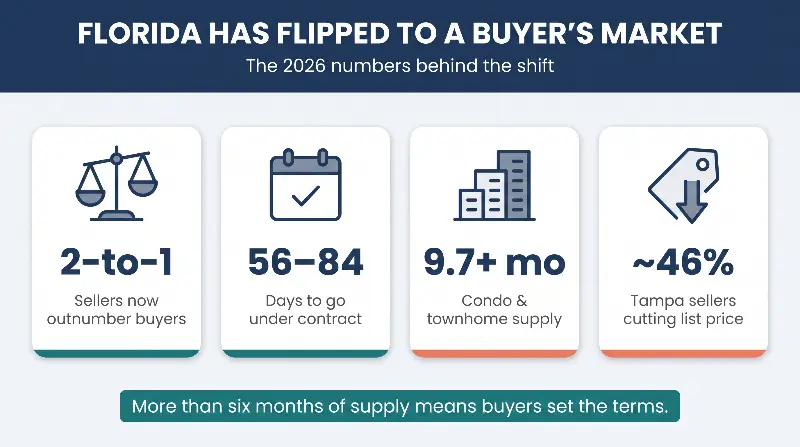
The numbers tell the story plainly. Four shifts define the 2026 Florida market, and together they explain why your home may be moving slower than you expected.
Inventory has surged
Florida now has roughly 5.2 months of supply for single-family homes and 9.7+ months for condos and townhomes. Anything above six months of supply has traditionally signaled a buyer's market -- and the condo segment is well past that line.
Homes are taking longer to sell
Typical listings now take 56 to 84 days to go under contract -- two to three months, versus the days-or-hours pace of the boom. In slower markets like Naples, the average stretches to around 140 days.
Price reductions are routine
In the Tampa Bay area, roughly 46% of sellers cut their list price in early 2026 -- one of the highest rates in the nation, according to Redfin. A price reduction is no longer a red flag; it's become the norm for homes that launched too high.
Buyers have leverage again
With options on the table, buyers are asking for -- and getting -- closing-cost contributions, interest-rate buy-downs, and repair credits after inspection. The negotiating power has clearly shifted to the buyer's side of the table.
None of this means your home won't sell. It means buyers can afford to be selective, so your strategy should focus on removing friction at every step. The sections below show exactly where to focus.
It's Not One Market -- It's 67 Counties
Here's what most national headlines miss: Florida isn't a single housing market. Conditions vary dramatically by region, and pricing correctly starts with knowing your local reality rather than a statewide average.
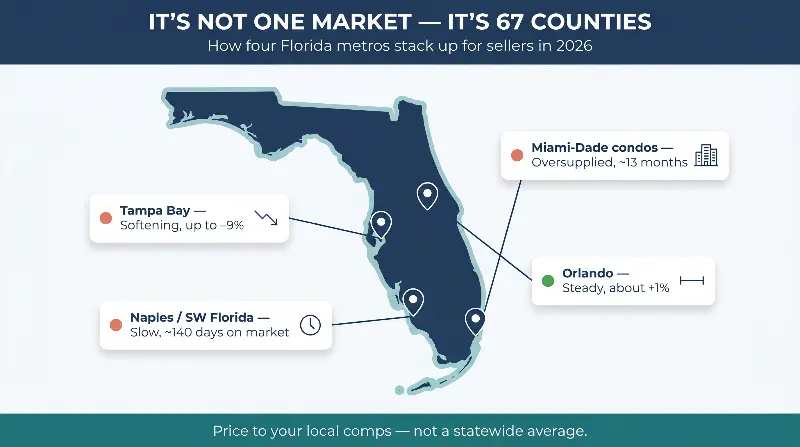
Tampa Bay has cooled fastest. After leading the nation in price growth during the boom, the metro is now among the softest in the state, with overbuilt suburban pockets where values could slip as much as 9% and nearly half of all sellers already cutting their list price. Naples and Southwest Florida tell a different story -- prices are holding, but the luxury-heavy inventory moves slowly, with homes averaging around 140 days on market. Miami-Dade's condo market faces its own pressure: a wave of new supply and the fallout from Florida's post-Surfside structural-reserve requirements have pushed inventory near 13 months and dragged the median below $400,000. Orlando, anchored by steady job growth and relative affordability, remains the most balanced of the big metros, with prices essentially flat.
The lesson: don't price your home off a statewide average or a national news story. Price it off what's actually happening on your street, in your county, this month. A 9% swing between an overbuilt Tampa suburb and a steady Orlando neighborhood is the difference between a fast sale and six months of price cuts -- which is exactly where a sharp local agent earns their fee.
Should You Sell Now -- or Wait?
It's the question every Florida homeowner is asking: if the market has softened, should you wait for prices to bounce back before listing? It's a reasonable instinct -- but for most sellers, waiting is a gamble that rarely pays off. Here's how to think it through.
Waiting has real costs
The forces that flipped the market aren't reversing quickly. Inventory is still climbing, and several major metros are forecast to soften further into 2026 -- so there's no guarantee your home is worth more next year than it is today. Meanwhile, the cost of simply holding a Florida home keeps rising. Every month you wait, you're paying property taxes, one of the highest homeowners insurance premiums in the nation, mortgage interest, and maintenance -- and if you're in a condo or HOA, potentially steep special assessments. Those carrying costs can quietly erase any modest price gain you were hoping to wait for.
When selling now makes sense
- You have a genuine reason to move -- downsizing, relocating, a job change, or a life transition
- Your metro is on the softening list (Tampa Bay, Southwest Florida, or the Miami condo market)
- Your carrying costs are high -- a large insurance premium, rising assessments, or a mortgage you'd like to retire
- You've built substantial equity and would rather lock it in than risk further softening
When waiting can be reasonable
- You have no timeline and can comfortably ride out a full market cycle, which can take years
- Your local market is one of the steadier ones, like Orlando
- Your carrying costs are low and your home easily covers them
- You'd be selling into the same market you'd be buying in -- a lateral move where today's prices cut both ways
The honest bottom line: timing the exact top or bottom of a market is a losing game even for professionals. If you have a real reason to sell, a correctly priced home sells in today's market -- and the certainty of a sale now usually beats the hope of a slightly higher price later, especially once carrying costs are counted.
A tale of two listings
To see why pricing matters more than waiting, consider two nearly identical Florida homes listed the same week, both of which would realistically appraise around $500,000. The only difference is strategy. (The figures below are an illustrative example, not a guarantee.)
| Seller A — priced to today's comps | Seller B — priced to the 2022 peak | |
|---|---|---|
| List price | $499,000 | $549,000 |
| Buyer response | Multiple showings in week one; an offer by week three | Few showings, no offers |
| Price changes | None needed | Cut to $519K (day 30), then $499K (day 65) |
| Final sale price | $492,000 | $475,000 |
| Days on market | ~40 days | ~115 days |
Seller B chased the market down -- and because buyers treat a stale, repeatedly reduced listing as damaged goods, ended up accepting $17,000 less than Seller A while waiting nearly three months longer and paying three extra months of taxes, insurance, and interest. The home priced realistically from day one won on every measure. In a buyer's market, the list price you choose on day one is the single most important decision you'll make.
The 5 Moves That Sell a Home in This Market
A buyer's market rewards realism and punishes wishful thinking. These five moves separate the homes that sell from the ones that sit.

1. Price to today's comps -- not last year's peak
This is the single biggest factor, full stop. A growing number of successful sellers even price slightly below comparable homes on purpose -- not to leave money on the table, but to attract a bigger pool of buyers and create urgency. A home that looks like clear value gets seen, gets showings, and often draws competing offers. A home priced on hope gets skipped -- and every week it sits, buyers wonder what's wrong with it.
2. Budget for concessions before you list
Expect buyers to ask for help, and decide in advance what you'll give. Contributing to closing costs or buying down a buyer's interest rate can be the difference between a signed contract and another month on the market -- and it often costs you less than a second price reduction would.
3. Presentation matters again
When buyers had no choices, they overlooked tired carpet and cluttered rooms. Now they have dozens of options. Clean, declutter, handle the small repairs, and invest in good listing photos. In a market where your home is compared side by side with the one down the street, presentation is no longer optional.
4. Mind the timing
Florida's market typically firms up heading into summer, and easing mortgage rates are drawing buyers back in. If you have flexibility on when to list, work with a local agent to time your launch for when foot traffic is strongest in your area.
5. Don't fight the inspection
With more leverage, buyers are scrutinizing inspection reports harder than they have in years. Going in expecting reasonable repair requests -- rather than digging in your heels -- keeps deals together. A collapsed sale puts you right back at the starting line, often with a stigma attached. If your home is older or coastal, consider a pre-listing inspection so surprises don't blow up the deal at the eleventh hour.
- Anchoring to a 2021 or 2022 number. What a neighbor got at the peak is no longer the comp. Buyers and appraisers are pricing off the last 90 days.
- Chasing the market down. A series of small price cuts signals weakness and nets less than one correct price at launch.
- Refusing all concessions. Holding firm on every term in a market where buyers have options is the fastest way to watch your listing go stale.
- Skipping the prep. Tired photos and deferred maintenance get your home filtered out before a buyer ever walks through it.
Selling or moving? Your biggest tax benefit is on the line.
Most Florida homeowners have tens of thousands of dollars in Save Our Homes protection — and lose it by accident when they move. Check what yours is worth and what happens to it if you sell.
Selling a Long-Held Home? Protect Your Tax Benefits First
Many Florida sellers aren't flipping a house -- they're selling a home they've owned for decades, whether to downsize, move closer to family, or simplify life in retirement. If that's you, two tax considerations can be worth more than a few thousand dollars of negotiation on the sale price. Handle them before you list.
Don't leave your Save Our Homes savings behind
If you've owned your Florida home for years, the gap between its market value and its assessed value -- your accumulated Save Our Homes benefit -- can be substantial. Florida's portability rules let you transfer up to $500,000 of that benefit to your next Florida home, sometimes worth thousands per year in lower taxes. If you're buying again in-state, calculate this before you sell so you don't lose years of accumulated protection by accident.
Know your capital-gains exclusion
If the home has been your primary residence, you can typically exclude up to $250,000 in gains ($500,000 for a married couple filing jointly) from federal capital-gains tax, provided you've owned and lived in it for at least two of the last five years. On a home held for 20 or 30 years, that exclusion can protect a meaningful chunk of your equity -- but the rules have conditions worth confirming with a tax professional before you list.
- Check your Save Our Homes benefit and how much is portable to your next home
- Confirm you meet the 2-of-5-year ownership and residency test for the capital-gains exclusion
- File your portability application (Form DR-501T) by March 1st after establishing your new homestead
- Establish homestead on the new property within 3 tax years to keep the transfer
Frequently Asked Questions
Straightforward answers to the questions Florida sellers are asking most about the 2026 market shift.
Selling or moving? Your biggest tax benefit is on the line.
Most Florida homeowners have tens of thousands of dollars in Save Our Homes protection — and lose it by accident when they move. Check what yours is worth and what happens to it if you sell.
Share this guide
