Two Miami condos with the same view and the same floor plan can sell for very different prices because of the building around them. One has a recent inspection, a funded reserve account and a clean budget. The other has a repair bill coming that nobody has paid for yet. Buyers can now see the difference. Florida's post-Surfside laws require condo buildings three stories and taller to get structural inspections and reserve studies, and most associations must post the results online. This guide walks through the six things that tell you how good your building really is, what a good result looks like, and what each one means for your sale.
1. Inspection: Has the building passed its milestone inspection or 40-year recertification, and are required repairs done?
2. SIRS: Does the building have a current structural integrity reserve study?
3. Reserves: Is the budget collecting what the study recommends?
4. Assessments: Is a special assessment passed, planned or likely?
5. Insurance: What does the master policy cost and what is the deductible?
6. Lending: Can buyers get a conventional mortgage in the building?
Why the Building Matters More Than Ever
Before 2022, most condo buyers in Florida looked at the unit, the amenities and the monthly fee. The building's long-term repair needs were hard to see. Many associations kept reserves low or voted to waive them so fees stayed down.
That changed after the Champlain Towers South collapse in Surfside in June 2021. In 2022 the Legislature passed Senate Bill 4-D, and it has been amended several times since. It created three requirements that now shape every Miami condo sale:
- Milestone inspections of the structure, for buildings three or more habitable stories tall.
- Structural integrity reserve studies that say how much the association must save for major structural repairs.
- An end to waiving those reserves. Owners can no longer vote to skip saving for the items the study covers.
At the same time, Fannie Mae and Freddie Mac tightened the rules for lending in condo buildings, and insurance costs climbed. The result is simple. A building with its paperwork and finances in order is easier to sell. A building without them can lose buyers who need a mortgage.
Check 1: The Milestone Inspection and 40-Year Recertification
A milestone inspection is a structural inspection by a licensed engineer or architect. Under Florida Statute 553.899, it applies to condo buildings three or more habitable stories tall. The first one is due by December 31 of the year the building turns 30, and then every 10 years after that. Local officials can require it at 25 years based on local conditions, such as closeness to salt water.
The inspection has two phases:
- Phase 1 is a visual check of the structure. If the engineer finds no signs of serious deterioration, the inspection ends there.
- Phase 2 is required when Phase 1 finds substantial structural deterioration. It is a deeper investigation, often with testing, and it comes with a list of repairs.
Miami-Dade County also has its own older program, the building recertification, still widely called the "40-year recertification." Since a 2022 county ordinance, it starts at 30 years and repeats every 10 years. Coastal condo buildings three or more stories tall, within 3 miles of the coastline and built in 1998 or later, start at 25 years. It covers both structural and electrical safety.
The inspection or recertification is done on time. Phase 1 found no substantial deterioration, or any Phase 2 repairs have been finished and signed off. The association sent owners the inspector's summary within 45 days, as the law requires, and posted the full report on its website.
An overdue inspection, a Phase 2 report with repairs not yet started (the law requires repairs to begin within 365 days of the report), or an unsafe-structure notice from the county. These are the issues that make lenders decline loans in the building (see Check 6).
Check 2: The Structural Integrity Reserve Study (SIRS)
The SIRS is the building's long-term repair plan for its most important parts. Under Florida Statute 718.112(2)(g), a condo building three or more habitable stories tall must have one, and it must be redone at least every 10 years. The study covers the roof, the structure and load-bearing walls, fireproofing and fire protection systems, plumbing, electrical systems, waterproofing and exterior painting, and windows and exterior doors. It must be prepared or verified by a licensed engineer or architect, or a certified reserve specialist.
For each item, the study estimates how many years it has left, what it will cost to replace, and how much the association should put away each year to have the money ready. Two numbers in it matter most to you:
- Percent funded: how much money is in reserves compared with how much the study says should be there by now.
- Recommended annual contribution: what the association should be saving each year from now on.
A SIRS runs dozens of pages, and the key figures are easy to miss. The Condo Room has a plain-English walkthrough of how to read a SIRS report that shows where those numbers sit in a real study.
Check 3: Reserves and the Budget
A good study is only half of it. The other half is whether the association is actually following it. Compare two documents:
- The SIRS, which says how much the association should save each year.
- The annual budget, which shows how much it is actually collecting for reserves.
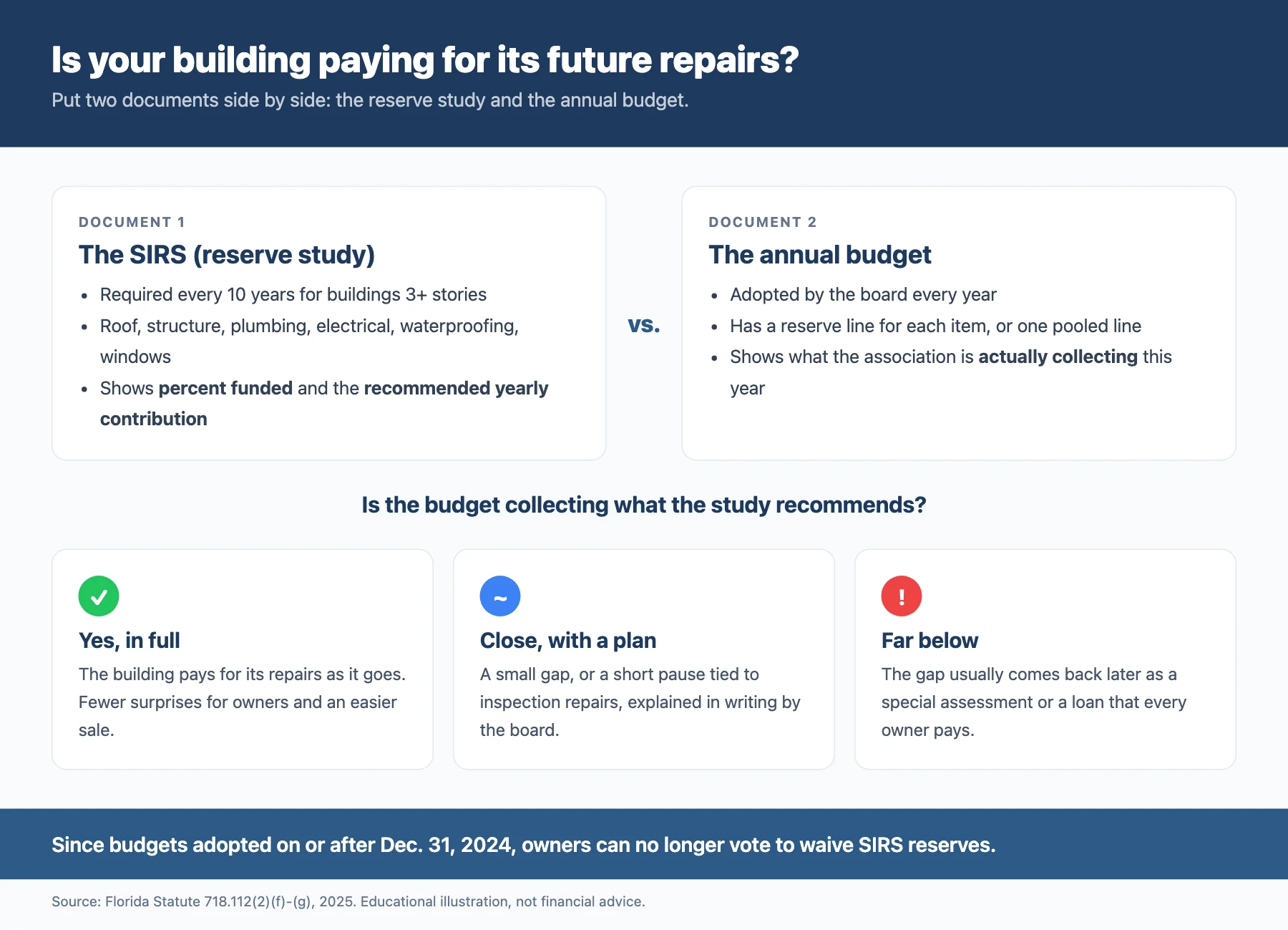
If the budget collects what the study recommends, the building is paying for its future repairs as it goes. If the budget collects much less, the gap does not disappear. It usually comes back later as a special assessment or a loan that every owner pays.
Percent funded can mislead on its own. A building that just finished a large repair may show a low balance even though it is in good shape. The Condo Room explains what "100% funded" actually means and what range counts as strong. Its step-by-step guide to checking a condo's reserves shows how to put the budget and the study side by side.
For budgets adopted on or after December 31, 2024, Florida law does not let owners waive or reduce the reserves for the items in the SIRS. Before that, many Miami buildings waived reserves year after year. If your building did, the catch-up is likely showing up in your fees now.
Selling or moving? Your biggest tax benefit is on the line.
Most Florida homeowners have tens of thousands of dollars in Save Our Homes protection — and lose it by accident when they move. Check what yours is worth and what happens to it if you sell.
Check 4: Special Assessments
A special assessment is a one-time charge on every owner, on top of regular fees, to pay for something the reserves cannot cover. In older Miami towers these now often run to tens of thousands of dollars per unit for concrete restoration, roofs, windows or elevators.
Look for three things:
- Assessments already passed. These are on the board's meeting minutes and on the estoppel certificate the association issues before a sale.
- Assessments being discussed. Board agendas and minutes from the last year often show a big project coming before any vote.
- The gap between the study and the budget. The bigger the gap from Check 3, the more likely an assessment is.
If an assessment is coming and you are thinking about selling, the timing question is real. Our guide to selling a Florida condo before or after a special assessment walks through the trade-offs.
Check 5: The Master Insurance Policy
The association insures the building itself with a master policy. Your own HO-6 policy covers the inside of your unit. The master policy cost is built into your monthly fee, and in South Florida it has been one of the fastest-rising lines in condo budgets.
Under Florida Statute 718.111(11), the association must keep the building insured, and the replacement cost used for that coverage must be updated by an independent insurance appraisal at least once every 3 years. Three things are worth checking:
- The premium and how much it has risen over the last few years.
- The hurricane deductible. It is often a percentage of the building's insured value, and after a storm the association can assess owners to cover it.
- Who the insurer is. A building that can only get coverage from Citizens Property Insurance, the state-backed insurer of last resort, has fewer options. Since January 1, 2025, Citizens requires a milestone inspection report for new policies on condo buildings three or more stories tall and generally 30 years or older.
Check 6: Can a Buyer Get a Mortgage?
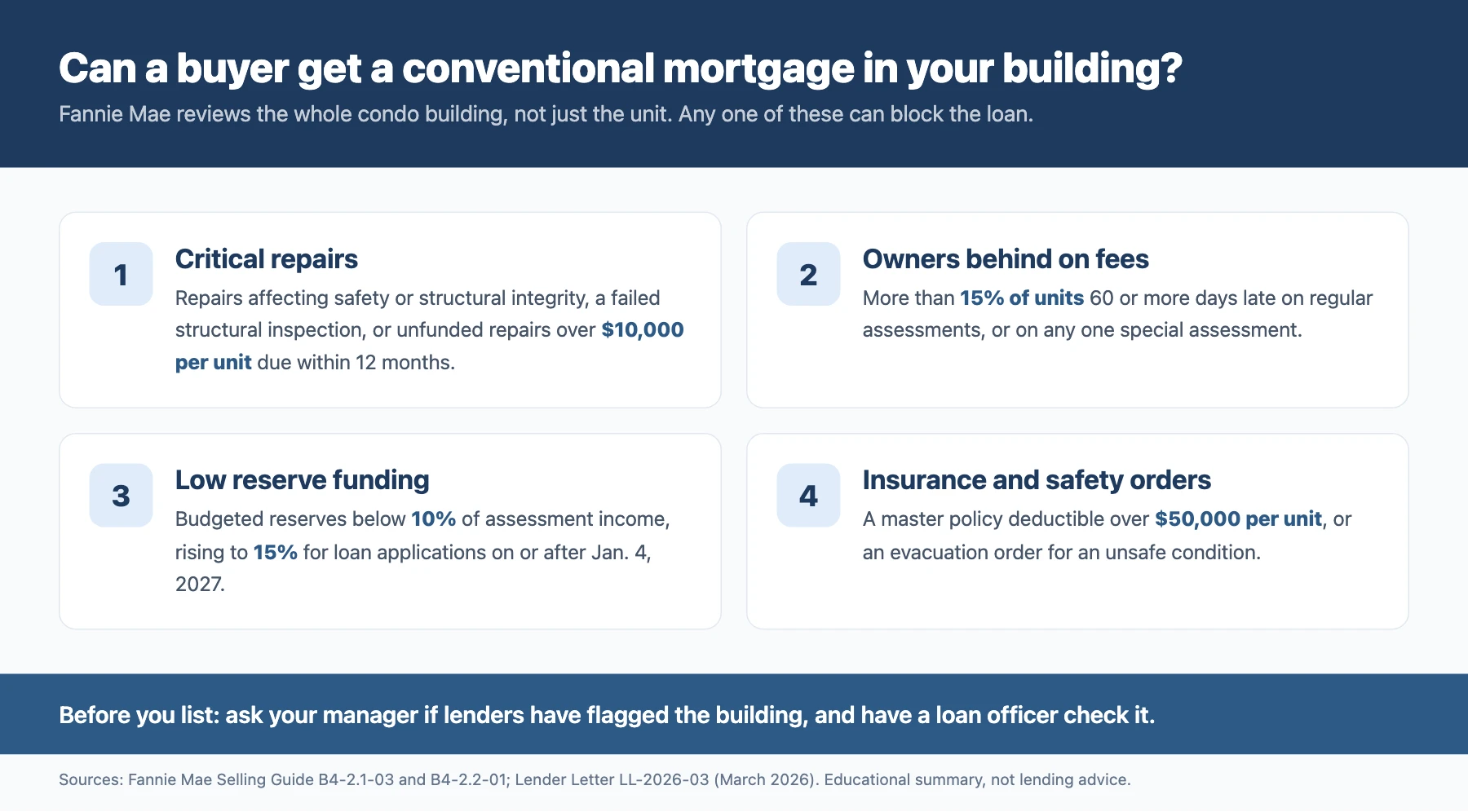
This is the check that most directly affects your sale price. Most buyers use a conventional loan that the lender sells to Fannie Mae or Freddie Mac. For condos, those agencies review the whole building, not just your unit. If the building fails, buyers who need that kind of loan cannot buy, and you are left with cash buyers and higher-cost lenders.
Under Fannie Mae's rules, a building can be ineligible for reasons including:
- Critical repairs. Repairs that affect the safety, soundness or structural integrity of the building, including a failed state or county structural inspection.
- Delinquent owners. More than 15% of units 60 or more days behind on their assessments.
- Low reserves. A budget that puts too little into replacement reserves. In March 2026, Fannie Mae and Freddie Mac announced that the minimum rises from 10% to 15% of budgeted assessment income for loan applications on or after January 4, 2027.
- Unsafe-condition evacuation orders. A building under an evacuation order is ineligible until it is fixed.
You cannot check this from outside the building. Ask the association manager whether lenders have flagged the building, and ask a loan officer to run the building before you list. It is better to know now than when a buyer's loan falls through three weeks before closing.
Where to Look It All Up
You have more access to this information than most owners realize. Here are the four places to look, from fastest to slowest:
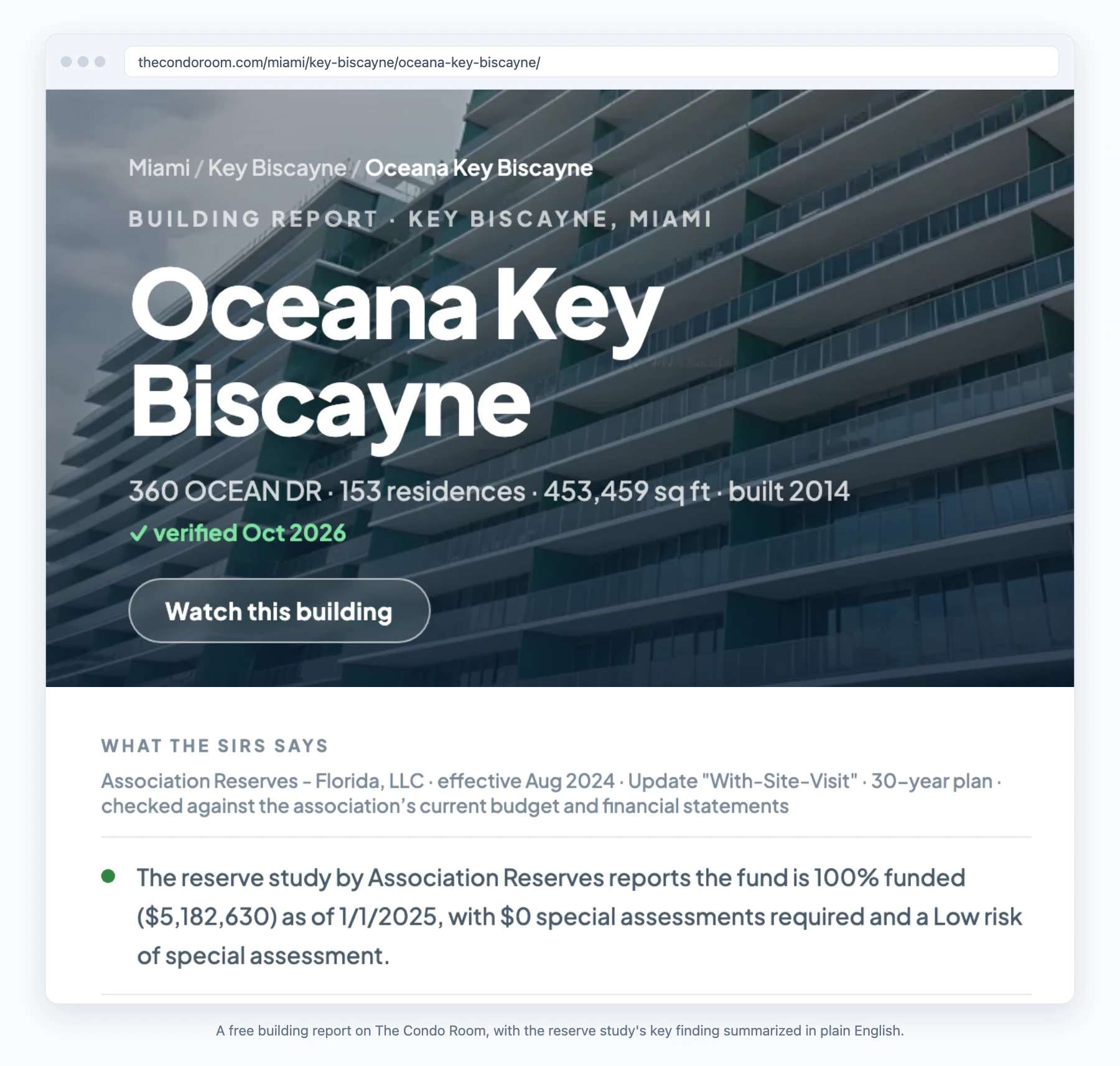
1. A free building report
The Condo Room publishes free building reports for more than 3,000 Miami-Dade condo buildings, with reserves, insurance, inspections, budgets and sales history on one page. Search for your building on its Miami building directory. It is the quickest way to see what a buyer will see.
2. Your association's website
Under Florida Statute 718.111(12)(g), since January 1, 2026, condo associations with 25 or more units must post key documents on a website or app that owners can access, within 30 days of receiving them. That includes the budget, the financial report, the last 12 months of approved board minutes, the SIRS, structural inspection reports and building permits for ongoing or planned work.
3. An official records request
As an owner, you can ask in writing to see the association's official records. Florida law gives the association 10 working days to make them available. Use this for anything not posted, such as board minutes and contracts.
4. The board meeting
Board meetings are open to owners. The budget meeting each fall is where you hear about reserves, insurance and upcoming projects first.
What It Means If You Are Selling
Under Florida Statute 718.503, a condo seller must give the buyer the association's governing documents, its annual financial statement and budget, a frequently asked questions sheet, the inspector's summary of any milestone inspection, and the most recent SIRS (or a statement that the association has not completed one). Unless the buyer received these more than 7 days before signing, the buyer can cancel within 7 days, not counting weekends and legal holidays. In other words, the buyer will see the six checks whether you look at them or not.
So look first. Price the unit with the building in mind:
- If your building is strong (inspection done, SIRS current, budget funding the study, no big assessment coming), say so in the listing. It sets your unit apart. Buildings like the Towers of Key Biscayne show what a well-documented building report looks like.
- If an assessment is coming, decide with your agent whether to sell before or after it, and how to price it in.
- If lending is a problem, expect a smaller pool of buyers and plan for cash offers.
Over time, building quality also shows up in price history. The Condo Room's 10-year look at Miami's best-performing condo buildings compares how buildings have held their value.
Finally, do not forget the tax side. If you have a homestead exemption, your Save Our Homes benefit can usually move with you to your next Florida home, and you may owe capital gains tax on the sale. Both are worth checking before you set a price. Our seller closing costs calculator shows what you would net.
Frequently Asked Questions
Common questions from Miami condo owners about the health of their building.
Look at six things: the milestone inspection or 40-year recertification, the structural integrity reserve study (SIRS), how much the budget puts into reserves compared with what the study recommends, any special assessments passed or planned, the master insurance policy, and whether buyers can get a conventional mortgage in the building. Most of these documents are on the association's website or available as official records. Free building reports such as The Condo Room's pull many of them together for Miami-Dade buildings.
A structural integrity reserve study (SIRS) is a study of the building's main structural and safety components, such as the roof, load-bearing walls, plumbing, electrical systems, waterproofing and windows. It estimates how long each will last, what it will cost to replace, and how much the association should save each year. Florida requires one at least every 10 years for condominium buildings three habitable stories or higher.
Percent funded compares the money the association actually has in reserves with the amount the reserve study says it should have by now. A building at 70 percent or more is generally in a strong position. A building far below that is more likely to need a special assessment or a loan when a big repair comes due. The number is most useful alongside the budget: check whether the association is now collecting what the study recommends each year.
Assessments owed on the unit, and those scheduled to come due while the estoppel certificate is in effect, are listed on that certificate, which the association issues before closing. The buyer becomes responsible for unpaid amounts on the unit. Florida law also requires a seller to give the buyer the association's governing documents, financial statement and budget, the milestone inspection summary and the most recent SIRS. Whether you must disclose a repair that has been discussed but not voted on depends on the facts, so ask a Florida real estate attorney before you list.
Most buyers use conventional loans sold to Fannie Mae or Freddie Mac, and those agencies review the whole building, not just the unit. A building can be ineligible if it needs critical repairs, has too many owners behind on assessments, does not budget enough for reserves, or has too few insurance protections. Ask your association manager whether lenders have flagged the building, and ask a loan officer to check the building before you list.
No. Your Save Our Homes benefit depends on your homestead and your assessed value, not on the building. But if the building's condition pushes you to sell, the timing matters: when you buy a new Florida homestead within the deadline, you can usually move up to $500,000 of that accumulated benefit to the new home. Check what your benefit is worth before you list.
Selling or moving? Your biggest tax benefit is on the line.
Most Florida homeowners have tens of thousands of dollars in Save Our Homes protection — and lose it by accident when they move. Check what yours is worth and what happens to it if you sell.
