The short version: staying home is the majority choice, not a minority one. The AARP 2024 survey found that 75% of Americans aged 50+ want to remain in their current home as they age.
In Florida the appeal is even stronger because of the state's homestead and Save Our Homes protections. Whether it works for you depends on three things: the modifications your home needs, the money you can find to pay for them, and the support around you. This guide is written for the ordinary Florida homeowner.
- Why Florida is one of the best states for aging in place — homestead, SOH cap, no income tax, climate
- Modifications organized by cost — what works for $50, $500, $5,000, or more
- Federal tax deductions — what the IRS lets you write off as a medical expense
- Florida programs — senior exemption, tax deferral, hurricane grants, Medicaid waivers
- Permit rules — the new July 2026 waiver for small projects
- When aging in place stops working — honest signals to watch for
You're Not Alone — The Majority Wants to Stay Home
The AARP 2024 Home and Community Preferences Survey — conducted with over 3,000 Americans 18 and older — found that 75% of adults 50 and older want to stay in their current home as they age, and 73% want to stay in their current community. The numbers have been remarkably stable: AARP's 2021 survey found 77% and 79% respectively. This is the majority preference, by a wide margin, and it strengthens with age.
The same survey identified what people actually plan to change. Among the 50+ adults planning home modifications, 72% target bathroom upgrades (grab bars, no-slip tile), and 71% target accessibility for getting into and around the home (ramps, chairlifts). And critically, one in three adults aged 50+ say their home needs modifications now to age in safely and independently.
So if you have been thinking about staying in your home and feeling like you should have an answer that everyone else has, you don't. Most people are exactly where you are. The questions are practical: can your specific home work, what would it cost, and what help is available.
Why Florida Is One of the Best States for Aging in Place
Florida offers a combination of advantages that few other states match. Most of them have nothing to do with weather:
1. Homestead exemption + Save Our Homes cap = a tax bill that does not balloon. Florida's homestead exemption reduces your home's taxable value by up to $50,000 (more after 2025's Amendment 5 inflation adjustment). The Save Our Homes cap limits annual increases in your assessed value to 3% or CPI, whichever is lower. For a homeowner who has owned their home 15+ years, the gap between the cap-limited assessed value and the home's market value can be $100,000 to $300,000 or more — saving thousands every year in property tax. That savings continues as long as you stay. See our Save Our Homes savings estimator for what your situation looks like.
2. No state income tax. Florida is one of nine states with no state income tax, which makes a real difference on fixed retirement income.
3. A senior-friendly building code that is mostly hands-off. Florida law does not require expensive accessibility features in single-family homes — it leaves most of the choices to you, which lets you modify only what you actually need.
4. Climate. The straightforward one. No snow, no ice on driveways, no winter falls.
5. A new permit waiver, effective July 1, 2026, that makes most small projects permit-free if they cost under $7,500. More on that below.
Together these create a long list of reasons why aging in place is often cheaper in Florida than almost anywhere else.
Modifications by Cost — What Works at Each Budget
The single biggest mistake most homeowners make is assuming aging in place requires a major renovation. It doesn't. The highest-impact modifications are also the cheapest. You can phase the work over years, taking on the next tier only as you need it.
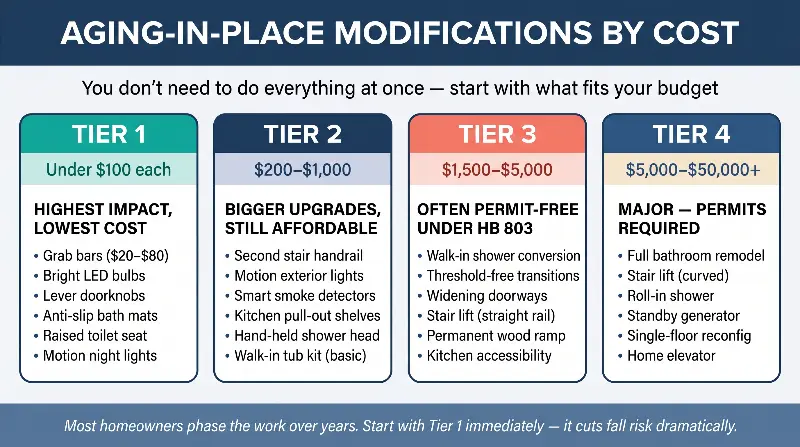
Highest impact, lowest cost
- Grab bars in the bathroom ($20–$80 each)
- Bright LED bulbs throughout
- Lever-handle doorknobs
- Anti-slip bath mats
- Raised toilet seat
- Night lights with motion sensors
- Rubber threshold ramps (small)
Bigger upgrades, still affordable
- Stair handrail added to second side
- Motion-sensor exterior lights
- Smart smoke and CO detectors
- Kitchen pull-out shelves and drawers
- Hand-held shower head with slide bar
- Walk-in tub conversion kit (low end)
- Generator transfer switch
Significant changes, often permit-free under HB 803
- Walk-in shower conversion (basic)
- Threshold-free door transitions
- Widening interior doorways
- Stair lift (basic straight rail)
- Permanent ADA-compliant wood ramp
- Kitchen accessibility (lowered counter section)
- Whole-home generator (portable, basic install)
Major renovations, permits typically required
- Full accessible bathroom remodel
- Stair lift (curved or multi-floor)
- Roll-in shower with curbless transition
- Whole-home generator (standby, hard-wired)
- Single-floor reconfiguration
- Home elevator ($30,000–$80,000+)
- Universal-design kitchen remodel
A practical pattern most homeowners follow: start with Tier 1 immediately (a few hundred dollars cuts fall risk dramatically), move to Tier 2 as needed (often when a spouse's mobility changes), consider Tier 3 around the time you're starting to think about whether to stay, and Tier 4 only when there is a specific medical or mobility reason. You do not need to do everything at once. The 75% of Floridians who want to stay home mostly do it by phasing — not by writing one big check.
Selling or moving? Your biggest tax benefit is on the line.
Most Florida homeowners have tens of thousands of dollars in Save Our Homes protection — and lose it by accident when they move. Check what yours is worth and what happens to it if you sell.
Your Homestead + SOH Cap Is Your Single Biggest Longevity Asset
This is the most important financial point in the article, and the one most homeowners underestimate: your Florida homestead and Save Our Homes cap are saving you real money every year you stay in your home — and that savings is permanent only if you stay.
Here is the math, using a typical Florida example: a home worth $400,000 with 15 years of Save Our Homes protection on it. Compare staying versus selling and buying a similar home at today's market value:
| If you STAY in your current home | If you SELL and buy a similar one | |
|---|---|---|
| Market value | $400,000 | $400,000 |
| Assessed value | $250,000 (capped by Save Our Homes) | $400,000 (resets at purchase) |
| Homestead exemption | − $50,000 | − $50,000 |
| Taxable value | $200,000 | $350,000 |
| Annual property tax (at about $1,800 per $100,000 of taxable value) | $3,600 | $6,300 |
| Difference | — | $2,700 more — every single year |
That $2,700-a-year difference is your single most important longevity asset. Even spending $20,000 on home modifications often pays for itself in about 7 years of preserved Save Our Homes cap savings. And the modifications are partly tax-deductible (see the tax section below), while the lost Save Our Homes protection is not recoverable except through "portability" — the rule that lets you transfer the cap to a smaller Florida home if you move within the state.
Florida has a few additional financial tools that compound this advantage:
- The Save Our Homes portability rule (Fla. Stat. §193.155(8)) lets you transfer your accumulated tax cap to a new Florida home if you do eventually move within the state — but it does not work if you move out of Florida or buy a much smaller home.
- The senior limited-income exemption (Fla. Stat. §196.075) adds up to $50,000 of homestead exemption (more in some counties) for homeowners aged 65+ with limited income. See the programs section below.
- The property-tax deferral (Fla. Stat. §197.252) lets qualifying seniors postpone some or all of their property tax until the home is sold — useful in years when cash is tight.
The New HB 803 Permit Waiver Helps from July 1, 2026
This is genuinely new. Florida's HB 803 (Chapter 2026-63, Laws of Florida), signed by Governor DeSantis on May 6, 2026 and effective July 1, 2026, requires local governments to exempt single-family homeowners from obtaining a building permit for any work valued at less than $7,500. Five trades still require permits regardless of value (electrical, plumbing, structural, mechanical, gas), and work in flood-hazard areas still requires permits, but most Tier 1, Tier 2, and many Tier 3 aging-in-place modifications now qualify for the waiver.
That matters for aging-in-place projects because it removes a real cost and time barrier. A grab-bar installation, a ramp build, a walk-in tub conversion that does not require new plumbing, a doorway widening that does not affect a load-bearing wall — all of these can now proceed without a permit application, fee, or inspection (so long as you submit the simple written request the law requires).
Read our full guide to the HB 803 $7,500 permit waiver for the exact mechanics, exclusions, and HOA implications.
What Federal Taxes Let You Deduct
The IRS lets you deduct home modifications whose main purpose is medical care as a medical expense, under IRS Publication 502 and Section 213(d) of the federal tax code. The mechanics are straightforward:
Improvement cost − increase in home value = deductible medical expense
Two practical catches: you only get to deduct the part of your total medical expenses that goes above 7.5% of your AGI (adjusted gross income — the number near the bottom of your tax return). And you have to itemize on Schedule A (the IRS form for itemizing deductions) instead of taking the standard deduction. If a modification doesn't increase your home's market value — most accessibility ones don't — the full cost counts as a medical expense.
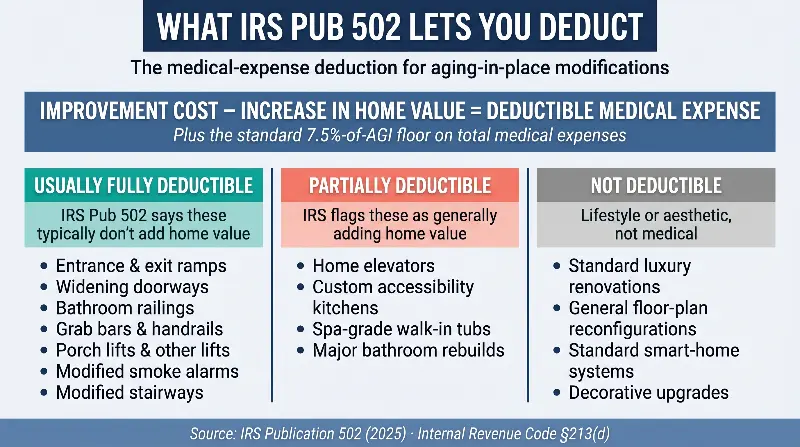
IRS Publication 502 specifically lists the following as modifications that typically do NOT increase home value — meaning the full cost can usually be deducted as a medical expense:
- Entrance and exit ramps
- Widening doorways at entrances and exits
- Bathroom railings and support bars
- Porch lifts and other lifts
- Handrails and grab bars
- Modifications to fire alarms, smoke detectors, and other warning systems
- Modifications to stairways
The IRS flags home elevators as generally adding home value — meaning only part of the cost (the part that exceeds the value increase) can be deducted. For very large modifications, having an appraiser document the before-and-after market value protects the deduction.
For many homeowners on fixed income who already have significant out-of-pocket medical costs (Medicare premiums, supplements, prescriptions, dental, hearing aids), the 7.5%-of-income threshold is reached easily.
Florida Programs You May Not Know About
Florida has more aging-in-place financial help than most homeowners realize. The big ones:
1. The Florida senior limited-income exemption. If you are 65 or older and your household income is below a threshold that adjusts each year (around $36,000 for the 2026 tax year), you may qualify for an additional homestead exemption of up to $50,000 — or up to $250,000 in some counties that have adopted the higher local-option limit. This is a direct reduction of your tax bill, and many eligible Floridians never apply. To claim it, file Form DR-501SC (your county property appraiser's office has the form, and most have it on their website too) by March 1 of the year you want it. Cite: Fla. Stat. §196.075.
2. Florida property-tax deferral for seniors. If you are 65 or older with limited income (or a disabled veteran), Florida lets you postpone some or all of your property taxes until the home is sold. The unpaid taxes become a lien on the home with interest, but you don't have to write the check now. Whether your county participates varies; ask your county tax collector for the application. Cite: Fla. Stat. §197.252.
3. My Safe Florida Home program. Florida's hurricane-mitigation grant program offers free wind-mitigation inspections and grants for hardening improvements like impact windows and reinforced garage doors. The aging-in-place overlap is real: these improvements reduce both storm damage risk and the maintenance burden at a vulnerable time. See our My Safe Florida Home 2026 update.
4. Medicaid waivers for home modifications. Florida's Long-Term Care Medicaid program covers home modifications and in-home care for low-income seniors who medically qualify (through what's called a "Home and Community-Based Services" waiver, or HCBS waiver). Eligibility is strict on assets and income, and there is usually a waitlist. The program is administered through your county's Area Agency on Aging — a network of state-funded local offices that handle senior services. If you might qualify, apply earlier than you think you need to.
5. VA HISA grants for veterans. The VA's Home Improvements and Structural Alterations grant (called HISA for short) pays for home modifications to accommodate a veteran's medical condition. The grant is larger if the condition is service-connected (meaning it was caused by or worsened during military service), but a smaller HISA grant is available for non-service-connected conditions too. Contact your local VA medical center.
6. Medicare Advantage extras. Original Medicare does not pay for home modifications. Some Medicare Advantage plans — the private insurance plans that replace Original Medicare — now offer "supplemental benefits" that include limited home-modification allowances. Check the Evidence of Coverage document for your specific plan; benefits vary widely.
When Aging in Place Stops Working
Honest reassessment is part of the plan. Aging in place is not a one-way commitment — it's an arrangement that works until it doesn't, and the signals that it has stopped working are usually clear in hindsight. Some patterns to watch for:
- Falls that need ER or hospital visits. One serious fall is a wake-up call to add modifications. Repeated falls are a signal that modifications alone are no longer enough.
- A spouse becoming a 24-hour caregiver. The caregiving spouse's health predictably suffers if this continues for years. The financial savings from staying home should not be measured if the cost is a second person's health.
- Memory or cognition changes affecting daily safety. Stove fires, getting lost on familiar streets, medication confusion. Specialized care is hard to replicate at home.
- Social isolation. The home advantage disappears if the community has moved on, friends have moved away, and the home becomes a place of long days alone.
- Cost-prohibitive modifications. If the next round of necessary modifications would cost more than the equity you would gain by selling and moving, the math has shifted.
None of these signals alone necessarily means it's time to move. Two or three of them happening together usually does.
What a Florida CCRC Actually Costs (For Comparison)
For context, here are the rough numbers on the most common alternative: a Continuing Care Retirement Community, or CCRC.
CCRCs (sometimes called "Life Plan Communities") bundle independent-living apartments together with assisted-living, skilled-nursing, and often memory-care — so you move in once and can move between care levels on the same property as your needs change. The economics:
- Upfront entrance fee: typically $100,000 to $1,000,000+, depending on the community, the size of your apartment, and your contract. Some contracts return part of the entrance fee to your estate when you pass; many do not.
- Monthly fee: the average in Naples is around $3,790/month, in Palm Beach County around $3,490/month, both above the national average (per Caring.com market data).
- What's included: meals, housekeeping, maintenance, activities, transportation, and — depending on the contract — some or all of your future medical care.
- Trade-offs: you sell your Florida home, losing your homestead and Save Our Homes cap. The entrance fee is cash that leaves your estate. And contracts vary widely on what happens if you outlive your savings.
The Florida Office of Insurance Regulation regulates CCRCs at floir.gov/home/continuing-care-retirement-communities; that page is a useful starting point if you want to research specific communities.
For a homeowner whose Florida home is worth $400,000 and whose SOH cap is saving $3,000 a year in property tax, the CCRC math is rarely better than staying home unless significant medical needs require the bundled-care structure. For a homeowner whose home requires major modifications, whose family is far away, and who would prefer the social structure of a single community, the CCRC math can be better. The right answer is specific to your situation.
Practical First Steps
If you are reading this and thinking about your own situation, here is a sensible order to start:
- Make your home safer this month. Tier 1 modifications cost a few hundred dollars total and dramatically reduce fall risk. Grab bars, bright lighting, lever doorknobs, raised toilet seat. Do these now whether you have other plans or not.
- Check whether you qualify for the Florida senior exemption. If you are 65+ and your household income is roughly under $36,000 for 2026, file Form DR-501SC (your county property appraiser's office has it, online too) by March 1. This is direct tax savings every year.
- Look up your Save Our Homes savings. Use our SOH portability calculator to see what your cap is actually saving you. This is the financial backbone of the case for staying.
- If you are a veteran, contact the VA about HISA grants and any service-connected modifications you may qualify for.
- If your income is limited, contact your county's Area Agency on Aging. They administer Medicaid HCBS waivers, food programs, and a host of services Floridians often miss.
- If your home is older or in poor condition, consider a wind-mitigation inspection under the My Safe Florida Home program. Free, and identifies improvements that may both protect against storms and qualify for grants.
- Phase the larger modifications. Don't try to do everything at once. Tier 1 immediately. Tier 2 within a year or two as needed. Tier 3 only when there is a specific reason. Tier 4 only when medically necessary.
- Talk to your family. Aging in place works better when family members know the plan, know what to look for, and know the signals that suggest a reassessment.
Frequently Asked Questions
Common questions Florida homeowners ask about aging in place, answered with the underlying source cited where applicable.
Yes — and most Floridians want to. The AARP 2024 Home and Community Preferences Survey found that 75% of adults 50 and older want to stay in their current home as they age. Whether it works for you depends on three things: whether your home can be modified to fit your changing needs, whether you can afford the modifications (Florida law and federal tax rules both help), and whether you have support nearby for the times you need it. For most Florida homeowners, the answer is yes — especially if you plan early and start with the cheapest, highest-impact changes first.
Grab bars in the bathroom. They cost about $20 to $80 each, can be installed in an afternoon, and dramatically reduce fall risk — which is the leading cause of injury for adults 65 and older. Other high-impact under-$100 changes: brighter LED bulbs throughout the house (vision changes), lever-handle doorknobs (easier for arthritic hands), and a raised toilet seat. Together these cost under $300 and often eliminate the biggest day-to-day risks.
Grab bars and most simple bathroom safety changes have never required permits. Starting July 1, 2026, under Florida HB 803, single-family homeowners can also skip the permit for any work valued under $7,500 — which covers many bathroom retrofits, doorway widening, and basic ramps. Five trades still require permits regardless of cost: electrical, plumbing, structural, mechanical (HVAC), and gas. A walk-in shower conversion that requires moving the plumbing still needs a permit, even under $7,500.
Often, yes. Under IRS Publication 502 and Internal Revenue Code §213(d), home modifications whose main purpose is medical care can be deducted as medical expenses. The deductible amount equals the cost of the modification minus any increase in your home's value. IRS Pub 502 specifically lists entrance and exit ramps, widened doorways, bathroom railings and grab bars, porch lifts, and handrails as modifications that typically do NOT increase home value — meaning the full cost can usually be deducted. Home elevators are flagged as generally adding value, so only part of the cost is deductible.
For most aging-in-place modifications, no — at least not in any meaningful way. Florida's Save Our Homes cap (Fla. Stat. §193.155) limits annual increases in your homestead's assessed value to 3% or the change in CPI, whichever is lower. A grab bar, a ramp, or a walk-in shower retrofit will not by themselves push you over that cap. Larger renovations (a bathroom rebuild that adds square footage, for example) can be assessed separately as "improvements," but the basic safety and accessibility modifications most homeowners need rarely move the needle on assessed value.
Florida has several. The senior limited-income exemption under Fla. Stat. §196.075 adds up to $50,000 of homestead exemption (more in some counties) for homeowners 65+ with limited income — directly reducing your tax bill. The senior property-tax deferral under Fla. Stat. §197.252 lets qualified low-income or 65+ homeowners postpone some or all property taxes until the home is sold. The My Safe Florida Home program offers grants for hurricane hardening that can sometimes overlap with accessibility-related work (impact windows, garage door reinforcements). And federal programs like Medicaid Home and Community-Based Services waivers sometimes cover home modifications for medically-eligible Floridians.
Aging in place stops working when one of three things is true: (1) you need more medical or memory care than home modifications can provide and a family member or caregiver cannot fill the gap, (2) the cost of necessary modifications exceeds what you can recover by selling and moving to a more suitable home, or (3) you are increasingly isolated and the home is no longer a place where you can maintain the social connections that matter to your health. The signals are usually clear in retrospect — falls that need ER visits, a spouse becoming a 24-hour caregiver, isolation that becomes depression. Honest reassessment every few years helps.
Original Medicare generally does NOT pay for home modifications themselves — though it does cover medical equipment you can take home (walkers, wheelchairs, hospital beds) when a doctor prescribes it. Some Medicare Advantage plans (the private plans that replace Original Medicare) now offer limited home-modification allowances; check your specific plan's benefits document. Florida Medicaid can pay for home modifications for low-income seniors who medically qualify, through what's called a Home and Community-Based Services waiver, but eligibility is strict and there are usually waitlists. Veterans may qualify for the VA's HISA grant (Home Improvements and Structural Alterations). For your specific situation, contact your county's Area Agency on Aging — the local office for senior services.
Selling or moving? Your biggest tax benefit is on the line.
Most Florida homeowners have tens of thousands of dollars in Save Our Homes protection — and lose it by accident when they move. Check what yours is worth and what happens to it if you sell.
Share this guide
