The short version: almost every reverse mortgage in the United States is the same product — a Home Equity Conversion Mortgage, or HECM. It is backed by the federal government (HUD and the FHA), which is why lenders are willing to offer it. For 2026, the most a HECM will be insured against is $1,249,125 — the same cap nationwide, including in Florida. Florida itself does not have a separate reverse mortgage law; the rules come from federal HUD regulations. Before any HECM can close, you are required to sit down for a one-on-one counseling session with a HUD-approved counselor. The rest of this guide explains, in plain English, what the program does, what it costs, and what is worth thinking about before you sign anything.
HECM = the federally backed reverse mortgage. Pronounced "heck-um." Almost every reverse mortgage is one of these.
Non-recourse = you (and your family) can never owe more than the home is worth. If the loan balance grows bigger than the house's value, the federal insurance covers the difference. The lender cannot come after your other savings or your heirs.
Property charges = the bills you must keep paying even with a reverse mortgage: property taxes, insurance, HOA or condo fees, special assessments, ground rents.
LESA = "Life Expectancy Set-Aside." A pot of money the lender holds back to pay your property taxes and insurance for you automatically. It does NOT pay HOA or condo fees.
Deferral period = the time a surviving spouse who was not on the loan can keep living in the home after the borrower dies, as long as they meet certain conditions.
What a Reverse Mortgage Actually Is
A reverse mortgage is a loan that lets a homeowner aged 62 or older borrow against their home equity without making monthly mortgage payments. Interest accrues on the unpaid balance and is added to what is owed each month. The loan becomes due and must be repaid when the borrower dies, sells the home, or permanently moves out — typically by selling the home or, if heirs want to keep it, by paying off the balance.
Two facts about reverse mortgages are widely misunderstood and worth stating clearly up front:
1. The borrower remains the homeowner. A reverse mortgage is a loan secured by the home, not a sale of the home. The borrower keeps title, the right to occupy, the right to sell, and the responsibility for property taxes, insurance, and maintenance. The lender places a mortgage lien on the property; it does not take ownership.
2. The loan must be repaid. No reverse mortgage gives a homeowner "free money." Interest, mortgage insurance premiums, and servicing fees accrue every month and are added to the balance. Over a decade or two of accrual, the balance can grow substantially and consume most of the home's equity. That is by design — the point of the product is to convert equity into cash — but it is not a free transfer.
The HECM — The Dominant Product
Almost every reverse mortgage a Florida senior will be offered is a HECM. The reason it dominates is simple: the federal government insures the loan, which makes lenders comfortable making it. That same insurance is what protects you and your family under the non-recourse rule.
The 2026 cap is $1,249,125. That is the most the government will insure on a single loan, and it applies the same way in Florida as everywhere else. The cap is not how much you will actually receive. What you can borrow depends on three things:
- How old you are. Older borrowers can borrow a bigger share of the home's value.
- Current interest rates. Higher rates mean less money available.
- The lesser of your home's appraised value or the cap. If your home is worth less than $1.25 million (which describes most homes), the appraised value is what matters.
A small number of "jumbo" reverse mortgages exist for higher-value homes and, in some products, for borrowers as young as 55. They are not HECMs and not federally insured. Most of this guide is about the HECM because it is what you are most likely to be offered.
Source: FHA Mortgagee Letter 2025-22, setting the 2026 cap for FHA case numbers assigned January 1 through December 31, 2026.
Who Is Eligible
To qualify for a HECM, you and your home need to meet four tests:
- Age 62 or older. Every borrower on the deed has to be at least 62. The younger of two borrowers determines how much you can borrow — older means more.
- This is your main home. You have to live in the house as your main residence and keep living there for the life of the loan. Vacation homes and rental properties do not qualify.
- Eligible type of home. Single-family homes work. Two-to-four-unit buildings work if you live in one of them. Condos work only if the condo association is FHA-approved (you can ask your association or look it up on HUD's list). Manufactured homes work if they meet HUD's standards. For Florida condo owners: changes to condo rules in 2025 and 2026 may affect whether your specific building still qualifies — worth checking before you spend on an application.
- You can keep up with the bills. Since 2015, lenders are required to check whether you can afford the ongoing property taxes, insurance, and other charges. They look at your credit, your history of paying property bills, and how much money you have left each month after expenses. If they decide you might struggle, they will require a LESA — the set-aside account that pays your taxes and insurance for you automatically out of your loan money.
Living in Florida or having a homestead exemption does not change any of these federal rules. Florida does not add its own qualifications.
The Three Ongoing Requirements (And Why They Matter in Florida 2026)
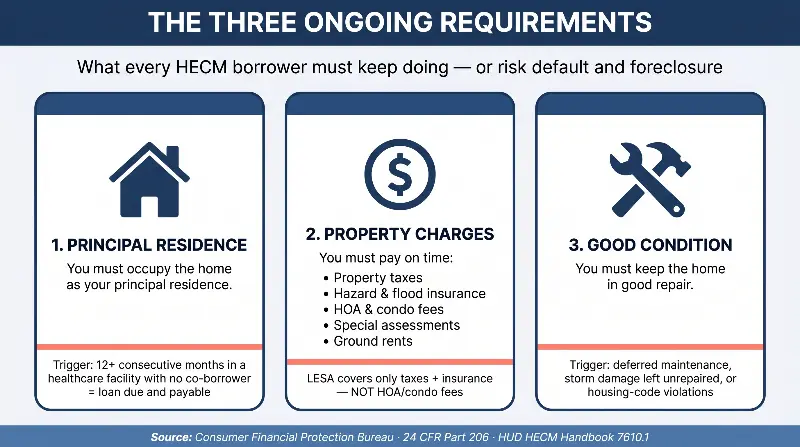
This is the part Florida seniors most need to understand. Once you have a HECM, you have to keep doing three things for the rest of the loan. Failing any one of them can put you into default and, ultimately, foreclosure — even though you are not making mortgage payments. The three are:
- Live in the home as your main home. If you leave for more than 12 months in a row to go into a hospital, rehab, nursing home, or assisted living — and no other borrower is still in the house — the loan must be paid off.
- Pay the property bills on time. That means property taxes, homeowners insurance, flood insurance, ground rents, HOA fees, condo fees, and special assessments.
- Keep the home in good shape. Letting the property fall apart counts as a separate default reason, even if your bills are current.
Three Florida-specific pressures in 2026 make ongoing affordability a stricter test than it would be in other states:
1. The insurance squeeze. Florida insurance premiums have shot up, and carriers have been dropping policies. If you cannot keep insurance in force, the lender will buy you an expensive replacement policy (called "force-placed coverage") and add it to your bill. If you still cannot keep insurance going, the loan can be called due. (See our Citizens take-out letters article.)
2. The HOA and condo fee gap. The LESA — the set-aside that pays your taxes and insurance automatically — does not pay HOA fees, condo fees, or special assessments. Those bills are still on you. With Florida's 2025 condo law forcing buildings to fund repairs they had been putting off, fees and special assessments have jumped sharply (see our SIRS article). If your condo board votes a $30,000 special assessment and you cannot pay it, that unpaid bill can become a lien that triggers HECM default.
3. Hurricane damage. If a storm damages your home and you cannot get it repaired, you can fall out of compliance with the "keep the home in good shape" rule. Insurance money for repairs may also go straight to the lender for those repairs, not to you.
Back in 2012, the federal consumer protection agency reported that 9.4% of reverse mortgage borrowers were behind on their property taxes or insurance — about 54,000 seniors at risk of losing their homes. That number is from before the 2015 rules that required lenders to check whether borrowers could keep up with the bills, so today's default rate is lower. But the pattern still holds: people who lose their homes after taking out a reverse mortgage almost always lose them because they fell behind on taxes, insurance, or HOA fees — not because they made a bad investment.
Selling or moving? Your biggest tax benefit is on the line.
Most Florida homeowners have tens of thousands of dollars in Save Our Homes protection — and lose it by accident when they move. Check what yours is worth and what happens to it if you sell.
Costs and Disbursement Options
Reverse mortgages have two kinds of cost: what you pay upfront at closing, and what builds up against your loan balance every month.
Upfront costs (paid at closing). These include an origination fee paid to the lender, an upfront mortgage insurance premium paid to the FHA, third-party closing costs (appraisal, title search, recording fees), and the HUD-approved counseling fee. Together they typically run 4–6% of the home's value — meaning you commonly spend $20,000 to $40,000 on a $500,000 home before any loan money reaches you. Ask your counselor to walk through the specific 2026 numbers, since they are updated by HUD periodically.
Ongoing costs (added to your balance). Every month, the lender adds interest, an ongoing mortgage insurance premium, and a small servicing fee to what you owe. You are not paying these in cash — they just keep growing the loan balance. Over 10 or 20 years they add up to a substantial amount.
How you actually receive the money. The HECM program lets you pick how you get the money. Your choice matters more than you might think — research has shown that people who take the money in one big upfront payment have a much harder time keeping up with property taxes and insurance later. Your options are:
| Option | What you get |
|---|---|
| Lump sum | One single payment at closing. Available only on fixed-rate loans. Historically the most likely to lead to trouble later because the money runs out. |
| Tenure | Equal monthly payments for as long as at least one borrower keeps living in the home. |
| Term | Equal monthly payments for a set number of months you choose (for example, 10 years). |
| Line of credit | You take money out as you need it. The portion you have not used actually grows over time at the loan's rate. Often considered the most flexible option. |
| Combination | Some monthly payments plus a smaller line of credit. |
Surviving Spouses, Heirs, and What Happens to the Home
Two groups of people need to understand what happens to the home after the borrower dies or moves into long-term care: a surviving spouse who is not on the loan, and the family members who will inherit.
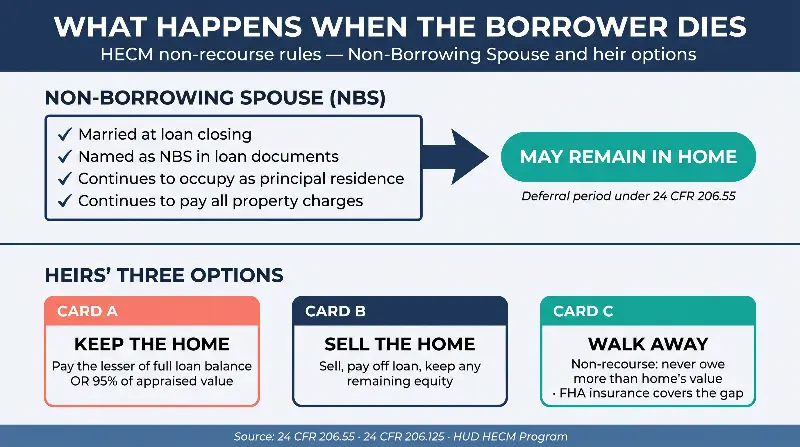
If your spouse is not on the loan. If you are getting a HECM and your spouse will not be on the loan with you (often because they are under 62), it is critical that they be officially named as a "Non-Borrowing Spouse" in the loan documents. If they are properly named and they (a) were already married to you when the loan closed, (b) keep living in the home, and (c) keep paying the property taxes, insurance, and HOA fees after your death, they can stay in the home for the rest of their life. That is the deferral period. A spouse who is NOT named as a Non-Borrowing Spouse at closing has no automatic right to stay and could be forced to leave. Make sure the lender names your spouse correctly.
If your children or other heirs inherit. When you die (or you and your spouse both die or permanently move out), the loan becomes due. Your family has four choices:
- Keep the home by paying off the lesser of (a) the full loan balance or (b) 95% of what the home is worth. The 95% rule matters: even if the loan balance has grown larger than the home's value, your family only has to pay 95% of the home's value to keep it.
- Sell the home, pay off the loan, and keep whatever equity is left over.
- Hand the home back to the lender with a "deed in lieu of foreclosure" — nobody pays anything and there is no foreclosure on the family's record.
- Walk away entirely. Because of the non-recourse rule, your family is never personally on the hook. If the loan balance is bigger than the home's value, federal insurance pays the lender the difference. Your family does not.
In Florida, the home goes through normal Florida probate like any other inherited asset. Probate typically takes 6 to 12 months, sometimes longer. Your heirs usually have about 30 days after your death to tell the lender what they plan to do, with extensions available. A Florida estate attorney who knows reverse mortgages can walk your family through it.
Does Florida Have Its Own Reverse Mortgage Law?
This is worth a short answer because secondary sources often suggest otherwise: Florida does not have its own reverse mortgage product law. The actual rules — who qualifies, what the cap is, what your rights are, what happens to your spouse and heirs — come from federal HUD and FHA regulations. Florida state law simply points to the federal definition.
What Florida does provide is a general consumer-protection statute, the Florida Deceptive and Unfair Trade Practices Act, that applies if a lender or salesperson misleads you. So if you ever feel pressured or misled about a reverse mortgage in Florida, that statute (along with federal protections) is what your attorney would use.
The practical takeaway: the rules you actually need to understand come from the federal HUD-approved counseling session, not from Florida state law.
Pros and Cons — Fairly Stated
Below is a balanced summary of what reverse mortgages do well and what they can do badly. Both sides are real. The right answer for you depends on your specific situation, not on a generic list.
What HECMs do well
- Cash without monthly payments. You can turn part of your home equity into spendable money without ever making a monthly mortgage payment.
- Family is never on the hook. Thanks to the non-recourse rule, you and your heirs can never owe more than the home is worth. Federal insurance covers any shortfall.
- You stay in your home. A reverse mortgage does not sell your home. You keep title and the right to live there as long as you meet the three requirements.
- Choice of how you get the money. Monthly payments for life, a line of credit you draw on as needed, or a combination. The line-of-credit option even grows over time.
- Federal backstop. If your lender goes out of business, the FHA's insurance makes sure your scheduled payments keep coming.
- Set-aside option for taxes and insurance. If you need it, the LESA pays your property taxes and homeowner's insurance for you automatically.
- Not taxed as income. The money you receive is a loan, not income, so it does not show up on your taxes.
What HECMs can do badly
- Expensive to start. Closing costs commonly run 4 to 6 percent of the home's value, so $20,000 to $40,000 on a $500,000 home before any money reaches you.
- Balance keeps growing. Interest and fees are added every month. Over 10 to 20 years, the balance can eat most of your home equity.
- You can still lose the home. Falling behind on property taxes, insurance, HOA dues, or special assessments can put you in default — even though you have no mortgage payment to miss.
- Spouse risk. If your spouse is not on the loan and not properly named as a Non-Borrowing Spouse, they may have to leave the home after you die.
- Harder to borrow against the home later. Refinancing or getting a home equity line on top of a HECM is much harder.
- Less to leave the family. Your heirs typically inherit less equity than they would if you had not taken out the loan.
- Aggressive marketing in the industry. The required counseling exists because misleading sales pitches have been a problem for decades. Florida's consumer protection law also applies if you are misled.
Florida-Specific Alternatives to Consider First
Before signing a reverse mortgage, it is worth at least looking into the other options below. None of these is automatically better than a HECM — they fit different situations — but they are easy to overlook in a sales conversation. A HUD counselor will go through these with you.
- Florida property tax deferral for seniors. Florida law lets qualifying homeowners aged 65 and older with limited income postpone paying part or all of their property taxes until the home is sold. The unpaid taxes become a lien on the home (with interest) instead of cash you owe each year. Rules and income limits vary by county — check with your county tax collector.
- Extra senior exemption on your property taxes. Florida offers an additional homestead exemption of up to $50,000 (or up to $250,000 in some counties) for homeowners 65+ with limited income. This reduces your tax bill without touching your home equity. Many eligible seniors never claim it.
- Downsize and bring your tax cap with you. Florida's "Save Our Homes" rule lets you transfer your existing tax cap to a smaller home if you move within Florida. Combining downsizing with this transfer can dramatically reduce your monthly costs (smaller home, smaller bills) while preserving your tax savings. See our SOH portability calculator.
- Home equity line of credit (HELOC) or cash-out refinance. If you still have income that qualifies you, a regular HELOC or refinance is often much cheaper upfront than a HECM. The trade-off is that you have to make monthly payments.
- Government benefits you may not be claiming. Many Florida seniors are eligible for benefits they have not signed up for — SNAP, LIHEAP energy assistance, Medicare Savings Programs, and prescription drug help. Adding these up can reduce your monthly expenses enough that a reverse mortgage stops feeling necessary. A HUD counselor checks these as part of the required session.
- "Sale-leaseback" companies. Some companies offer to buy your home outright and rent it back to you. These are not federally regulated like a HECM, the terms vary wildly, and there are real horror stories. If you consider one, get independent legal advice before signing anything.
The Mandatory HUD Counseling Step
Federal law requires every borrower, every spouse, and any other owner of the home to sit down for a one-on-one counseling session with a HUD-approved counselor before signing a reverse mortgage. The counselor is independent — they do not work for the lender, and they have no financial interest in whether you take the loan. They issue a certificate at the end. No lender can close your reverse mortgage without that certificate in hand.
The counselor's job is to walk you through the things that matter for your specific situation:
- How the loan actually works — how the balance grows over time, and how it gets repaid in the end.
- The three ongoing requirements and how to keep up with them.
- What happens to your spouse if they are not on the loan.
- What happens to your family when you die.
- How much it actually costs — upfront fees and ongoing charges.
- Whether it affects your government benefits like Medicaid or SSI.
- The alternatives — including the Florida options listed above — so you can compare.
Counseling sessions are inexpensive (often $100 to $200) and can sometimes be waived if money is tight. Do not rely on the lender to set up the counseling. Find your own counselor through the official HUD list to make sure you get someone genuinely independent. Treat this session as the most important step in the decision — not a box to check.
Frequently Asked Questions
Common questions Florida seniors and their families ask about reverse mortgages, answered with the underlying federal regulation or Florida statute cited.
A reverse mortgage is a loan that lets a homeowner aged 62 or older borrow against their home equity without making monthly mortgage payments. Interest accrues on the unpaid balance and is added to what is owed. The loan is repaid when the borrower dies, sells the home, or permanently moves out — typically by selling the home or by heirs paying off the balance to keep it. The dominant product in the United States is the federally insured Home Equity Conversion Mortgage (HECM), administered by HUD and the FHA.
For FHA case numbers assigned January 1 through December 31, 2026, the HECM Maximum Claim Amount is $1,249,125, per FHA Mortgagee Letter 2025-22. It is a single nationwide cap (150% of Freddie Mac's 2026 conforming limit of $832,750) that applies uniformly to Florida and all other states. The figure is the maximum claim amount HUD will insure — it is not the amount any individual borrower will receive, which depends on age of the youngest borrower, current interest rates, and the lesser of the appraised home value or the Maximum Claim Amount.
Per the Consumer Financial Protection Bureau and HUD's HECM program: (1) the home must remain the borrower's principal residence, (2) the borrower must pay property charges on time (property taxes, hazard and flood insurance, ground rents, condominium fees, homeowners' association fees, and special assessments), and (3) the borrower must keep the home in good condition. Failing any of the three may lead to default and foreclosure. The HUD Life Expectancy Set-Aside (LESA) covers only taxes and hazard/flood insurance — it does not cover HOA or condo fees, leaving Florida condo and HOA borrowers personally responsible for those charges.
No, not really. Florida does not have its own reverse mortgage rules — state law simply points to the federal definition. The product rules you actually deal with (eligibility, costs, your rights, what happens to your spouse and heirs) all come from federal HUD regulations. Florida does have a general consumer protection law that applies if a salesperson misleads you, but the substantive product rules are federal.
For loans taken out after August 2014, your spouse can be protected — but they have to be officially named as a "Non-Borrowing Spouse" in the loan paperwork. If they are named, and they (a) were already married to you when the loan closed, (b) keep living in the home, and (c) keep paying the property taxes, insurance, and HOA fees after your death, they can stay in the home for the rest of their life. A spouse who is NOT named at closing has no automatic protection and may be forced to leave. Make absolutely sure your lender names your spouse correctly.
Your family has four options. They can keep the home by paying off the lesser of (a) the full loan balance or (b) 95% of what the home is worth. They can sell the home, pay off the loan, and keep any leftover equity. They can hand the home back to the lender (no foreclosure on their record). Or they can walk away. Thanks to the non-recourse rule, your family is never personally responsible. If the loan balance is bigger than the home's value, federal insurance pays the lender the difference — not your family.
Three pressures make the property-charge requirement more demanding in Florida than in many states. First, the Florida property insurance market has produced sharply higher premiums and frequent non-renewals; if a homeowner cannot maintain hazard insurance, the lender may force-place coverage and accelerate the loan. Second, condo and HOA fees are rising rapidly as buildings comply with the 2025 Structural Integrity Reserve Study (SIRS) law, and HECM LESA does not cover those fees. Third, condo special assessments (sometimes tens of thousands of dollars at once) are unpredictable, and a missed assessment can become a lien that triggers default. None of these risks unique to Florida automatically disqualify a borrower; they make ongoing affordability a stricter test.
Before signing a HECM, a Florida senior should at least consider: (a) Florida property-tax deferral under Fla. Stat. §197.252 for qualified low-income or age 65+ homeowners; (b) the senior limited-income exemption under Fla. Stat. §196.075 (up to an additional $50,000 of homestead exemption with income and age qualifications); (c) downsizing combined with Save Our Homes portability under Fla. Stat. §193.155(8) to preserve the existing tax cap on a smaller home; (d) a HELOC or cash-out refinance if income still qualifies; and (e) consulting a HUD-approved counselor before any product decision. The point is not that any one of these is better — the point is that they should be ruled out first.
Selling or moving? Your biggest tax benefit is on the line.
Most Florida homeowners have tens of thousands of dollars in Save Our Homes protection — and lose it by accident when they move. Check what yours is worth and what happens to it if you sell.
Share this guide
