Buying a home with someone you're not married to is one of the most powerful ways to beat Florida's affordability wall — and one of the easiest ways to create a legal mess. Two incomes qualify for more house. Shared costs make the mortgage, insurance, and taxes survivable. But the moment two or more names go on a deed, you've created a legal relationship that Florida law governs whether you planned for it or not. The difference between a smart co-buy and a painful one comes down to three things: how you take title, how homestead applies to each of you, and whether you have an exit plan in writing.
Who can: Friends, partners, siblings, parent + adult child — not just married couples
How to hold title: Tenancy in common (flexible, unequal shares, no survivorship) or joint tenancy with right of survivorship (equal shares, auto-passes to survivors). Tenancy by the entirety is married-only.
Homestead: Applies only to owners who live there — and only to their share
Mortgage: Co-borrowers are each liable for the whole loan
Exit: Any co-owner can force a sale by partition — a written co-ownership agreement is your protection
Why Co-Buying Is on the Rise
Florida's cost of ownership has climbed on every front at once — home prices, mortgage rates, property insurance, and, for many, HOA and condo assessments. For a lot of would-be buyers, one income simply doesn't stretch far enough. Pooling resources with someone you trust changes the math: combined income qualifies for a larger loan, and splitting the monthly carrying costs makes an otherwise unaffordable home workable.
That's why co-buying among non-couples is growing — two friends splitting a starter home, siblings keeping a family property, an unmarried couple building together, or a parent helping an adult child get in. The upside is real. The key is to treat it like the significant legal and financial partnership it is.
The 4 Ways to Hold Title in Florida
How you take title is the single most important decision, because it controls what happens when an owner dies, wants out, or runs into creditors. Florida recognizes a few distinct forms:
1. Tenancy in Common (TIC) — the flexible default
Florida's default form of co-ownership under Statute 689.15. Each owner holds a separate share that can be equal or unequal (useful when people contribute different down payments). There's no automatic survivorship — when an owner dies, their share passes to their own heirs or estate. Any co-owner can sell or mortgage their own share independently. Most flexible, but the "share goes to my heirs" feature surprises people.
2. Joint Tenancy with Right of Survivorship (JTWROS) — avoids probate
Owners hold equal, undivided shares, and when one dies their share automatically passes to the surviving owners, bypassing probate. It must be created with explicit survivorship language in the deed (for example, "as joint tenants with right of survivorship") and requires the four "unities" — time, title, interest, and possession — meaning owners take equal shares through the same deed at the same time.
3. Tenancy by the Entirety — married couples only
A special form with strong creditor protection, but it is available only to legally married spouses. Unmarried co-buyers cannot use it. It's worth knowing exists so you understand why co-buyers don't get that extra layer of protection automatically.
4. Ownership through an LLC — the advanced option
Some co-buyers, especially for investment or higher-asset situations, hold the property in a limited liability company and govern it with an operating agreement. This adds liability separation and a built-in framework for shares, contributions, and exits — but it can complicate financing and forfeits the homestead exemption, since an LLC isn't a person's permanent residence. Get professional advice before going this route.
TIC vs. JTWROS at a Glance
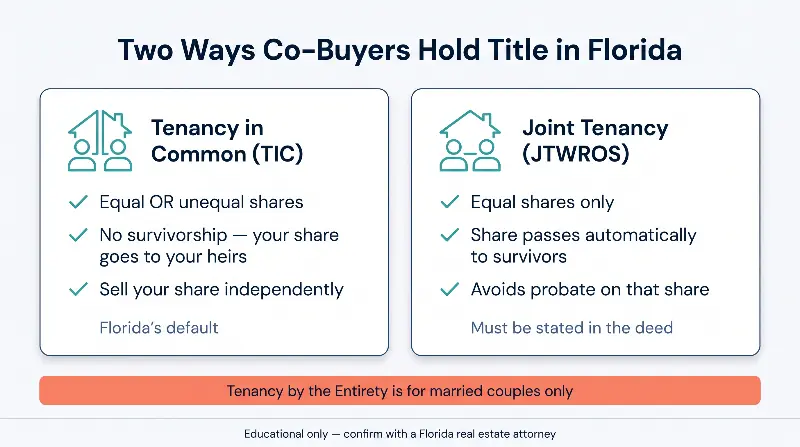
| Feature | Tenancy in Common | Joint Tenancy (JTWROS) |
|---|---|---|
| Ownership shares | Equal or unequal | Equal only |
| If an owner dies | Share goes to their heirs / estate | Share passes to surviving owners |
| Avoids probate? | No | Yes (for that share) |
| Sell your share alone? | Yes | Yes, but it breaks the joint tenancy |
| Florida default? | Yes (Statute 689.15) | No — needs explicit deed language |
| Best for | Unequal contributions; keeping your share in your own family | Partners who want the home to pass to each other automatically |
Which Structure Fits You?
Answer three quick questions for a starting point. This is an educational pointer, not legal advice — your attorney should confirm the right structure and draft the deed.
Co-Ownership Structure Helper
A quick starting point — confirm with a Florida real estate attorney
Educational pointer only, not legal advice. A Florida real estate attorney should confirm the structure and prepare your deed and agreement.
Selling or moving? Your biggest tax benefit is on the line.
Most Florida homeowners have tens of thousands of dollars in Save Our Homes protection — and lose it by accident when they move. Check what yours is worth and what happens to it if you sell.
Homestead & Save Our Homes for Co-Owners
This is where co-buying gets Florida-specific — and where a lot of people are caught off guard. The homestead exemption and the Save Our Homes cap don't automatically cover the whole property just because someone lives there.
Homestead applies only to owners who make the home their permanent residence — and only to their proportional share. If two friends each own 50% and both live there, each can claim homestead benefits on their own 50%. But if one owner lives elsewhere, that owner's share is not homestead property.
Florida's famous homestead creditor protection follows residency, not just title. A non-resident co-owner's share is not shielded — that owner's creditors may be able to reach it, potentially forcing a sale of the interest. If a parent and adult child co-own but only one lives there, the other's share is exposed. Structure and residency matter.
The Save Our Homes benefit follows the same logic: when co-owners later move, the accumulated assessment differential is divided by each owner's proportionate interest, and each resident owner can port their share to a new homestead. There's also an income-tax upside — each owner-occupant may be able to claim their own federal $250,000 capital gains exclusion on their share when the home is sold, potentially sheltering more total gain than a single owner could.
Every co-owner who lives in the home and wants the exemption files their own homestead application (Form DR-501) with the county property appraiser by March 1. Don't assume one filing covers everyone — it doesn't.
The Mortgage & Liability Trap
Ownership (title) and the loan (mortgage) are two different things — and the loan is where the shared risk concentrates. If you're co-borrowers on the same mortgage, you're each liable for the entire loan, not just your share. If one person stops paying, the lender can come after the others for the full amount, and the late payments hit everyone's credit.
Some co-buyers put one person on the loan and everyone on title, but that loads all the borrowing risk (and credit benefit) onto one person. All co-borrowers also have to qualify with the lender, so one person's weak credit can raise the rate or sink the approval for the group. Decide deliberately who borrows, who's on title, and how you'll handle a month someone can't pay — before closing, not after.
The Co-Ownership Agreement: Your Most Important Document
The deed says who owns the home. A co-ownership agreement (sometimes a cohabitation or property agreement) says how you'll run it — and how you'll unwind it. It's the single best thing you can do to protect both the money and the relationship. Have a Florida real estate attorney draft it before you close.
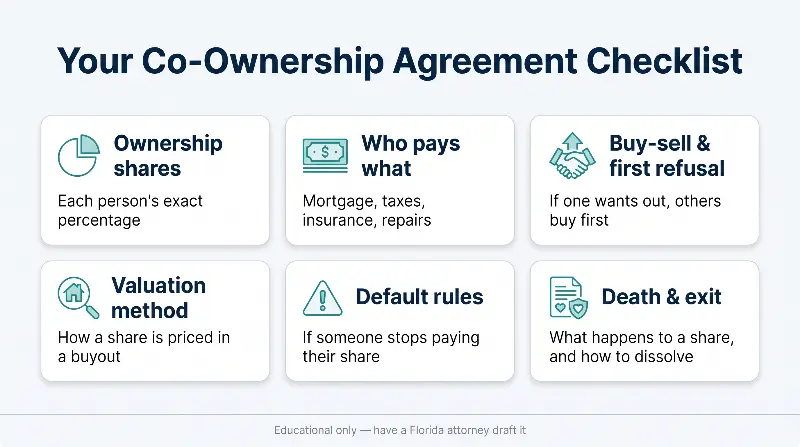
What the agreement should cover
- Ownership shares — each person's exact percentage
- Who pays what — mortgage, taxes, insurance, HOA, repairs, and how they're split
- Buy-sell / right of first refusal — if one wants out, the others get first chance to buy the share
- Valuation method — how the home (or a share) is priced in a buyout, e.g. an appraisal, to avoid lowball fights
- Default rules — what happens if someone stops paying their share
- Death and exit — what happens to a share on death, and the orderly way to dissolve the co-ownership
The Exit: Partition Actions
Here's the reality that makes the agreement so important. Under Chapter 64 of the Florida Statutes, any co-owner can file a partition action asking a court to divide the property or force its sale — even if the other owners object. The right to partition is treated as nearly absolute, because Florida courts won't force people to stay co-owners against their will.
That's a powerful backstop, but it's a blunt and expensive one: partition litigation costs real money in legal fees, takes time, and can permanently damage a friendship or family relationship. It's the default exit when co-owners can't agree — which is exactly why you want a negotiated exit (buy-sell, right of first refusal, agreed valuation) written down in advance, so you rarely have to reach for the courthouse.
What to Do Before You Sign
Your co-buying checklist
- Decide how you'll hold title — TIC or JTWROS — and put the exact language in the purchase contract and deed. Don't leave it to be sorted out at closing.
- Sort out the mortgage — who borrows, who's on title, and how you'll cover a missed month.
- Get a co-ownership agreement drafted by a Florida real estate attorney before closing.
- Plan your homestead — each resident owner files their own homestead application by March 1 to claim their share of the exemption.
- Talk about death and exits now — wills or survivorship for what happens if an owner dies (see writing a Florida will), and a clear buyout path if someone wants out.
Co-buying can be the smartest move in a tough market — as long as everyone goes in with eyes open. If a co-ownership ever needs to unwind, understanding your capital gains, your Save Our Homes benefit, and how title transfers work (much like it does in a divorce split) will help you exit with the most money and the fewest surprises.
Frequently Asked Questions
Common questions about buying a Florida home with a friend, partner, or family member.
Yes. Friends, unmarried partners, siblings, and parents and adult children can all buy a Florida home together. They typically hold title either as tenants in common (separate, possibly unequal shares, no automatic survivorship) or as joint tenants with right of survivorship (equal shares that pass automatically to the surviving owners). Tenancy by the entirety, which offers extra creditor protection, is only available to married couples. Because the default in Florida is tenancy in common, the deed must clearly state your intended arrangement.
With tenancy in common, each owner holds a separate share that can be equal or unequal, and when an owner dies their share passes to their own heirs or estate, not the other owners. Any tenant in common can also sell or mortgage their share independently. With joint tenancy with right of survivorship, owners hold equal shares and a deceased owner's share automatically passes to the surviving owners, avoiding probate. Joint tenancy must be created with explicit survivorship language in the deed and requires the four "unities" of time, title, interest, and possession. Tenancy in common is Florida's default under Statute 689.15 unless the deed says otherwise.
The Florida homestead exemption applies only to owners who make the property their permanent residence, and only to their proportional ownership share. If a co-owner does not live in the home, that owner's share is not homestead property. For example, a resident who owns a 50% interest can claim homestead benefits on that 50% share. This also affects creditor protection: a non-resident co-owner's share is not shielded by Florida homestead protection, so that owner's creditors may be able to reach it.
Usually yes. If you are co-borrowers on the same loan, you are each jointly and severally liable for the entire mortgage, not just your share. If one co-owner stops paying, the lender can pursue the others for the full amount, and a missed payment hurts everyone's credit. Some co-buyers put one person on the loan and others on title only, but that concentrates the borrowing risk on one person. All co-borrowers must qualify with the lender.
Under Chapter 64 of the Florida Statutes, any co-owner can file a partition action asking a court to divide or force the sale of the property, even over the objection of the others. The right to partition is considered nearly absolute, and courts will not force people to remain co-owners. Partition litigation is expensive and can damage relationships, which is why a written co-ownership agreement with a buy-sell clause and a valuation method is the best way to plan an orderly exit before a dispute happens.
It is strongly recommended. A co-ownership (or cohabitation) agreement sets out each person's ownership share, who pays what portion of the mortgage, taxes, insurance, and repairs, what happens if someone wants out or stops paying, how the property is valued in a buyout, a right of first refusal, and what happens on death. Without one, Florida's default rules apply and the only exit when co-owners disagree may be a costly partition lawsuit. Have a Florida real estate attorney draft it before closing.
Selling or moving? Your biggest tax benefit is on the line.
Most Florida homeowners have tens of thousands of dollars in Save Our Homes protection — and lose it by accident when they move. Check what yours is worth and what happens to it if you sell.
