
The tax figure on a listing belongs to the seller, not to you. When a longtime owner sells, the tax discount they built up over years does not come with the house. The day you buy, the county resets the home's taxable value to today's full market value -- so your bill is calculated on what you paid, not on what the seller was paying. On a home someone owned for a decade, that can mean double the taxes, or more. Here's exactly why it happens, and how to see your real number before you sign.
Why It Happens: Save Our Homes Resets on Sale
Florida's Save Our Homes cap limits how much a homesteaded property's assessed value can rise -- no more than 3% (or inflation) per year, no matter how fast the market climbs. Over time, that creates a widening gap between a home's market value and its much-lower taxed value. It's a fantastic benefit -- for the person who has it.
The catch: that benefit belongs to the owner, not the property. When the home changes hands, Florida law removes the prior owner's cap and reassesses the property at just value (full market value) as of January 1 of the year after the sale. You start fresh -- at today's price.
"When they receive their first tax bill after the sale, with their reset rate, it's at the current [market value]."
— Amy Mercado, Orange County Property Appraiser
A Real Example: Same House, Double the Tax
Orange County's property appraiser lays it out simply: someone who bought for $100,000, lived there 10 years while the home rose to $300,000, might pay only about $1,000 a year in taxes. The new buyer? They are taxed on the full $300,000 -- a far bigger bill for the identical house.
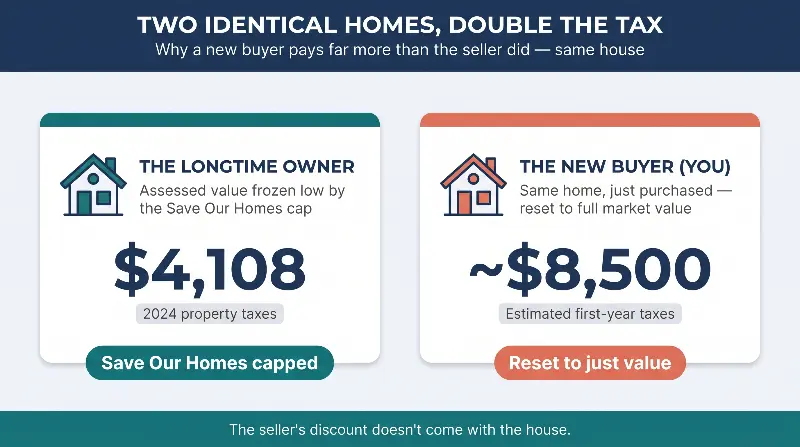
A 2025 Lake Orlando listing showed it in black and white: priced at $535,000, with the previous owner's 2024 taxes of $4,108 displayed on the listing -- but an estimated $8,225–$9,194 for a new buyer claiming homestead for the first time. Same house. Roughly double the tax.
The Trap: Don't Trust the "Taxes" Number on the Listing
That tax figure on the listing -- or on Zillow or Redfin -- is the seller's number, built on their capped, frozen value. For you, it is close to meaningless, and buyers who budget off it are the ones who get blindsided.
The higher bill doesn't show up at closing. Your home is reassessed at just value on January 1 after you buy, so the new number appears on your TRIM notice the following August and your tax bill that November -- often more than a year after you moved in.
How to Estimate Your Real Bill Before You Buy
You can get a realistic number in about ten minutes. Don't rely on the listing -- run the math yourself.
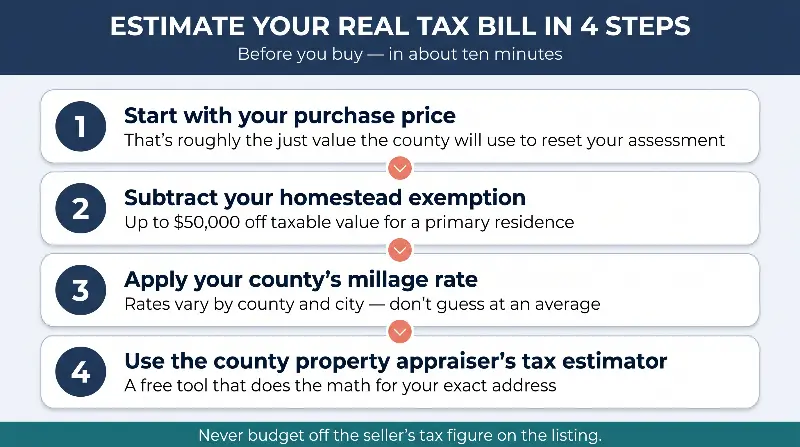
- Start with your purchase price. That's roughly what the county will use as your new "just value."
- Subtract your homestead exemption if it will be your primary residence -- currently up to $50,000 off the taxable value (only $25,000 of it applies to the school-tax portion).
- Apply your county's millage rate to what's left. Rates vary by county and city, so don't guess at a statewide average.
- Use the county property appraiser's tax estimator. Almost every Florida county has a free "new buyer" or tax-estimator tool that does this math for your exact address -- search "[your county] property appraiser tax estimator."
If the November 2026 ballot amendment passes, the homestead exemption grows to $150,000 in 2027 and $250,000 in 2028 -- but only for non-school taxes, and newly arrived residents wait several years to qualify. See our $250,000 exemption guide for how that would change your math.
One Way to Soften the Blow: Portability
Here's the part that helps if you're already a Florida homeowner moving to a new place: you don't have to leave your Save Our Homes savings behind. Florida's portability rules let you transfer up to $500,000 of your accumulated benefit to your next Florida home, shrinking the reset.
- Re-establish homestead on the new home within three tax years
- File the portability application (Form DR-501T) with your county by March 1
- At least one owner must be the same on both the old and new homestead
If you're moving to Florida for the first time, you don't have a benefit to bring yet -- so you'll start at full market value. Either way, knowing this before you buy is what separates a smart purchase from a budget-busting surprise.
See what you'll really pay -- and what your Save Our Homes benefit is worth.
Most Florida buyers underestimate their first tax bill by thousands. Check your numbers and, if you're moving, how much of your Save Our Homes benefit you can carry with you.
Frequently Asked Questions
Share this guide
