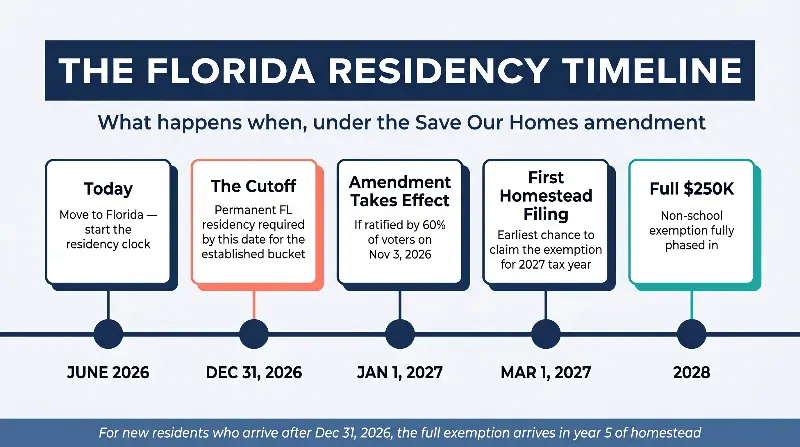
Florida's Save Our Homes amendment (CS/HJR 1F) doesn't just raise the homestead exemption. It introduces a one-time line in the sand: the constitutional test of whether you were a permanent Florida resident as of December 31, 2026. Cross that line on the right side and your homestead's non-school exemption rises from $50,000 today to $150,000 in 2027 and $250,000 in 2028. Cross it on the wrong side and you receive only a $50,000 non-school exemption for your first four years as a homesteader. The Legislature designed it that way to give existing Floridians the benefit without fueling a fresh migration wave. The test is statutory and factual: it does not depend on owning property, on having a homestead exemption, or even on having lived in Florida for any particular length of time — only on whether Florida is genuinely your permanent home on that single date.
What the Amendment Actually Does
The Florida Legislature passed the Save Our Homes amendment (CS/HJR 1F) on June 2, 2026 (House 75–26, Senate 30–9), placing it on the November 3, 2026 statewide ballot under the ballot title "Save Our Homes from Excessive Property Taxes." Under Fla. Const. art. XI, §5, the amendment needs 60% voter approval to take effect. If approved, its provisions begin January 1, 2027.
The amendment has four substantive moving parts:
1. The headline number — a much larger homestead exemption. Today, Florida homestead owners exempt the first $25,000 of assessed value from all property taxes (schools included), and an additional $25,000 above $50,000 of assessed value from non-school taxes, for a total non-school exemption of $50,000 (Fla. Stat. §196.031). The amendment leaves the school portion alone but raises the non-school exemption in two steps: to $150,000 beginning January 1, 2027 and to $250,000 beginning January 1, 2028. The $250,000 figure is adjusted annually for inflation thereafter using CPI-U.
2. School taxes are untouched. The amendment explicitly excludes school district levies. On a typical Florida tax bill, school taxes are roughly 35–40% of the total. Even with the full $250,000 exemption, the school portion of the bill stays the same.
3. The non-homestead cap drops from 10% to 5%. The 10% annual assessment-increase cap on non-homestead property (rentals, second homes, commercial property) under Fla. Stat. §§193.1554 and 193.1555 drops to 5% beginning January 1, 2027. This applies to all non-homestead property regardless of when the owner became a Florida resident.
4. The five-year residency rule. The provision that matters most for new residents. The amendment creates a two-bucket system: established Florida residents receive the full exemption; people who were not Florida residents on December 31, 2026 receive a smaller exemption for their first four years and step up in year five.
The amendment also directs the Legislature, through general law, to develop a schedule for the further elimination of homestead property taxes. That schedule is not yet defined; the amendment leaves the timetable and dollar amounts to future legislation.
A closer look at the 10%-to-5% non-homestead cap
The cap drop is the amendment's quieter half, but it matters — particularly for snowbirds with a Florida second home, landlords who own rental property in Florida, and owners of commercial real estate. Under current law, the assessed value of any non-homestead Florida property cannot rise more than 10% per year, regardless of how fast the market value moves. That ceiling is in two places: Fla. Stat. §193.1554 for residential non-homestead property (vacation homes, rentals of up to nine units) and Fla. Stat. §193.1555 for all other property — nonresidential plus any residential property not assessed under §193.155 or §193.1554 (commercial buildings, larger rentals, raw land). The Florida Constitution authorizes both caps under Article VII, Section 4(g) and (h).
Beginning January 1, 2027, the amendment halves the ceiling to 5% per year. In year one the effect is small — just a slower-than-otherwise increase. Over a decade of compounding the difference is substantial. A non-homestead property whose market value doubles over ten years would see its assessed (and therefore taxable) value rise considerably more slowly under the 5% cap than under the 10% cap, shielding the owner from a portion of the corresponding tax increase. The dollar magnitude depends on the property's market trajectory, the county and special-district millage stack, and how long the owner keeps the property.
Three details worth noting:
- Reset on sale. Both caps reset to just (market) value when the property changes ownership. So the 5% protection — like the 10% protection before it — only benefits owners who hold long enough for the cap to bind. A buyer who purchases in 2028 starts at market value; the 5% cap then begins limiting future annual increases.
- Different cap from Save Our Homes. The 3% Save Our Homes cap under Fla. Stat. §193.155 applies only to homestead property. Non-homestead property is not eligible for Save Our Homes regardless of how long it has been held; the 10%-now-5% cap is its parallel (but weaker) protection.
- No residency cutoff for this change. Unlike the homestead-exemption portion of the amendment, the non-homestead cap drop does not have a two-bucket system. Every Florida non-homestead owner — in-state, out-of-state, individual, entity, established resident, new resident — gets the 5% cap on the same January 1, 2027 effective date.
For someone moving to Florida who plans to keep an existing rental or vacation property in their old state, the cap change is irrelevant. For someone moving who intends to keep an out-of-state Florida vacation home as a second home, or buy investment property in Florida, the cap change is one more provision that benefits long-term holders.
The enrolled bill text (CS/HJR 1F) and accompanying staff analysis are on the Florida Senate's bill page — or you can read the bill alongside a plain-English explainer and an address-based savings estimator on our Save Our Homes amendment page. The amendment language sits in Section 6 (Homestead exemptions) of Article VII of the Florida Constitution; the non-homestead cap drop sits in Section 4. Quotations in this guide come from the enrolled text.
The Two Buckets: Established vs. New Residents
The amendment text divides Florida homestead owners into two categories.

Established residents (Section 6(a)(1)a). "Every person who has the legal or equitable title to real estate and maintains thereon the permanent residence of the owner…" gets the full schedule of exemptions:
- $25,000 for school district levies
- $150,000 for non-school levies beginning January 1, 2027
- $250,000 for non-school levies beginning January 1, 2028, adjusted for inflation thereafter
New residents (Section 6(a)(1)b). The new-resident bucket captures every person who, "on or after January 1, 2027, has the legal or equitable title to real estate and maintains thereon the permanent residence of the owner…, who had not maintained a permanent residence in this state as of December 31, 2026." That person gets a smaller exemption for the first four years of homestead, and steps up in the fifth year. Specifically:
- $25,000 for school district levies (same as established residents)
- $50,000 for non-school levies for the first four years of exemption under this subparagraph
- Beginning the fifth year of exemption, steps up to the full amount under sub-sub-subparagraph a.2.II. — meaning the $250,000 (inflation-adjusted) amount that established residents enjoy
The key piece of the text is the residency test: it asks about December 31, 2026, not about when you bought your home or when you file for homestead. A person who was a Florida resident on December 31, 2026 falls into the established bucket whenever they later become an owner-occupant and file for homestead. A person who was not a Florida resident on that date falls into the new-resident bucket, even if they buy a Florida home years later.
| Situation | Permanent FL resident on Dec 31, 2026? | What you get in 2028 |
|---|---|---|
| Lived in Florida for 20 years, own your home, have homestead | Yes | $250,000 non-school exemption ($25,000 school) |
| Renting in Florida since 2024; buy a home in 2028 | Yes | $250,000 non-school exemption when you file homestead |
| Moved to Florida in September 2026; declared domicile by Dec 31, 2026; buy a home in 2027 | Yes | $250,000 non-school exemption when you file homestead |
| Move to Florida January 5, 2027; buy a home and file homestead by March 1, 2028 | No | $50,000 non-school for years 1–4; $250,000 starting year 5 |
| Out-of-state owner of Florida vacation home; not a Florida resident | No | Not a homestead at all (vacation property is not eligible); separate 5% non-homestead cap applies |
The dollar gap between the two buckets is meaningful. At a typical Florida non-school millage rate of about 12 mills, the difference between a $50,000 and a $250,000 exemption is roughly $2,400 per year in tax savings — for four years, on every qualifying homestead.
What "Permanent Residence" Means in Florida Law
The amendment does not create a new definition of permanent residence. It uses the existing one in Florida statute.
Fla. Stat. §196.012(17) defines "permanent residence" as "that place where a person has his or her true, fixed, and permanent home and principal establishment to which, whenever absent, he or she has the intention of returning." The statute adds that a person may have only one permanent residence at a time. Other dwellings — vacation homes, second homes, properties rented to others — are not permanent residences.
This is fundamentally a factual question about a person's life. The statute and Florida case law do not require any particular length of time, ownership of property, or formal filing. A person can become a Florida permanent resident the day they move to Florida if they meaningfully intend the move to be permanent.
Permanent residence is distinct from three other concepts people frequently conflate:
Permanent residence is not homestead exemption. The homestead exemption (Fla. Stat. §196.031) is a tax benefit you affirmatively apply for, with a March 1 filing deadline. Many Florida permanent residents do not have homestead exemption — renters by definition cannot have it, and homeowners sometimes do not file or do not qualify. Permanent residence is the underlying factual status; homestead is one downstream consequence available to owner-occupants.
Permanent residence is not state of domicile for income tax purposes. Although strongly correlated, the two are evaluated under different bodies of law. A person can in principle be domiciled in another state for income tax purposes while being treated as a Florida permanent resident for property tax — though in practice this rarely happens because the factors overlap and Florida appraisers consider out-of-state tax filings.
Permanent residence is not the same as a Declaration of Domicile. The Declaration of Domicile under Fla. Stat. §222.17 is one piece of evidence supporting permanent residency, but the underlying factual question is broader. Filing the declaration does not by itself make you a permanent resident; it documents your stated intent.
Already a Florida homeowner thinking about a second move?
If you sell and leave Florida, you give up tens of thousands of dollars per year in compounded Save Our Homes protection — and the new full Save Our Homes exemption is reserved for established residents. Check what your benefit is worth before you list.
How Property Appraisers Decide Who Qualifies
Florida property appraisers do not have a single test for permanent residency. They apply a totality-of-the-circumstances analysis using the factors enumerated in Fla. Stat. §196.015. The statute lists, among others:
- A formal declaration of domicile recorded under §222.17
- A Florida driver license or identification card
- Florida vehicle registration and tag
- Florida voter registration
- Address listed on the most recent federal income tax return
- Location of the person's spouse and children
- The place from which the person works or earns income
- Whether the person previously claimed a permanent residency benefit (such as homestead) in another state
- Address used on utility bills and other documents
- Other indicators of the person's residential intent
No single factor is dispositive. In contested cases — particularly snowbird and dual-state cases — appraisers tend to look hardest at the questions of which state you treat as your tax home, where your driver license and voter registration are, and whether you maintain an active residence elsewhere. A person who recently moved to Florida and has not updated any of these markers has a weaker case for permanent residency than one who has affirmatively done so.
This matters for the amendment because the residency test will be applied retroactively. When you eventually file for homestead exemption — whether in March 2027, 2030, or later — the property appraiser will determine whether you were a Florida permanent resident on December 31, 2026. The evidence you produce at that point is what they will rely on, so building a contemporaneous paper trail in 2026 is what makes the case provable later.
Florida case law on permanent residency is well developed. Appraisers and the Department of Revenue have published guidance over the years. The Florida Property Appraisers' Association maintains a model homestead application; the DOR Form DR-501 itself prompts applicants for many of these factors. If your residency is likely to be contested, anticipate the appraiser's questions.
Establishing Florida Residency: A Practical Checklist
If you are considering a move and want to make sure you fall into the established-resident bucket under the amendment, the actions below are the ones property appraisers actually weigh. None is individually decisive; the combination demonstrates intent. All should be completed before December 31, 2026.
- Move to Florida and live there. Permanent residence is, at its core, a factual question. There is no formal substitute for actually establishing your home in Florida and treating it as such. The other items below document that fact; they do not create it.
- Get a Florida driver license. Obtain one through the Florida Department of Highway Safety and Motor Vehicles. Surrender your out-of-state license at the same time.
- Register your vehicles in Florida. Florida law generally requires registration within 10 days of becoming a resident. The Florida title and tag are strong evidence of intent.
- Register to vote in Florida. Florida voter registration is a standard residency factor and a strong indicator of intent. Register with your county supervisor of elections.
- Record a Declaration of Domicile. File the declaration under Fla. Stat. §222.17 with the clerk of the circuit court in your Florida county. This is a sworn statement of intent to make Florida your permanent home.
- Update your federal tax return address. Use your Florida address on your next federal Form 1040 (filed in 2027 for tax year 2026). The IRS uses the address on the return to determine your state for various federal purposes, and Florida appraisers look at this.
- Sever your prior state's residency markers. Cancel your former state's driver license, voter registration, and any homestead-equivalent benefit you previously claimed. Many states audit former residents who attempt to switch domicile but maintain connections; appraisers in your new state will look at this too.
- Use the Florida address on financial accounts and correspondence. Bank statements, brokerage statements, professional licenses, and personal mail should reflect your Florida address.
- Consider where you work and where your family is. Florida statute lists these as residency factors. If you work remotely for an out-of-state employer, that is fine; if you continue to commute to your prior state, expect more scrutiny.
- Document the move date. Keep moving company receipts, utility connection dates, lease or closing documents, and any other evidence that establishes when you actually relocated. Appraisers sometimes ask when you became a Florida resident, and contemporaneous records are stronger than memory.
None of these steps requires you to own a Florida home. You can complete all of them as a renter and still be a Florida permanent resident on December 31, 2026 — which is what the amendment requires.
If you do plan to buy a Florida home, your closing costs and the timing of homestead filing involve additional Florida-specific considerations — documentary stamps, intangible tax, prepaids, and the January 1 / March 1 homestead calendar. Our Florida buyer closing costs guide walks through them.
Snowbirds, Dual-State Owners, and Other Special Cases
Snowbirds with a Florida vacation home. Spending winters in Florida is not the same as being a Florida permanent resident. Snowbirds who maintain their primary residence (driver license, voter registration, declaration of domicile) in another state are not Florida permanent residents under §196.012(17). Their Florida property is non-homestead. They do, however, benefit from one change in the amendment: the non-homestead annual assessment-increase cap drops from 10% to 5% beginning January 1, 2027. For a snowbird considering an actual move, the standard residency checklist above applies; the move would need to be made meaningfully and documented, not merely declared.
Dual-state owners. A person who owns property in two states can only have one permanent residence at a time. Florida appraisers are particularly attentive to dual-state cases — they look at where the person spends time, where their family is, whether they have claimed homestead-equivalent benefits in the other state, and whether they have severed ties. Owners who attempt to claim Florida residency while continuing to use their other home as a primary residence have weak cases. Owners who genuinely move and document the move have strong cases. The 183-day rule of thumb is more associated with state income tax than with property tax, but spending the majority of the year in Florida is corroborating evidence of permanence.
Military service members and federal employees. Florida residency rules accommodate active-duty military personnel and certain federal employees who maintain Florida as their state of legal residence even when stationed elsewhere. The Servicemembers Civil Relief Act and Florida-specific provisions on military homestead apply; specifics are beyond the scope of this guide and warrant individual legal advice.
Owners whose Florida home is held in a trust or LLC. Homestead exemption requires that the owner-occupant have the "legal or equitable title" to the property. A revocable living trust where the resident is the trustee or beneficiary generally qualifies; an LLC or other entity-owned property generally does not, because the entity is the legal owner. Anyone moving to Florida and intending to claim homestead should align the title structure with the exemption requirements before filing.
The 2030 county override. The amendment includes a provision allowing a county or municipality, beginning January 1, 2030, to waive the four-year wait for the new-resident bucket by a two-thirds vote of its governing body, for what the amendment calls "a critical local need." The term is undefined in the bill and would be developed through general law. This is not a path you can plan around today, but it is worth knowing exists.
What Happens If the Amendment Fails
The amendment requires 60% voter approval on November 3, 2026 to be ratified. If it falls short, none of the amendment's provisions take effect. Property tax law in Florida continues as today:
- The homestead exemption stays at $50,000 in total ($25,000 for all levies plus $25,000 for non-school levies, per Fla. Stat. §196.031)
- The Save Our Homes 3% annual assessment cap remains under Fla. Stat. §193.155
- The non-homestead 10% annual assessment-increase cap remains under §§193.1554 and 193.1555
- There is no two-bucket residency split, and no December 31, 2026 cutoff matters
For someone considering a move, the question is whether the potential upside of qualifying as an established resident is worth structuring the move around. If the amendment passes, the upside is real — once the full $250,000 exemption is phased in (2028 onward) an established homesteader saves roughly $2,400 per year against a new resident at typical Florida non-school millage, until the new resident steps up to the full amount in year five. If the amendment fails, the residency cutoff is irrelevant. The standard reasons to move to Florida (no state income tax, climate, family) do not depend on the amendment either way.
A reasonable approach: if you would move anyway and the timing is roughly within 2026, complete the residency steps before December 31. If the amendment passes you will be in the better bucket. If it fails you have not lost anything — the steps are the same ones you would take to become a Florida resident regardless.
Beyond Property Tax: Other Reasons to Reconsider the Move
The amendment is a property tax provision. Moving to Florida has tax and life consequences far beyond property taxes; for many people these matter more than the homestead bucket.
No state income tax. Florida has no individual income tax (Fla. Const. art. VII, §5(a)). For high earners moving from high-tax states (New York, California, Illinois, New Jersey, Connecticut, Massachusetts), this is typically the largest financial reason to move. The exit-state's tax authority may audit the residency change; the IRS does not directly care, but federal residency documentation supports state cases.
No state estate tax. Florida does not impose a state estate or inheritance tax. For estates above the federal exemption, this matters; for estates below, it does not change the federal liability.
Insurance costs. Florida homeowners insurance is among the most expensive in the country, particularly in coastal counties, and the market has been volatile since the 2017–2022 storm cycle. Anyone buying a Florida home should obtain a binding quote (not an estimate) before closing and should expect the premium to be a significant share of total housing cost — sometimes the largest single line on the closing statement after the mortgage payment.
Capital gains on the sale of your prior home. If you are selling a home in your prior state to fund the move, IRC §121 allows up to $250,000 of gain ($500,000 for married couples filing jointly) to be excluded if you meet the two-year ownership and use tests. The exclusion is a federal rule and does not depend on the destination state. See IRS Publication 523.
Save Our Homes does not transfer from out of state. The Save Our Homes 3% cap is a Florida constitutional benefit and applies only to Florida homesteads. New Florida homeowners coming from out of state start fresh with their new home's assessed value as the baseline. Save Our Homes portability under §193.155(8) only applies when moving between Florida homesteads.
Probate and asset protection. Florida has well-developed homestead protections under the state constitution (Fla. Const. art. X, §4) that include creditor protection on the primary residence. These protections apply once Florida is your homestead; they are independent of the amendment.
Frequently Asked Questions
The questions people considering a move to Florida ask most about the amendment, answered with the underlying statute or amendment section cited.
No. The amendment's operative text requires that you "maintained a permanent residence in this state as of December 31, 2026." Permanent residence under Fla. Stat. §196.012(17) is a factual residency test, not a homestead-status test. You can satisfy it as a renter or as a homeowner who has not yet filed for homestead exemption, provided Florida is your true permanent home. You will of course need to own a Florida home and file for homestead exemption later to actually claim the exemption when you become an owner-occupant.
Under the operative bill text, you would fall into the new-resident bucket and receive only the $25,000 school exemption and a $50,000 non-school exemption for your first four years of homestead. Beginning with your fifth year of exemption under that subparagraph, you would step up to the full expanded exemption ($250,000 in 2028 dollars, adjusted for inflation thereafter). The legal test is whether you maintained a permanent residence in Florida as of December 31, 2026; being a resident on January 1, 2027 alone does not satisfy that.
Fla. Stat. §196.012(17) defines "permanent residence" as the place where a person has their true, fixed, and permanent home and to which, whenever absent, they have the intention of returning. Fla. Stat. §196.015 lists the factors property appraisers may consider in determining permanent residency: formal declarations of domicile (Fla. Stat. §222.17), Florida driver license or identification card, Florida voter registration, Florida vehicle registration, location of the spouse and children, place of employment, address used on federal income tax returns, address listed on utility bills, and other indicators of intent.
Not as snowbirds. The full exemption requires that Florida be the owner's permanent residence — meaning a single, primary domicile. If a person spends winters in Florida but maintains their permanent residence (driver's license, voter registration, declaration of domicile) in another state, they are not a Florida permanent resident and would not qualify. Non-homestead property, including vacation homes, does benefit from a separate change under the amendment: the annual assessment-increase cap drops from 10% to 5% beginning January 1, 2027 under Fla. Stat. §§193.1554 and 193.1555.
Nothing changes. The existing $50,000 homestead exemption under Fla. Stat. §196.031 remains in place for all Florida homestead owners, the Save Our Homes 3 percent assessment cap under Fla. Stat. §193.155 continues, and there is no two-bucket residency split. The amendment has no effect on property taxes unless ratified by at least 60 percent of voters under Fla. Const. art. XI, §5.
Florida courts and property appraisers look at a combination of evidentiary factors rather than any one document. The strongest paper trail typically includes: a Florida driver license or identification card issued by the Florida Department of Highway Safety and Motor Vehicles, Florida voter registration, Florida vehicle registration, a recorded Declaration of Domicile filed with the county clerk under Fla. Stat. §222.17, severance of similar registrations in your prior state, use of the Florida address on your federal tax return, and consistent use of the Florida address in personal correspondence and financial accounts. None of these alone is dispositive; the appraiser evaluates the totality of evidence.
No. Under current Florida law, the homestead exemption removes the first $25,000 of assessed value from all property taxes, including school district levies. The amendment leaves that unchanged for both established and new residents — schools continue to tax all assessed value above $25,000 for everyone. The amendment only affects non-school levies (county, municipal, and special-district taxes). On a typical Florida bill, school taxes account for roughly 35–40 percent of the total.
Yes. The amendment's residency test under Fla. Stat. §196.012(17) is about where you genuinely have your permanent home, not whether you own property. A renter who treats Florida as their true and permanent home — with a Florida driver license, voter registration, declaration of domicile, and so on — can be a Florida permanent resident on December 31, 2026. Buying a home and filing for homestead exemption are downstream of permanent residency, not preconditions for it. You can satisfy the residency cutoff while renting and buy a home later, and still fall into the established-resident bucket when you eventually file for homestead.
See your estimated tax impact if the amendment passes.
Our Save Our Homes amendment savings estimator uses your address and your county's current millage to show what your bill would look like in 2027 and 2028 — useful whether you're already a Florida homeowner or planning the move.
Share this guide
