
For a one-time payment that averaged less than $800, thousands of Florida homeowners granted a company the exclusive right to list their home for the next 40 years. The company, MV Realty, marketed the cash as a no-strings "Homeowner Benefit." According to the Florida Attorney General, it came attached to a four-decade claim recorded against the property -- one the state says could cost a homeowner thousands to remove and that often surfaced only at a sale or refinance. In December 2025, the state secured an $18 million judgment and a court ordered the claims terminated. Here's what the record shows, and how to check that your title is clear.
How the Scheme Worked
MV Realty's program -- the "Homeowner Benefit Agreement" -- worked in a few steps. According to the Florida and California Attorneys General, the company offered homeowners an immediate cash payment of $300 to $5,000 (the Florida case record put the average at about $789) that they could keep "no matter what." In return, the homeowner granted MV Realty the exclusive right to be the listing agent if the home ever sold -- for the next 40 years, compared with a typical listing agreement of three to six months.
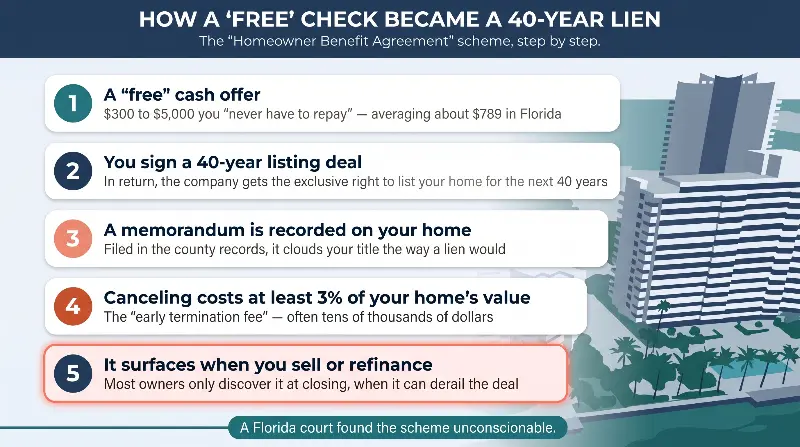
MV Realty then recorded a "Memorandum of Homeowner Benefit Agreement" in the county's public records. MV Realty told homeowners this was not a lien; the California Attorney General's complaint described it as "in fact a lien" that "clouds title." To cancel, according to the Attorneys General, a homeowner had to pay an "early termination fee" of at least 3% of the home's value, regardless of whether MV Realty had provided any listing services.
How the Recorded Claim Affected Homeowners
Because the memorandum was recorded in the public record against the property, it could make a home difficult or impossible to sell, transfer, or refinance until it was released. The Florida Attorney General said the claims "often make it difficult or sometimes impossible for the homeowner to refinance or otherwise tap into home equity."
According to the Attorneys General, many homeowners did not realize the memorandum had been recorded and discovered it at the closing table, when a title search turned it up, and were required to pay 3% of the home's value to clear it. The California Attorney General said homeowners paid "tens of thousands of dollars" in such early termination fees. The California complaint also states the agreement was written to bind successors for 40 years, including the original homeowner's heirs. The Florida Attorney General said the program was marketed to financially vulnerable homeowners as a "cash loan alternative."
MV Realty operated in 33 states, and by its own count more than 30,000 people nationwide signed up. Several other states acted too -- the California Attorney General reached a separate $2.5 million settlement in 2026 covering roughly 1,500 California homeowners.
What Florida Did About It
The state pursued the company in court for several years, and the case concluded in late 2025.
- November 2022: the Florida Attorney General sued MV Realty and its principals in Hillsborough County, alleging deceptive practices.
- February 2025: the court found MV Realty's actions "unconscionable" and ordered the company to terminate all of its Florida liens, barring it from enforcing the agreements, collecting early termination fees, or recording new memoranda.
- December 19, 2025: the Attorney General secured a final judgment under the Florida Deceptive and Unfair Trade Practices Act (FDUTPA) -- an $18 million suspended judgment ($6 million in disgorgement, $10 million in civil penalties, and $2 million in attorneys' fees), a required $3 million payment due by June 30, 2026, and a court order terminating every public-record memorandum -- clearing the claims that had bound 9,303 Florida homeowners. Failing to comply lets the state collect the full $18 million.
The Florida Legislature enacted Florida Statute 475.279, effective July 1, 2023. It provides that these "residential loan alternative agreements" -- exclusive listing rights lasting more than two years in which the broker pays the owner -- may not create a lien or encumbrance on residential property, and that a violation is an unfair and deceptive trade practice under FDUTPA.
How Listing Agreements and Agent Pay Work in Florida
For context, here is how listing agreements and real estate commissions are structured under Florida law -- which differs from the Homeowner Benefit Agreement on several points.
Listings have a definite end date
Under Florida Statute 475.25, a written listing agreement must contain a definite expiration date and may not automatically renew; a licensee can be disciplined for omitting the expiration date. According to Florida Realtors, a typical exclusive listing runs a few months.
Commissions are negotiable and paid at closing
Florida does not set real estate commissions; they are negotiable, and a seller and broker may agree on a flat fee, a percentage of the sale price, or a combination. A standard commission is paid from the sale proceeds when the home closes -- it does not involve an upfront payment to the homeowner or a claim recorded against the property.
2024 changes to agent compensation
Under a national legal settlement that took effect in August 2024, buyers using an MLS agent sign written agreements stating how the agent will be compensated, and offers of buyer-agent compensation are no longer displayed on the MLS.
By contrast, the Homeowner Benefit Agreement ran for 40 years, paid the homeowner up front, and was recorded against the home. Florida Statute 475.279, effective July 1, 2023, provides that an agreement of that type may not create a lien or encumbrance on residential property.
How to Confirm a Real Estate Agent Is Legitimate
Before you hire anyone to help sell or list your home, a few checks confirm that a Florida agent is licensed and operating within the state's rules.
- Verify the license. Look up the agent or broker on the Department of Business and Professional Regulation's MyFloridaLicense.com ("Verify a Licensee"), by name or license number. A Florida real estate license should show a Primary Status of "Current" and a Secondary Status of "Active," along with the license number, expiration date, and the broker the agent works under.
- Get the brokerage relationship in writing. Florida Statute 475.278 sets out the relationships a licensee can have with you -- most commonly a "single agent" (which carries duties of loyalty, confidentiality, honesty, full disclosure, accounting for funds, and presenting all offers) or a "transaction broker." A single-agent relationship must be disclosed in writing.
- Read the listing agreement. It should have a definite expiration date, state the commission (which is negotiable), and pay the agent from the sale proceeds at closing -- not through an upfront payment to you or a claim recorded against your home.
- Note anything outside normal practice. A request for a large upfront fee, a recorded lien or "memorandum" against your home, an exclusive term lasting years, or last-minute changes to wiring instructions for closing funds all fall outside standard Florida practice.
Complaints about a licensed Florida real estate agent go to the Florida Real Estate Commission (FREC) through MyFloridaLicense.com; the commission can impose fines or suspend a license.
How to Check and Clear Your Florida Title
The court ordered these claims terminated, but a stale recording can still show up on a title search -- so if you (or an older relative) ever took a "free" cash offer tied to your home, it's worth a two-minute check.
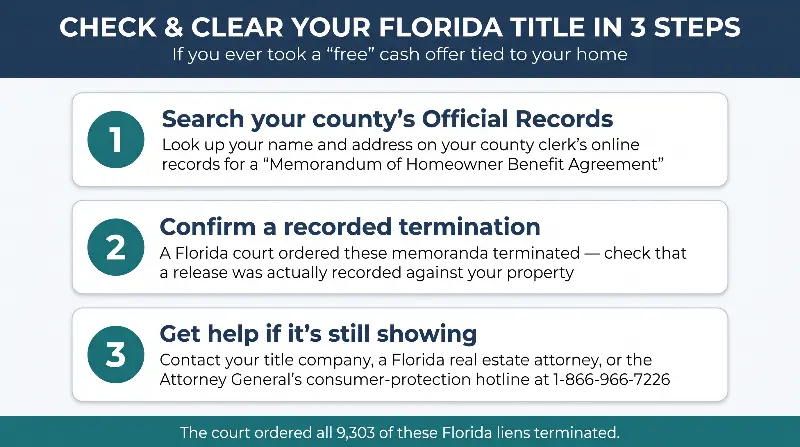
- Search your county's Official Records. Every Florida county clerk or comptroller offers a free online Official Records search. Look up your name and property address for a "Memorandum of Homeowner Benefit Agreement" or "MV Realty."
- Confirm a recorded termination. Because the court ordered these released, a termination should be on file. Check that a release was actually recorded against your property, not just promised.
- Get help if it's still showing. Contact your title company or a Florida real estate attorney to clear it, and report a lingering claim to the Florida Attorney General's consumer-protection hotline at 1-866-966-7226.
Selling or moving? Your biggest tax benefit is on the line.
Most Florida homeowners have tens of thousands of dollars in Save Our Homes protection — and lose it by accident when they move. Check what yours is worth and what happens to it if you sell.
Frequently Asked Questions
Share this guide
