
What Are Non-Ad Valorem Taxes?
Despite the name, non-ad valorem assessments aren't technically taxes at all. The term "ad valorem" is Latin for "according to value," which describes traditional property taxes calculated based on your home's assessed value. Non-ad valorem assessments, by contrast, are special charges for specific services or improvements that appear on your property tax bill but are calculated using a flat fee, per-unit basis, or other measurement completely independent of your property's value.
These assessments appear on your annual TRIM notice (Truth in Millage) that you receive each summer, and again on your November property tax bill. While they're collected by your county tax collector alongside your regular property taxes, they're set and authorized by various local governments, special districts, and other levying authorities rather than being based on millage rates applied to property values.
Key Differences: Ad Valorem vs Non-Ad Valorem
Ad Valorem Taxes
- • Based on property's assessed value
- • Calculated using millage rates
- • Reduced by homestead exemption
- • Protected by Save Our Homes cap
- • Funds general government services
Non-Ad Valorem Assessments
- • Flat fees or per-unit charges
- • Not based on property value
- • NOT reduced by any exemptions
- • No Save Our Homes protection
- • Funds specific services/improvements
Common Misconceptions About Non-Ad Valorem Assessments
"My homestead exemption will reduce these charges." This is false. Homestead exemption, along with senior exemptions and veteran exemptions, only apply to ad valorem taxes. Florida's Constitution specifically limits exemptions to property taxes based on value, meaning non-ad valorem assessments are charged in full regardless of exemption status.
"These charges are optional or negotiable." They are not. Non-ad valorem assessments are mandatory charges with the same legal standing as property taxes. They create liens against your property and can lead to tax certificate sales and foreclosure if unpaid, even on homestead properties that would otherwise be protected from most other liens.
"They'll go away when I pay off my mortgage." Non-ad valorem assessments are attached to the property itself, not your mortgage. Service-based assessments like garbage collection continue indefinitely. Infrastructure bonds typically run 15-30 years regardless of your mortgage status, and even after bonds are paid off, maintenance assessments continue.
"The buyer will pay these when I sell." While most assessments do transfer to the new owner, Florida law requires sellers to disclose all non-ad valorem assessments. Some lenders require PACE assessments to be paid off at closing. Additionally, high assessment amounts can affect your home's marketability and negotiated sale price.
Why Non-Ad Valorem Assessments Exist
The fundamental principle behind non-ad valorem assessments is the "benefit principle" in public finance. Rather than funding services through general property taxes paid by all residents, these assessments charge only the property owners who directly benefit from specific services or improvements. For example, if your neighborhood voted to install street lighting or pave roads, only properties within that district pay for those improvements through non-ad valorem assessments.
Florida law authorizes various entities to levy non-ad valorem assessments, including county and municipal governments, Community Development Districts (CDDs), special assessment districts, and PACE (Property Assessed Clean Energy) financing districts. The Florida Constitution and Chapter 197 of Florida Statutes provide the legal framework for these assessments, which must follow specific notice and hearing requirements before implementation. Understanding how property taxes work across Florida counties helps put these additional assessments in context.
Important for Home Buyers
When purchasing a property in Florida, always review the seller's most recent tax bill and TRIM notice to identify all non-ad valorem assessments. These charges can add $200-$3,000+ annually to your housing costs and won't appear in standard property tax calculations based solely on assessed value. Many buyers are surprised by CDD fees and other assessments that weren't factored into their budget. Consider these costs when calculating your total closing costs and ongoing homeownership expenses.
Where Non-Ad Valorem Assessments Appear
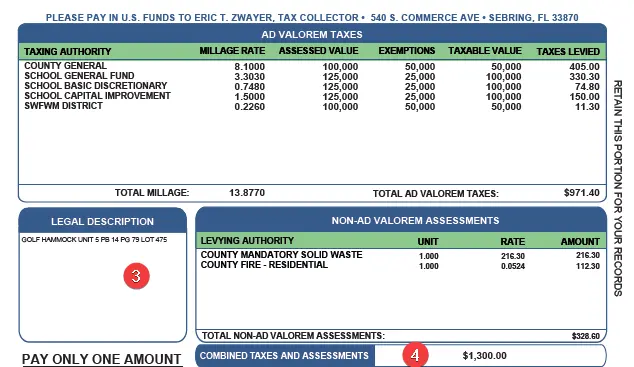
You'll find non-ad valorem assessments listed in a separate section on both your summer TRIM notice and your November tax bill. They're clearly labeled as "Non-Ad Valorem" to distinguish them from traditional property taxes. Each assessment includes the levying authority's name (such as "Fire Assessment" or "Solid Waste Collection"), the calculation method, and the amount charged. Some assessments may also include contact information for the responsible agency.
The total amount due on your tax bill combines both ad valorem taxes and non-ad valorem assessments into a single payment. This is why many homeowners mistakenly believe their exemptions should reduce the entire bill. Your tax collector processes one payment but distributes the funds to multiple agencies based on the itemized breakdown.
Types of Non-Ad Valorem Assessments
Florida homeowners may encounter several distinct types of non-ad valorem assessments on their property tax bills. Understanding the difference between service-based charges, infrastructure improvement assessments, and special district fees helps you budget appropriately and identify which assessments you can challenge. Each type has different characteristics, durations, and legal requirements.
Annual Service-Based Assessments
These ongoing charges fund specific municipal services provided directly to your property. Unlike traditional taxes that support general government operations, service-based assessments fund discrete services that benefit your property. These assessments typically continue indefinitely as long as you receive the service, and rates can be adjusted annually based on service costs.
| Service Type | Typical Annual Cost | Calculation Method |
|---|---|---|
| Solid Waste Collection | $150-$400 | Per residential unit |
| Fire Assessment | $150-$300 | Based on square footage |
| Stormwater Utility | $100-$250 | Per impervious surface area |
| Street Lighting | $40-$150 | Per lot or linear frontage |
Service-based assessments can be adjusted annually, though most require public hearings before rate increases. For example, Miami-Dade County's residential solid waste collection fee can change based on the annual budget adopted by the Board of County Commissioners. Many Florida counties offer assistance programs for low-income residents struggling with these mandatory service charges.
Infrastructure Improvement Assessments
When your neighborhood needs major improvements like road paving, drainage systems, or sewer connections, local governments often create Municipal Service Benefit Units (MSBUs) to finance these projects. These are one-time capital improvements financed through bonds, with property owners paying back the debt over a fixed period, typically 10-20 years.
Common MSBU projects include road paving ($500-$2,000 per year over 10-20 year terms), which covers base preparation, asphalt overlay, drainage improvements, and driveway aprons. Water and sewer connections typically cost $1,000-$5,000 per year over 20-30 year terms, with costs varying based on distance from existing lines. Drainage systems run $300-$1,200 per year over 10-15 year terms and include stormwater management, retention ponds, and drainage infrastructure. Street lighting installation costs $150-$500 per year over 10-15 year terms, plus ongoing annual maintenance fees of $40-$150.
MSBU assessments typically require approval from at least 51-66% of affected property owners through a petition process. The assessment is calculated based on the benefit each property receives, usually measured per lot, linear footage, or square footage. Property owners often have a 30-day window after project approval to prepay the full assessment and avoid financing charges, though this requires paying your share of the entire project cost upfront.
Understanding these infrastructure costs is particularly important when considering downsizing or relocating within Florida, as some neighborhoods carry significant unpaid assessment balances that transfer with the property.
Community Development District (CDD) Assessments
CDDs are independent special-purpose governments created under Chapter 190 of Florida Statutes to finance and manage infrastructure in master-planned communities. These are particularly common in newer developments throughout Florida. CDD assessments have two components and represent some of the largest non-ad valorem charges homeowners face.
The Bond (Debt Service) Assessment typically ranges from $1,000-$3,000 per year over 20-30 years. This component repays infrastructure bonds that financed roads, utilities, and amenities. The amount is fixed for the bond term, can be prepaid in full if you want to eliminate this portion, and transfers to the buyer when you sell.
The Operations & Maintenance (O&M) Assessment typically ranges from $300-$1,200 per year and continues indefinitely. This covers ongoing maintenance of common areas, landscaping, and infrastructure. Unlike bond assessments, O&M fees cannot be prepaid, can fluctuate annually based on the CDD's budget, and continue even after bonds are paid off. The amount is set by the CDD's elected board of supervisors.
Critical CDD Disclosure Requirements
Florida law requires sellers to disclose all CDD assessments to buyers, and buyers must sign written acknowledgment. However, many homebuyers are still surprised by these costs because they weren't properly explained during the sales process. When reviewing properties, always request the most recent tax bill and TRIM notice to see actual CDD charges.
Some of Florida's oldest CDDs established in the early 2000s now have some of the highest annual fees as infrastructure requires replacement and renovation. For example, communities like Venetian River Club charge over $4,000 annually in CDD assessments even decades after initial development. This illustrates why understanding the long-term financial commitment is crucial before purchasing in a CDD community.
PACE (Property Assessed Clean Energy) Assessments
PACE districts provide voluntary financing for energy efficiency, renewable energy, wind resistance, and water conservation improvements. While technically voluntary when you sign up, PACE assessments become mandatory liens that appear on your property tax bill. As of July 2024, Florida law requires all counties to offer PACE financing programs, though homeowners choose whether to participate.
Common PACE-eligible improvements include energy efficiency upgrades such as high-efficiency HVAC systems, solar panel installations, energy-efficient windows and doors, and insulation improvements. Hurricane protection improvements are also eligible, including impact windows and doors, reinforced roofing systems, hurricane shutters, and structural hardening.
PACE financing typically ranges from 5-30 years with interest rates of 6-13%. Assessment amounts vary widely based on project scope, from $2,500 minimum to $100,000+ for comprehensive improvements. While PACE provides 100% financing with no upfront costs, the total repayment often doubles the original project cost when accounting for interest and administrative fees over the full term.
PACE Super-Priority Lien Status
PACE assessments create super-priority liens that take precedence over mortgages. This means if your property goes to foreclosure, PACE debt is paid before your mortgage lender. Many mortgage companies now require PACE assessments to be paid off in full at closing when you sell or refinance, which can create unexpected financial burdens. Florida law (Section 163.08) requires sellers to disclose PACE liens to buyers, but the transfer rules vary by lender requirements.
Before entering a PACE agreement, consult with your mortgage lender to understand how it might affect future refinancing or sale. Some homeowners have found themselves unable to sell because buyers' lenders refused to approve mortgages on properties with PACE liens, requiring the seller to pay off balances that can exceed $50,000.
Florida recently strengthened consumer protections for PACE financing through SB 770, requiring enhanced disclosures, recorded phone calls explaining terms, and three-day cancellation periods. However, consumers should still carefully consider whether PACE financing makes financial sense compared to traditional home equity loans or other financing options. For hurricane protection improvements specifically, also explore the My Safe Florida Home grant program, which provides matching grants that don't create liens against your property.
Comparing Total Assessment Costs
The total non-ad valorem burden varies dramatically based on your property's location and special district memberships. Here's what homeowners in different situations might pay annually:
In a minimal scenario—an older established neighborhood with only county services—you might pay around $500/year (fire assessment, solid waste, and stormwater). A moderate scenario with an active road paving MSBU and full services could total $1,475/year. In a high assessment scenario—a CDD community with an active PACE loan—total non-ad valorem assessments can reach $7,250/year or more.
These examples illustrate why reviewing your full TRIM notice is essential when budgeting for Florida homeownership. While homestead exemption can save thousands annually on ad valorem taxes, it provides zero reduction on these non-ad valorem assessments. Understanding the full picture helps you make informed decisions about where to buy and whether to challenge assessments that may not provide adequate benefit to your property.
Why & How Long Are They Applied?
Non-ad valorem assessments exist based on the "benefit principle" in public finance—properties that directly benefit from specific services or improvements pay for them, rather than spreading costs across all taxpayers. Understanding how these assessments are authorized and how long they last helps homeowners plan financially and identify potential challenges.
Legal Authorization & Public Notice Requirements
Florida Statutes Chapter 197.3632 establishes strict procedural requirements before non-ad valorem assessments can be imposed. Local governments must provide substantial public notice and opportunity for property owners to object.
The required public process includes mailed notices to all affected property owners at least 20 days before hearings, published notices in local newspapers with geographic depictions of affected areas, full disclosure of assessment purpose, amount, calculation method, and the right to object, and a public hearing where the local governing board must hear testimony and written objections before adoption.
For infrastructure projects (MSBUs), most require 51-66% property owner approval through petition before proceeding. However, Florida law allows county commissions to impose MSBUs "at any time deemed necessary" for public health and safety reasons, though this power is rarely exercised without substantial community support.
Assessment Duration by Type
How long you'll pay depends entirely on the assessment type. Here's what determines duration:
Ongoing service assessments for garbage collection, fire protection, stormwater management, and street lighting continue indefinitely as long as services are provided. These are permanent charges that remain part of your tax bill until the service itself ends.
Bond-financed improvements like road paving, water/sewer installation, and drainage projects are tied to municipal bond maturity dates, typically lasting 10-30 years. The duration is fixed at project approval and cannot change.
| Assessment Type | Typical Duration | Can Be Prepaid? |
|---|---|---|
| Fire Assessment | Ongoing annually | No |
| Solid Waste | Ongoing annually | No |
| MSBU Road Paving | 10-20 years | Yes (within 30 days) |
| CDD Bond Debt | 20-30 years | Yes (anytime) |
| CDD O&M | Ongoing indefinitely | No |
| PACE Financing | 5-30 years | Yes (no penalty) |
Finding Duration Information on Your TRIM Notice
Your annual TRIM notice lists all non-ad valorem assessments but may not clearly state duration. Here's how to find specifics:
To find specific duration information, contact the levying authority listed on each assessment for bond maturity dates, check with your county property appraiser's office which maintains records of all assessment districts and bond terms, visit CDD websites where most publish budget documents showing remaining years on bonds, or request an estoppel letter when buying or selling to get exact payoff figures and remaining terms.
Why Bond Assessments Last So Long
Infrastructure improvements like road paving or water/sewer installation cost hundreds of thousands or millions of dollars. Rather than requiring property owners to pay upfront, local governments issue tax-exempt municipal bonds that spread the cost over 10-30 years at lower interest rates than private financing.
The advantages of bond financing include lower tax-exempt interest rates (typically 3-5%), the ability to spread costs over time rather than paying a lump sum, immediate access to improvements, and often the option to prepay without penalty.
However, there are important considerations. Total interest can equal the original cost over 30 years, the assessment transfers to the buyer when selling, unpaid assessments create a lien against the property, and these charges are not reduced by homestead exemption.
When Assessments Can Change
Bond assessments remain fixed for their entire term. However, service-based assessments and CDD O&M fees can change annually through budget adoption processes. Florida Statutes require new public hearings if assessments are increased beyond originally authorized maximums or if purposes change.
Watch for Annual Increases
Some assessments include automatic annual increases tied to inflation, typically capped at 5% per year. Review your assessment notices carefully each August when TRIM notices arrive. If you're planning to appeal property taxes, remember that non-ad valorem assessments follow different challenge procedures than ad valorem tax appeals.
Challenging Non-Ad Valorem Assessments
Unlike ad valorem property taxes which can be appealed through the Value Adjustment Board, non-ad valorem assessments follow different challenge procedures. Success requires understanding valid grounds for objection, strict deadlines, and the proper process for each assessment type.
Critical Difference: The Value Adjustment Board (VAB) handles ad valorem tax appeals but has NO jurisdiction over non-ad valorem assessments. Challenges must be filed directly with the levying authority or through circuit court.
Valid Grounds for Challenge
Not all disagreements with assessments provide legal grounds for challenge. Florida law recognizes these specific bases:
Valid grounds for challenge include situations where your property doesn't actually benefit from the service or improvement, you failed to receive the required 20-day advance notice, there's a mathematical error in the calculation, the assessment was already paid, your property is legally exempt from assessment, or the levying authority failed to follow Florida Statutes 197.3632 requirements.
Invalid grounds that won't succeed include disagreement with the cost amount (this doesn't invalidate a legal assessment), not personally using the service (you must still pay if your property receives benefit), already paying HOA fees (these don't preclude additional assessments), financial hardship (personal inability to pay isn't legal grounds), or having voted against the assessment (majority approval makes it valid for all).
Challenge Process & Deadlines
The challenge window is extremely narrow. Missing deadlines eliminates your ability to contest that year's assessment.
First, review your assessment notice within 20 days. When you receive your TRIM notice or assessment notification, you have 20 days to file written objections with the local governing board—mark your calendar immediately.
Second, contact the levying authority directly. Call the contact information listed on your tax bill. Many assessment errors can be resolved through direct communication with the agency (CDD office, county department, etc.).
Third, file a written objection with the local governing board stating specific grounds for challenge and supporting evidence. Include your property address, folio number, and contact information.
Fourth, attend the public hearing where the assessment roll is adopted (typically held between January 1 and September 15). Present testimony and evidence supporting your objection.
Finally, if unsuccessful, you may file a lawsuit in circuit court within 60 days of tax roll certification. This requires legal representation and court filing fees.
Required Documentation
Successful challenges require substantial evidence. Gather these documents before filing:
Gather your original assessment notice showing amount, calculation method, and hearing date. Include property records such as your deed, survey, or title documents showing property boundaries. If claiming no benefit, compile photos, engineering reports, or expert testimony demonstrating your property doesn't benefit. If challenging notice procedures, gather proof you didn't receive proper advance notice. For duplicate payment claims, collect receipts showing the assessment was already paid.
Success Rates & Realistic Expectations
Non-ad valorem challenges are difficult to win. Courts and governing boards give substantial deference to local government decisions when proper procedures were followed. Understanding realistic outcomes helps you decide whether to pursue a challenge.
Challenges based on mathematical errors have high success rates—calculation mistakes are easily corrected when documented. Procedural violations have moderate success rates; notice failures or improper hearings can void assessments entirely. However, disagreements over the amount have low success rates—courts rarely second-guess cost allocations when proper legal procedures were followed.
When to Hire Professional Help
Consider consulting an attorney experienced in Florida property tax law if your situation involves complex legal issues, substantial amounts, or requires circuit court action.
Consider hiring an attorney when the assessment exceeds $5,000 annually, constitutional or procedural violations occurred, you need to file a circuit court lawsuit, multiple properties are affected by the same assessment, or complex benefit analysis is required.
You may handle the challenge yourself when dealing with a simple mathematical error, you have clear documentation of previous payment, your property is obviously outside the benefit area, or the assessment amount is under $1,000 annually.
Payment Required During Challenge
Florida Statutes 194.014 requires property owners challenging assessments to pay all non-ad valorem assessments in full and at least 75% of ad valorem taxes before the March 31 deadline, even with an appeal pending. Failure to pay results in automatic dismissal. This differs from ad valorem tax appeals where you can pay a good faith estimate—non-ad valorem assessments must be paid in full to preserve your right to challenge.
Cost-Benefit Analysis
Before challenging, calculate whether potential savings justify the time, effort, and potential legal costs:
Challenge costs include your time (10-40 hours), attorney fees ($2,000-$10,000+), court filing fees ($400+), expert witnesses ($500-$3,000), and document preparation ($200-$500).
Potential savings equal your annual reduction multiplied by years remaining—for example, $800/year over 15 years equals $12,000. Your potential savings must exceed challenge costs to be worthwhile. Factor in the probability of success and the future sales impact if the assessment is removed.
For questions about specific assessments or their legal basis, contact your county property appraiser's office or consult the Florida Department of Revenue Property Tax Division for guidance.
How Homestead Exemption Affects Non-Ad Valorem Assessments
The Bottom Line: Homestead exemption provides ZERO reduction on non-ad valorem assessments.
This is one of the most common misconceptions among Florida homeowners. While homestead exemption can save you thousands annually on property taxes, it doesn't reduce non-ad valorem charges by a single dollar.
Why Exemptions Don't Apply
Florida Constitution Article VII, Section 6 and Florida Statutes 196.031 specifically limit homestead exemption to ad valorem taxes—those based on property value. Non-ad valorem assessments are special charges, not value-based taxes, placing them outside constitutional exemption protections.
Homestead exemption does reduce county ad valorem taxes, municipal ad valorem taxes, school board ad valorem taxes (partial), and special district ad valorem taxes—providing up to $50,722 reduction in taxable value (2025).
Homestead exemption does not reduce garbage/solid waste fees, fire assessments, stormwater charges, CDD bond and O&M assessments, PACE financing payments, or MSBU infrastructure assessments. These charges remain the same regardless of your exemption status.
Other Exemptions Also Don't Apply
The same constitutional limitation applies to ALL property tax exemptions, not just homestead:
This includes senior exemptions (age 65+), veteran exemptions (disabled veterans), disability exemptions, widow/widower exemptions, blind person exemptions, and additional homestead amounts. None of these reduce non-ad valorem assessments.
Save Our Homes Cap Also Doesn't Apply
The Save Our Homes benefit caps annual assessed value increases at 3% or CPI (whichever is lower) for homestead properties. This valuable protection applies ONLY to ad valorem taxes. Non-ad valorem service assessments can increase annually without any cap, and CDD O&M fees fluctuate based on district budgets without limitation.
Real-World Example: Tax Bill Breakdown
Note: Homestead exemption saved $1,014 on ad valorem taxes but $0 on non-ad valorem assessments.
Portability Doesn't Transfer Non-Ad Valorem Benefits
When using Save Our Homes portability to transfer your assessment difference to a new Florida home, you're only transferring the ad valorem benefit. If your old home had low non-ad valorem assessments and your new home has high CDD fees or MSBU charges, you'll pay the full new amounts.
Planning Implications
When evaluating properties or budgeting for Florida homeownership, calculate your complete tax burden including non-ad valorem assessments. Two homes with identical market values can have vastly different total tax bills based on their non-ad valorem charges.
Smart homebuyers request the seller's complete tax bill showing both ad valorem and non-ad valorem charges, review the TRIM notice to see all assessments, research CDD bond remaining years and payoff amounts, check for pending MSBU projects in the neighborhood, factor total costs into their housing budget, and compare properties in different Florida counties for total tax impact.
Understanding that exemptions don't reduce non-ad valorem assessments helps set realistic expectations for your total property tax burden. While pursuing all available exemptions remains worthwhile for ad valorem savings, budget separately for non-ad valorem charges that won't be reduced.
Frequently Asked Questions
Here are the most common questions we get about Non Ad Valorem Taxes in Florida, with honest, straightforward answers.
What's the difference between ad valorem and non ad valorem taxes?
+Can I protest or appeal my non ad valorem assessments?
+Are non ad valorem assessments tax deductible?
+Why did my non ad valorem charges increase?
+Do I pay non ad valorem taxes if my property is tax-exempt?
+Where can I find a breakdown of my non ad valorem charges?
+Still Have Questions About Non Ad Valorem Taxes?
Every situation is unique. We're here to help with personalized guidance for your specific circumstances.
Serving all Florida counties including Miami-Dade, Broward, Orange, Hillsborough, Pinellas, Palm Beach, Duval, and beyond
Live Chat
Available Now
Usually respond within seconds
Property Exemption Team
Our team includes real estate professionals and specializes in Florida Homeownership Guidance. We analyze current regulations, interview industry professionals, and provide educational resources to help Florida homeowners make informed decisions.
Official Resources & References
Sourced from government agencies and tax authorities to help you understand your property tax bill.
Tax Resources
Florida Property Tax Overview
Official state property tax information including non ad valorem assessments
FloridaRevenue.com →External links connect to official government and tax resources for additional research. Always consult qualified professionals for personalized advice.
Selling or moving? Your biggest tax benefit is on the line.
Most Florida homeowners have tens of thousands of dollars in Save Our Homes protection — and lose it by accident when they move. Check what yours is worth and what happens to it if you sell.
Check My Save Our Homes Benefit