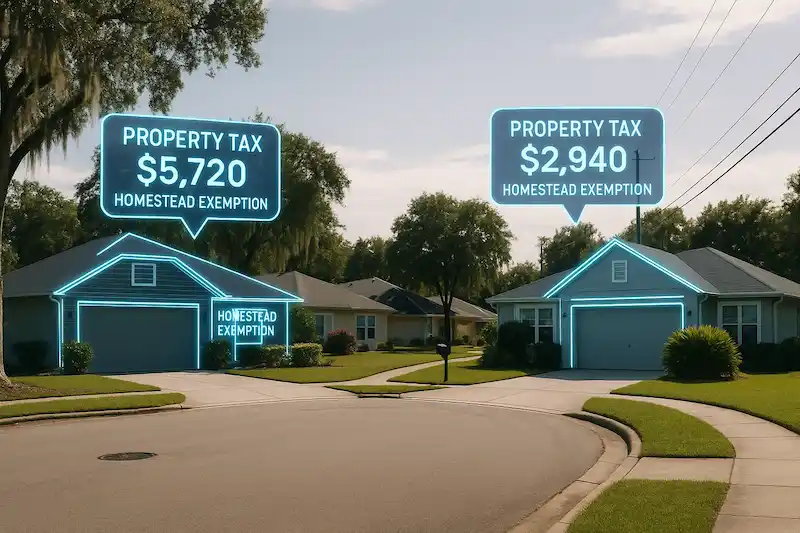
Orlando Property Tax Rates 2026: Area Breakdown
Orange County operates with multiple taxing authorities, creating combined effective tax rates that range from approximately 0.89% in some areas to over 1.74% in others. The median property tax rate in Orlando is 1.19%, significantly higher than the national median of 1.02%, but competitive within Florida's major metropolitan areas.
These rates reflect the combined millage from Orange County, City of Orlando (6.65 mills), Orange County Public Schools, and various special districts. The City of Orlando's millage rate has remained steady at 6.65 mills for the 13th consecutive year, though increased property values mean higher total tax bills for most homeowners.
2026 Update: Amendment 5 Impact
Florida voters approved Amendment 5 in November 2024, which increases the homestead exemption with annual inflation adjustments. For 2026, the total homestead exemption is $51,411. This change affects the second $25,000 portion of the exemption (now $26,411), providing additional tax relief for homeowners with assessed values between $50,000 and $75,000.
Understanding Orlando's Tourism-Driven Tax Environment
Orlando's economy, heavily driven by tourism and entertainment, creates unique property tax dynamics. Properties near theme parks often command higher assessed values due to short-term rental potential, with some zip codes like 32814 having median home prices of $649,566. This tourism economy also provides a broader tax base that helps support municipal services while creating opportunities for property investors.
Orlando's total millage rates vary from about 18.5 to more than 19.7 mills depending on where in the city you reside. Properties in different areas may have additional assessments for services like enhanced lighting, landscaping districts, or community development areas that can add to the total tax burden.
Orange County vs. City of Orlando Tax Components
Understanding your tax bill requires recognizing the different authorities that contribute to your total rate. Properties within Orlando city limits pay both county and municipal taxes, while unincorporated Orange County properties pay only county rates, typically resulting in lower overall taxes.
| Tax Authority | 2026 Millage Rate | Services Funded |
|---|---|---|
| Orange County | 4.43 mills | County services, sheriff, fire |
| City of Orlando | 6.65 mills | Police, parks, public works |
| School District | ~7.0 mills | Public schools, education |
| Special Districts | Varies | Water, lighting, improvement districts |
Tourism Impact on Residential Taxes
While Orlando's tourist tax doesn't directly affect residential property taxes, the tourism economy helps support the broader tax base through commercial property values and sales tax revenues. However, homeowners using their properties for short-term rentals may face additional scrutiny when claiming homestead exemptions.
For property investors and new residents, understanding the interplay between location-based tax rates and exemption opportunities is essential for accurate financial planning. Properties in different areas of Orlando can have significantly different tax obligations even with similar property values.
Key Resources for Orlando Property Owners
- Orange County Property Appraiser: Official property assessment and exemption information
- Orange County Tax Collector: Pay property taxes and access payment plans
- City of Orlando Tax Calculator: Calculate estimated property taxes by address
- Homestead Exemption Application: Apply for homestead exemption online
Orlando Property Tax Calculator
Calculate Your Orlando Property Taxes
Get accurate estimates based on your specific location and property details
Property Information
Enter your property's assessed or market value
Select your specific area for precise calculations
Reduces your taxable value and saves approximately $750+ annually
Advanced Options
Check applicable exemptions for more accurate calculations
Theme Park Area Properties
Properties near Universal Studios or Disney World may have higher assessed values due to tourism rental potential. This affects your tax calculation but also provides investment opportunities.
Tax Breakdown
2026 Payment Schedule & Discounts
| Payment Month | Discount | Amount Due | You Save |
|---|---|---|---|
| November 2025 | 4% | $4,606 | $192 |
| December 2025 | 3% | $4,654 | $144 |
| January 2026 | 2% | $4,702 | $96 |
| February 2026 | 1% | $4,750 | $48 |
| March 2026 | 0% | $4,798 | $0 |
Complete Your Tax Analysis
Our advanced tool identifies all available exemptions and personalized savings opportunities you qualify for in Orange County.
Discover My Orlando SavingsFree • Privacy Protected • Takes 2 minutes
Disclaimer: This calculator provides estimates for educational purposes only. Actual property taxes may vary based on final assessed values, exemptions, and budget changes. Always verify with Orange County Property Appraiser for official calculations.
How Orlando Property Tax is Calculated
Orlando property taxes involve multiple layered calculations from independent taxing authorities within Orange County. Unlike simpler systems, your final bill combines rates from Orange County, City of Orlando, Orange County Public Schools, and various special districts. Understanding this process helps you anticipate changes and identify potential savings opportunities.
The basic formula is: Annual Property Tax = (Assessed Value - Exemptions) × Total Millage Rate ÷ 1,000. For example, a $300,000 home with the full $51,411 homestead exemption and a 19.3 millage rate would pay $4,798 annually in property taxes within Orlando city limits.
Assessment Process in Orange County
The Orange County Property Appraiser determines your property's assessed value annually as of January 1st. Assessment notices are typically mailed by mid-April, containing both market value and assessed value along with an estimated tax bill. This assessed value may differ from market value due to Florida's "Save Our Homes" cap, which limits annual assessment increases to 3% or the Consumer Price Index for homesteaded properties.
Property owners have until August 25th to contest their assessment through the Value Adjustment Board. The homestead exemption ($51,411 for 2026) and other qualifying exemptions must be applied for by March 1st annually to reduce your taxable value. Orange County's online exemption system at exemption.ocpafl.org streamlines this process significantly.
Understanding Orlando's Multi-Authority Tax System
Your total millage rate combines several independent authorities. The City of Orlando has maintained its municipal rate at 6.65 mills for 13 consecutive years, but this represents only one component of your total tax bill. Properties within Orlando city limits pay both county and municipal taxes, while unincorporated Orange County properties pay only county rates.
| Tax Authority | 2026 Millage | Tax on $300k Home* | Services Funded |
|---|---|---|---|
| Orange County | 4.43 mills | $1,101 | Sheriff, county services, infrastructure |
| City of Orlando | 6.65 mills | $1,653 | Police, fire, parks, public works |
| School District | ~7.0 mills | $1,740 | Public schools, education programs |
| Special Districts | ~1.2 mills | $298 | Water, lighting, improvement districts |
| Total Orlando | 19.3 mills | $4,798 | All combined services |
*Assumes $300,000 assessed value with full $51,411 homestead exemption
Tourism Economy Impact on Property Values
Orlando's tourism-driven economy creates unique property tax dynamics. Properties near theme parks often command higher assessed values due to short-term rental potential, with some areas like the Universal Studios corridor or Disney World vicinity seeing rapid appreciation. This tourism demand affects both investment properties and primary residences, potentially increasing tax obligations but also providing equity growth opportunities.
The Orange County Property Appraiser considers market comparables when setting assessed values, including sales of similar properties used for vacation rentals. This means even homesteaded properties benefit from the higher valuations driven by tourism demand, though the Save Our Homes cap protects longtime residents from sudden assessment spikes.
Special Assessments and Non-Ad Valorem Charges
Beyond basic property taxes, some Orlando properties have additional charges for specific services or improvements. These may include streetlight districts, landscape maintenance districts, or community development districts (CDDs) common in newer developments. Non-ad valorem assessments for services like garbage collection, fire protection, or mosquito control appear as separate line items and are not reduced by homestead exemptions.
2026 Orlando Property Tax Payment Timeline
Tax Bills Available - Maximum Savings
Orange County tax bills become available November 1st
Holiday Discount Period
Pay during December for reduced rates
New Year Savings
Still time to save on your Orlando tax bill
Final Discount Month
Last chance for early payment savings
Payment Deadline
Final deadline: March 31st
Understanding Orlando's payment schedule helps homeowners maximize early payment discounts, which can save hundreds of dollars annually. The Orange County Tax Collector also offers installment payment plans for qualifying taxpayers whose previous year taxes exceeded $100.
Assessment Appeals and Value Adjustments
If you believe your Orange County property assessment is too high, you can appeal through the Value Adjustment Board. Most successful appeals involve properties with unique characteristics not captured in automated assessments, recent damage affecting value, or comparable sales that suggest a lower market value. Filing an appeal costs $15 for most residential properties and must be done by August 25th.
Before filing a formal appeal, contact the Property Appraiser's office directly at (407) 836-5044. Many assessment concerns can be resolved through informal review, especially when homeowners provide documentation of property conditions, recent comparable sales, or unique factors affecting their property's value.
Contact Information
Orange County Property Appraiser:
200 S. Orange Avenue, Suite 1700, Orlando, FL 32801
Phone: (407) 836-5044
Office Hours: 8:00 AM - 5:00 PM, Monday-Friday
Orange County Tax Collector:
200 S. Orange Avenue, 16th Floor, Orlando, FL 32801
Phone: (407) 434-0312 Option 2
Website: octaxcol.com
Understanding these calculation processes helps Orlando homeowners make informed decisions about exemption applications, assessment appeals, and portability benefits when moving within Florida. The combination of Orange County's online tools and multiple exemption opportunities provides significant potential savings for qualifying homeowners.
How to Apply for Orlando Homestead Exemption: Step-by-Step
Applying for homestead exemption in Orange County can save Orlando homeowners approximately $992 annually through the $51,411 exemption. The process has been streamlined with online applications, but understanding the requirements and deadlines ensures you maximize your tax savings without delays or complications.
Complete Application Process
- Gather required documents: Deed, Florida driver's license, voter registration, and Social Security card
- Apply online at exemption.ocpafl.org or visit the office in person
- Office location: 200 S. Orange Avenue, Suite 1700, Orlando, FL 32801
- Call for assistance: (407) 836-5044
- Office hours: 8:00 AM to 5:00 PM, Monday through Friday
- Complete Form DR-501 with accurate property and residency information
- Submit before March 1st deadline for the current tax year benefits
- Receive confirmation within 30-45 days of processing
Eligibility Requirements for Orlando Homestead
To qualify for homestead exemption in Orange County, you must own and occupy the property as your permanent legal residence on January 1st of the tax year. The property must be your primary residence, not a vacation home, investment property, or short-term rental. You must demonstrate residency through official documents showing your Orlando address as your permanent home.
Required Documents
- • Property deed showing your ownership
- • Florida driver's license with Orlando address
- • Voter registration in Orange County
- • Social Security card or verification
- • Vehicle registration (if applicable)
- • Additional proof of residency if needed
Important Dates
- • March 1: Homestead application deadline
- • January 1: Must own/occupy as of this date
- • April 15: Assessment notices mailed
- • August 25: Appeal deadline if needed
- • November 1: Tax bills become available
- • March 31: Final tax payment deadline
Online Application Process
Orange County's online exemption system at exemption.ocpafl.org streamlines the homestead application process. You'll need your property's parcel ID, which you can find using the Property Appraiser's parcel search at ocpaweb.ocpafl.org/parcelsearch. The system walks you through each step and allows document uploads for verification.
Step-by-Step Online Application
Find Your Parcel ID
Use the Property Appraiser's search tool to locate your property and copy the parcel ID
Start Online Application
Visit exemption.ocpafl.org and select "Homestead Exemption Application"
Complete Property Information
Enter your parcel ID and verify property details are correct
Upload Required Documents
Scan and upload your driver's license, deed, and other supporting documents
Review and Submit
Double-check all information before final submission
Common Mistakes to Avoid
Orange County actively investigates homestead exemption fraud using sophisticated cross-referencing systems. The most common disqualifying mistakes include maintaining homestead on a property you no longer occupy as your primary residence, using the property for short-term rentals like Airbnb while claiming homestead, or failing to notify the Property Appraiser when you move to a new primary residence.
Serious Consequences
Homestead exemption fraud in Orange County results in:
- Back taxes owed for all ineligible years
- 15% annual interest on unpaid amounts
- 50% penalty on the total amount owed
- Possible criminal prosecution for intentional fraud
Additional Exemptions Available
Beyond homestead exemption, Orange County offers additional property tax exemptions for qualifying residents. Senior citizens aged 65 and older with qualifying incomes may receive an additional $50,000 exemption. Veterans with service-connected disabilities can receive exemptions ranging from partial to complete property tax elimination.
Senior Exemption
Additional $50,000 exemption for seniors 65+ with qualifying income
Veteran Exemption
Disability-based exemptions up to 100% of property taxes
Disability Exemption
$5,000 exemption for qualified disabled individuals
Save Our Homes Portability
If you're moving to Orlando from another Florida location where you had homestead exemption, you can transfer up to $500,000 of your accumulated Save Our Homes benefit. This portability benefit must be applied for by March 1st of the year following your move and can significantly reduce your initial Orlando property tax burden.
The portability application is separate from your homestead exemption application but can be completed simultaneously through the Orange County system. This benefit is particularly valuable for retirees moving to Orlando from other parts of Florida, as it preserves years of accumulated tax savings.
Orlando Homeowners: Don't Miss Tax Savings
Join hundreds of Orlando homeowners who receive free deadline reminders, exemption alerts, and property tax updates specific to Orange County.
Sign Up FreeFree updates • No spam • Unsubscribe anytime
After You Apply
Once your homestead exemption is approved, it automatically renews each year as long as you continue to own and occupy the property as your primary residence. You'll see the exemption reflected on your annual assessment notice and tax bill. If you sell the property or move to a new primary residence, you must notify the Orange County Property Appraiser to avoid potential fraud penalties.
The $51,411 homestead exemption for 2026 provides immediate tax relief, while the Save Our Homes protection caps your annual assessment increases at 3% or inflation, whichever is lower. This combination of benefits makes homestead exemption one of the most valuable tax advantages available to Orlando homeowners.
Getting Help with Your Application
Online Support: Complete application guidance at exemption.ocpafl.org
Phone Assistance: (407) 836-5044 during business hours
In-Person Help: 200 S. Orange Avenue, Suite 1700, Orlando, FL 32801
Forms Download: DR-501 Homestead Application Form
Homestead Exemption Benefits in Orlando
Orange County homestead exemption provides $51,411 in assessed value reduction for 2026, consisting of $25,000 for all taxes including school district levies, and $26,411 for county, municipal, and special district taxes only. This represents an increase from the previous $50,000 total exemption due to Amendment 5, which automatically adjusts the second portion for inflation annually.
For a typical Orlando homeowner with a $300,000 property value, the homestead exemption saves approximately $992 annually in property taxes. The exemption also includes the valuable "Save Our Homes" benefit, which caps your annual assessment increases at 3% or the Consumer Price Index, whichever is lower, protecting you from dramatic tax increases even as Orlando property values rise rapidly due to tourism demand.
Orlando Market Reality
Orlando's tourism-driven real estate market has seen property values increase significantly faster than most Florida markets. Without Save Our Homes protection, many longtime homeowners would face unaffordable tax increases. The homestead exemption provides both immediate savings and long-term assessment protection essential for housing affordability in Central Florida's competitive market.
Qualifying Requirements in Orange County
To qualify for homestead exemption in Orange County, you must own and occupy the property as your permanent legal residence on January 1st of the tax year. The property must be your primary residence, not a vacation home, investment property, or short-term rental operation. You must demonstrate residency through documents like voter registration, driver's license, vehicle registration, or other official records showing your Orlando address as your primary residence.
Applications must be filed with the Orange County Property Appraiser's office by March 1st annually. The online application system has streamlined this process significantly, allowing document uploads and status tracking. New Orlando residents can apply online immediately upon establishing residency, making the process more accessible than previous years.
Tourism Area Considerations
Orlando's unique tourism economy creates special considerations for homestead exemption eligibility. Properties near theme parks or in tourist-heavy areas often have higher assessed values due to their rental income potential. However, homeowners who rent out their homesteaded property through platforms like Airbnb or VRBO may jeopardize their exemption status, as the property must remain your primary residence.
Orange County's exemption fraud detection systems cross-reference vacation rental registrations with homestead exemption claims. While renting a room or portion of your primary residence typically doesn't disqualify your exemption, operating a short-term vacation rental business from your homesteaded property can result in exemption loss and significant penalties.
Additional Exemptions for Orlando Residents
Beyond the standard homestead exemption, Orange County offers additional property tax exemptions for qualifying residents. Senior citizens aged 65 and older with household incomes below specific thresholds may qualify for an additional $50,000 exemption. Veterans with service-connected disabilities can receive exemptions ranging from partial to complete property tax elimination depending on their disability rating.
Available Exemptions
- Homestead: $51,411 for primary residence
- Senior (65+): Additional $50,000 with income limits
- Veteran Disability: Based on VA disability rating
- Widow/Widower: $500 with specific requirements
- Disability: $500 with physician certification
- Deployed Military: Special provisions available
Cumulative Benefits
Example Savings:
Homestead: $992/year
Senior (if qualified): +$965/year
Total potential: $1,944/year
Based on $300,000 home with 19.3 mills rate
Disabled individuals may qualify for a $500 exemption with proper physician certification. These exemptions can be combined with the homestead exemption, potentially providing substantial tax relief for qualifying homeowners. The cumulative effect of multiple exemptions can reduce property tax bills by thousands of dollars annually, particularly valuable in Orlando's higher-tax environment.
Save Our Homes Portability Benefits
One of the most valuable aspects of Orlando's homestead exemption is the ability to transfer your accumulated "Save Our Homes" benefit when you move to a new primary residence within Florida. This portability benefit allows you to carry up to $500,000 of your previous property's assessment savings to your new Orlando home, significantly reducing the initial tax burden.
For example, if your previous Florida home had an assessed value $200,000 below its market value due to the Save Our Homes cap, you can transfer this entire benefit to reduce your new Orlando property's assessed value. This feature makes Orlando particularly attractive for retirees moving from other Florida locations, as it preserves years of accumulated tax savings during the transition.
Portability Success Story
"When we moved from Tampa to Orlando in 2023, we transferred $300,000 in Save Our Homes benefits to our new $450,000 home. Instead of being taxed on the full value, our assessed value started at only $150,000. This saved us over $5,800 in the first year alone and continues saving thousands annually as Orlando property values increase."
— Recent Orlando transplant from TampaAvoiding Common Disqualification Mistakes
Orange County actively investigates homestead exemption fraud using sophisticated detection systems that cross-reference voting records, driver's licenses, utility connections, and vacation rental registrations. The most costly mistake is maintaining homestead exemption on a property you no longer occupy as your primary residence, which can result in back taxes, 15% annual interest, and a 50% penalty.
Orlando's tourism market creates unique risks for homestead exemption holders. Using your homesteaded property for short-term rentals while claiming it as your primary residence is grounds for exemption loss. If you move to a new primary residence, you must apply for homestead exemption on the new property and notify the Property Appraiser about your previous property to avoid fraud penalties.
Orange County Enforcement
Orange County has some of Florida's most aggressive homestead exemption enforcement. The Property Appraiser's office regularly audits exemption claims and has recovered millions in fraudulent exemptions. Penalties include all back taxes owed, 15% annual interest, and a 50% penalty on the total amount. Intentional fraud can also result in criminal prosecution.
Long-Term Financial Impact
The combination of immediate tax savings and Save Our Homes assessment protection provides substantial long-term financial benefits for Orlando homeowners. As Central Florida property values continue rising due to population growth and tourism development, the assessment cap becomes increasingly valuable, potentially saving thousands of dollars annually compared to properties without homestead protection.
Orlando's homestead exemption also provides important estate planning benefits. The exemption can be transferred between spouses, and in some cases, surviving spouses can maintain assessment levels. However, when properties transfer to heirs other than spouses, the exemption resets and assessments return to market value, potentially creating significant tax increases for inherited properties.
Application Timeline and Renewal
New Orlando residents should apply for homestead exemption as soon as they establish residency, but no later than March 1st for the current tax year. The exemption takes effect January 1st of the year following your application, so applying in 2026 provides benefits starting with the 2027 tax year. Late applications are not accepted except under very limited circumstances defined by Florida statute.
Once approved, your homestead exemption automatically renews annually as long as you continue owning and occupying the property as your primary residence. The exemption appears on your annual assessment notice and property tax bill. Orange County's online system allows you to verify your exemption status and make any necessary updates to your contact information.
Understanding homestead exemption benefits is crucial for any Orlando property owner, as the combination of immediate tax savings and long-term assessment protection can save thousands of dollars annually. The 2026 exemption of $51,411 makes this exemption even more valuable, particularly given Orlando's higher property tax rates compared to many other Florida locations. For comprehensive guidance on the application process and additional exemptions available, homeowners should review Orange County's resources and consider consulting with property tax professionals for complex situations.
Recent Changes and What's Ahead
Amendment 5 Impact on 2026 Orlando Taxes
Amendment 5, approved by Florida voters in November 2024, indexes the homestead exemption to inflation annually. For 2026, the total exemption has risen to $51,411. This change affects the second $25,000 portion of the exemption, providing additional relief for Orlando homeowners with assessed values between $50,000 and $75,000. The inflation adjustment is calculated using the Consumer Price Index and will only increase the exemption when inflation is positive.
Orlando's Millage Rate Stability
The City of Orlando has maintained its municipal millage rate at 6.65 mills for thirteen consecutive years, demonstrating fiscal discipline despite growing service demands. Mayor Buddy Dyer announced this achievement as part of Orlando's $1.8 billion budget for fiscal year 2026. However, maintaining the same rate while property values increase means the city collects approximately $21 million more in revenue, a 6% increase over the previous year.
Orange County maintained its property tax rate at $4.43 per $1,000 of taxable value for 2026, meaning the owner of a property taxed at $300,000 pays $1,329 in county taxes alone. Despite rate stability, most Orlando homeowners still see higher tax bills due to rapid property value appreciation that outpaces the modest rate consistency.
Tourism Recovery and Property Value Impact
Orlando's tourism industry has fully recovered from pandemic lows, with record visitor numbers driving increased demand for both short-term rentals and permanent housing. This recovery has accelerated property value growth in areas near theme parks and entertainment districts. Properties in zip codes like 32814, near Universal Studios, have median home prices exceeding $649,566, significantly impacting property tax obligations for homeowners in these areas.
Short-Term Rental Regulations
Orange County has implemented stricter regulations on short-term vacation rentals, including enhanced registration requirements and compliance monitoring. These changes affect homeowners considering vacation rental income and create additional scrutiny for homestead exemption claims. Properties operating as short-term rentals may face challenges maintaining homestead exemption status if they don't remain the owner's primary residence.
Infrastructure Investment and Tax Implications
Orlando's 2026 budget includes 20 new police department employees and full-year funding for SunRail expansion, demonstrating continued investment in infrastructure and public safety. These service improvements, while maintaining current tax rates, are funded through increased property values and new construction rather than rate increases. The city's ability to expand services without raising rates reflects Orlando's strong economic growth and property value appreciation.
Orange County faces ongoing pressure from Florida's Chief Financial Officer to reduce property tax rates, with CFO Blaise Ingoglia arguing the county is "overtaxing" residents by approximately $190 million annually. This political pressure may influence future rate decisions, though county officials defend current spending levels as necessary for maintaining services and infrastructure in a rapidly growing region.
Climate and Insurance Considerations
While Orlando faces fewer direct hurricane risks than coastal Florida areas, rising insurance costs affect the total cost of homeownership and may influence property values. Some properties in flood-prone areas may see insurance requirements impact their marketability, though this hasn't significantly affected property tax assessments in most Orlando neighborhoods.
Looking Ahead: Legislative and Market Trends
Florida legislators continue discussing potential property tax reforms, including proposals to eliminate or significantly reduce property taxes statewide. While these remain largely aspirational, any changes would fundamentally alter Orlando's revenue structure and service delivery model. Property owners should stay informed about legislative developments that could affect future tax obligations.
2026 Planning Considerations
Orlando homeowners should prepare for continued property value growth in 2026, making homestead exemption application crucial for new residents. The city's budget planning process for 2027 begins in fall 2026, with final millage rates typically determined by October. Early exemption applications and staying informed about rate changes help homeowners plan for tax obligations and potential savings opportunities.
Orange County's property tax system will continue evolving as the region balances growth management, infrastructure needs, and affordability concerns. Understanding these trends helps Orlando property owners anticipate changes and make informed decisions about exemption applications, assessment appeals, and long-term financial planning in Central Florida's dynamic real estate market.
Stay Updated on Orlando Property Tax Changes
- City of Orlando Budget: Official budget updates and millage rate announcements
- Orange County Property Appraiser: Assessment notices and exemption updates
- Orange County Tax Collector: Payment schedules and new services
- Florida Department of Revenue: Statewide policy changes and exemption updates
Frequently Asked Questions
Common questions about Orlando property taxes with straightforward answers based on current Orange County regulations.
How does Orlando's tourist tax affect residential property taxes?
+Can I transfer my Save Our Homes benefit when moving to Orlando from another Florida city?
+What's the difference between Orange County and City of Orlando property taxes?
+How do theme park areas affect property values and taxes?
+Can I lose my homestead exemption if I rent out part of my Orlando property?
+How do I appeal my property tax assessment in Orange County?
+What happens to my Orlando property taxes if I move to a new home within the city?
+How do Orlando's early payment discounts work and how much can I save?
+Still Have Questions?
Don't see your question answered here? Our Florida property tax experts are here to help!
Live Chat
Available Now
Usually respond within seconds
Property Exemption Editorial Team
Our content is researched exclusively from official sources including the Orange County Property Appraiser, Florida Department of Revenue, and current Florida statutes. All tax rates and procedures are verified against government databases. This guide reflects regulations as of March 2026 and is updated as laws change.
Official Resources & References
Authoritative sources from government agencies and official organizations to support your Orlando property tax research and applications.
Orange County Resources
Orange County Tax Collector
Pay property taxes, access payment plans, and find tax information
octaxcol.com →
Florida Tax & Property Resources
Florida Property Tax Exemptions
Official state exemption information and application forms
FloridaRevenue.com →External links connect to official government agencies for additional research. Always consult qualified professionals for personalized advice.